

While the U.S. midterm elections were drawing most of the market’s attention, another development with far-reaching implications for Wall Street’s trading model passed more quietly.
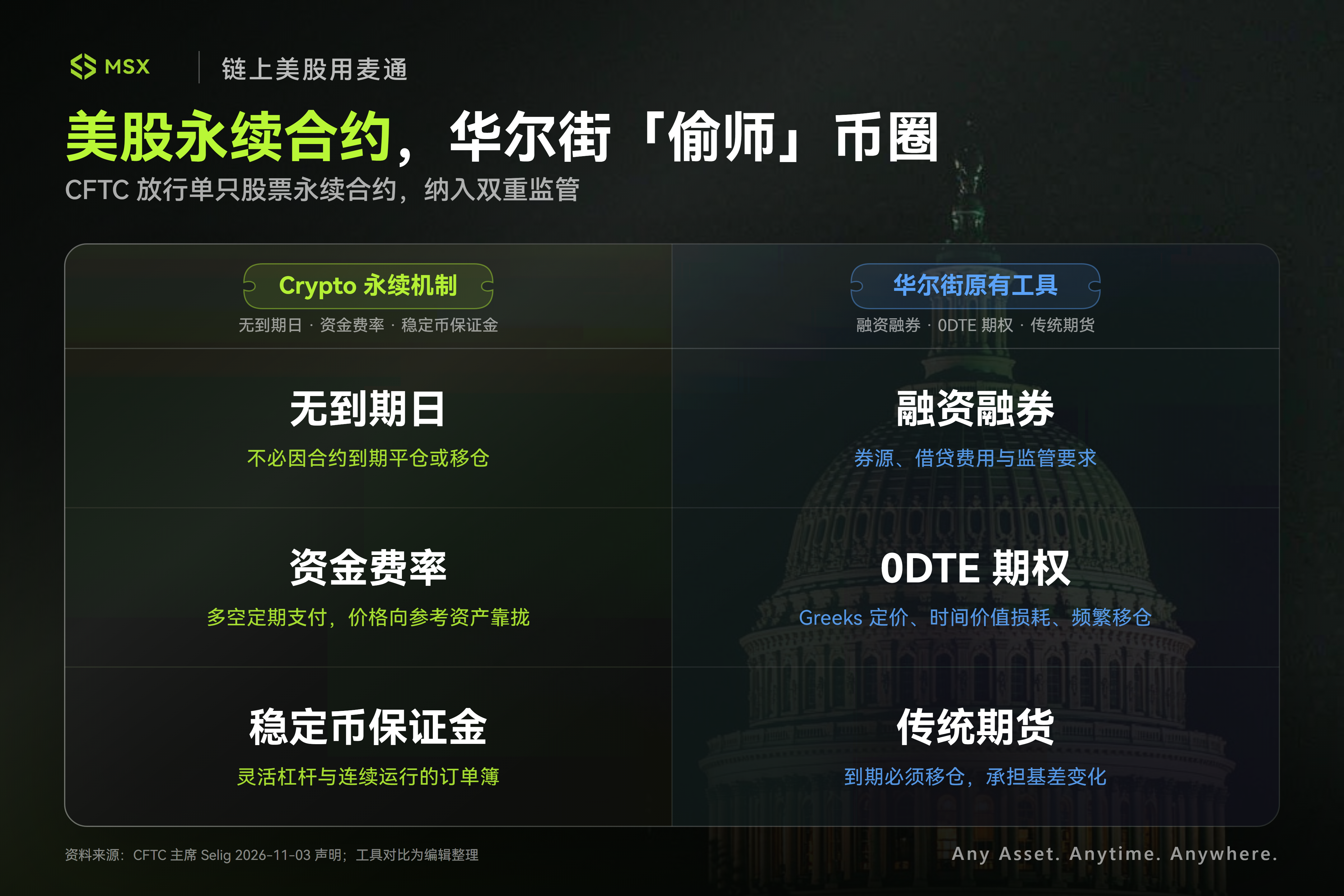
On Nov. 3, Commodity Futures Trading Commission Chairman Mike Selig said single-stock perpetual futures had been cleared to begin trading on regulated U.S. exchanges for the first time, under a dual oversight framework involving both the CFTC and the Securities and Exchange Commission.
That brings a product popularized by crypto trading venues into the U.S. regulated securities environment. Put simply, Wall Street is starting to adopt one of crypto’s most successful market inventions of the past decade: perpetual futures, or perps.
The shift is not being driven by traditional finance alone. Over the past several months, crypto platforms have been trying to bring U.S. equities such as Apple, Nvidia and Tesla on-chain, using perpetual contracts, stablecoin margin and 24/7 order books to reorganize how those assets trade. Now even Intercontinental Exchange, the parent company of the New York Stock Exchange, is considering bringing Hyperliquid’s perpetual infrastructure into the U.S.
A year ago, the debate centered on whether U.S. stocks could trade around the clock like crypto. A year later, the question has changed: can equities adopt crypto’s trading rules directly?
Why perpetual futures caught Wall Street’s attention
To understand the significance of the CFTC’s decision, it helps to start with what perpetual futures changed in the first place.
The source article describes perps as one of the few genuinely native financial innovations to come out of crypto. It says the product was first introduced in 2016 by BitMEX, the crypto derivatives exchange that shut down earlier this year.
In U.S. equities, investors looking for leverage or short exposure in names such as NVDA or TSLA have traditionally relied on tools that each come with clear limits.
- Margin trading and securities lending depend on broker financing and stock borrow availability. Costs can be high, and shorting is constrained by borrow supply, lending fees and regulatory requirements.
- Options, especially the increasingly popular 0DTE contracts, can offer sharp payoff profiles, but Greeks-based pricing, theta decay and frequent rollovers raise the barrier for many investors and fragment liquidity across strikes and expiries.
- Traditional futures have fixed expiration dates, forcing investors who want to keep exposure on to roll positions and absorb extra trading costs and basis risk.
Crypto perpetual futures removed the expiry date. Traders can hold long or short exposure indefinitely instead of closing or rolling because a contract matures. Exchanges use periodic funding payments between longs and shorts to keep the contract price aligned with the reference asset, while flexible leverage and continuously running order books create a trading experience that differs sharply from conventional securities markets.
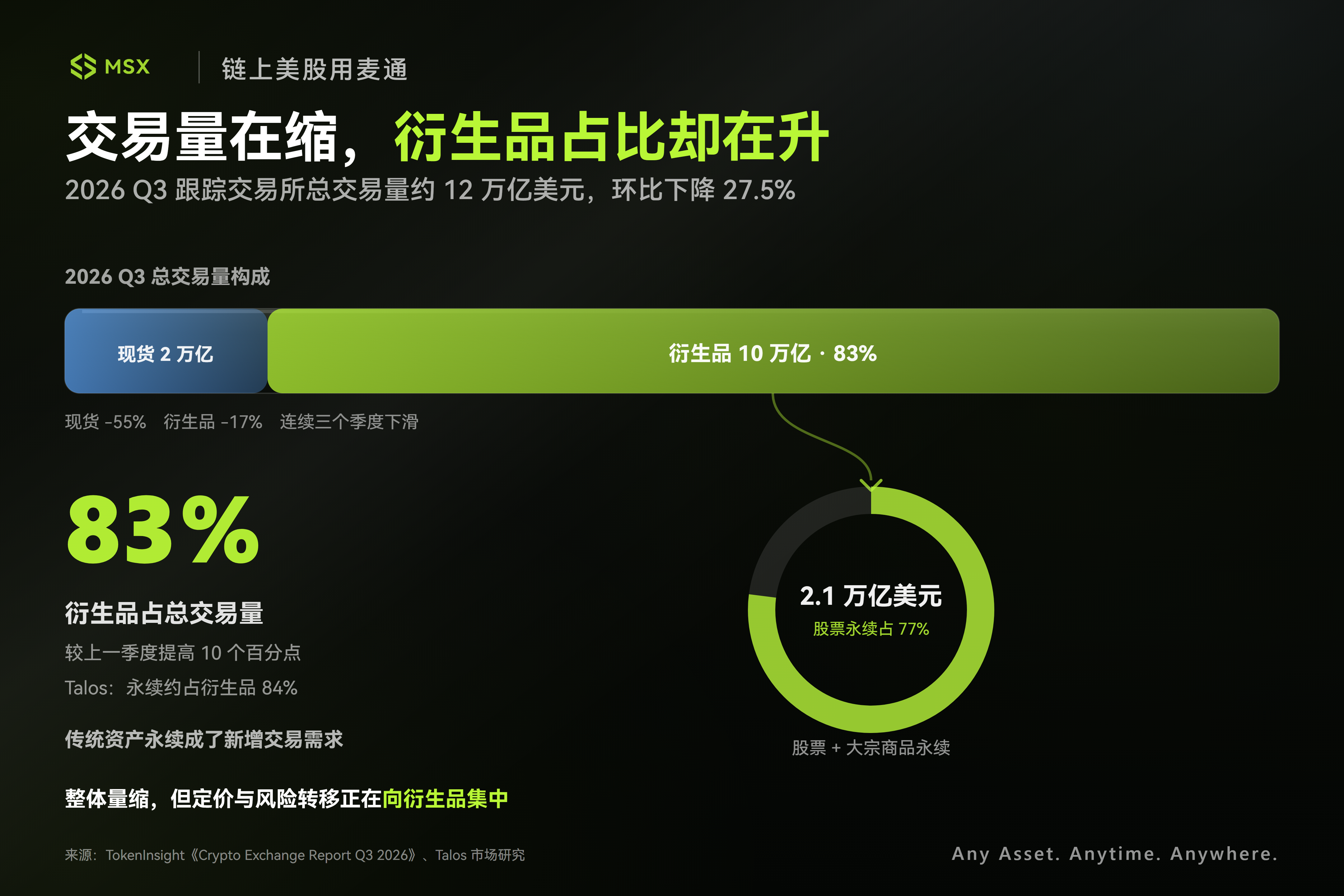
That structure has become central to crypto market activity. BTC and ETH perpetuals have grown into the dominant derivatives instruments in digital assets, supporting large trading ecosystems at exchanges such as Binance, OKX and Bybit. Citing The Block, the article says perpetuals accounted for about 75% of total volume on centralized crypto exchanges in 2025, with nearly $49 trillion in annual trading, well above spot and options markets. The trend continued into 2026. TokenInsight’s latest Q3 exchange report said derivatives represented 83% of total volume across major crypto trading platforms.
In other words, perps are no longer just a high-leverage product. They have become core infrastructure for liquidity, price discovery and risk transfer across the industry.
That raises a sharper question. If global investors can already trade Nvidia or Tesla exposure 24/7 on crypto venues, why has it been so difficult to offer similar products inside the U.S. regulated system?
The answer lies partly in market plumbing and partly in regulation.
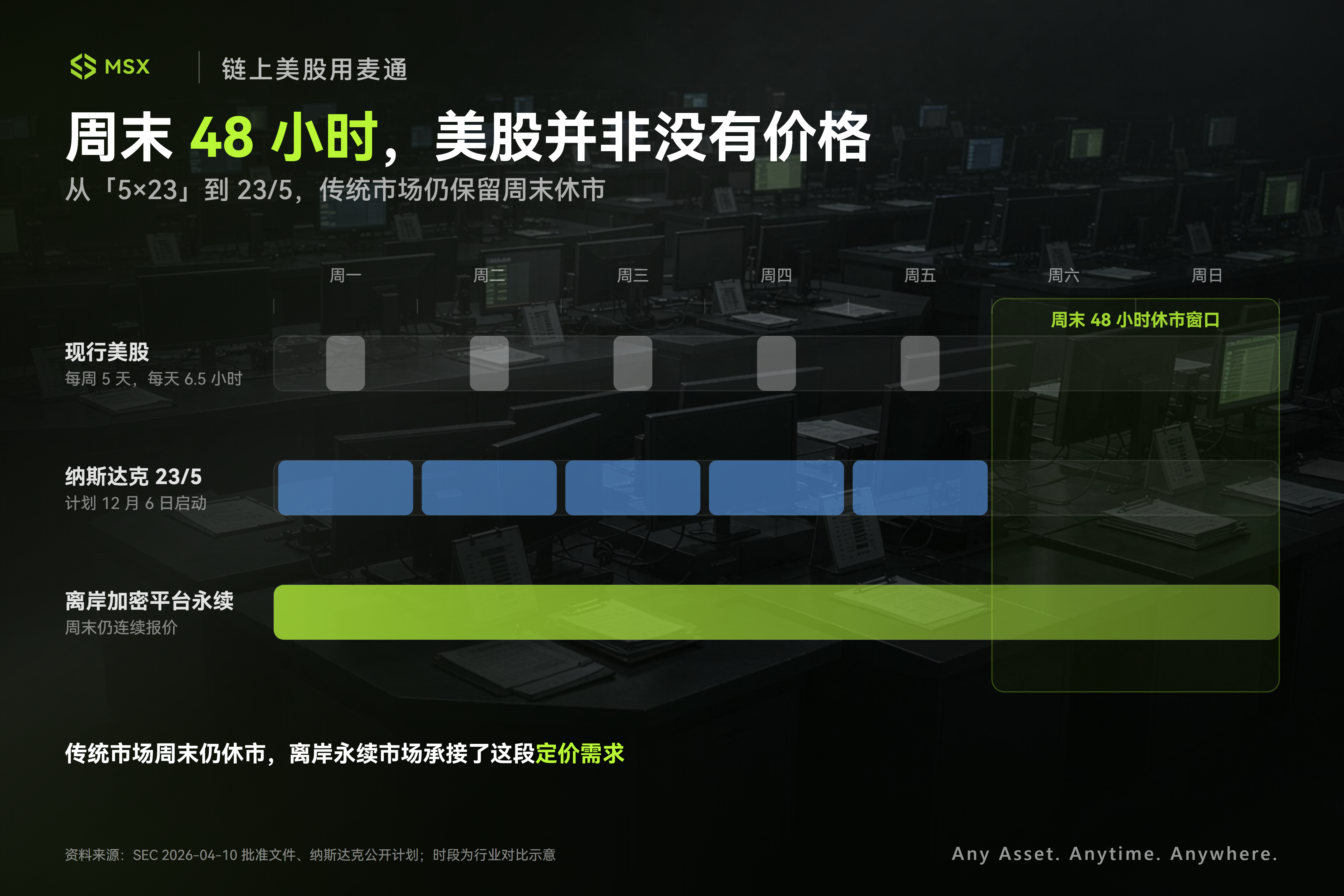
On the infrastructure side, U.S. cash equities still rely on tightly connected systems. Even if Nasdaq extends front-end matching to 23 hours a day, brokers, custodians and the Depository Trust & Clearing Corporation still depend on centralized ledgers, end-of-day batch processing, reconciliation and margin transfers. The forced one-hour daily shutdown and the 48-hour weekend closure reflect the practical limits of legacy financial infrastructure.
On the regulatory side, stock perpetuals sit in an awkward place. They reference single-name equities, but they use a crypto-native perpetual derivatives structure. That puts them at the boundary between the CFTC, which oversees commodities and derivatives, and the SEC, which oversees securities markets. For a long time, uncertainty around product classification and jurisdiction made it difficult to launch them clearly in the U.S.
That started to change this year.
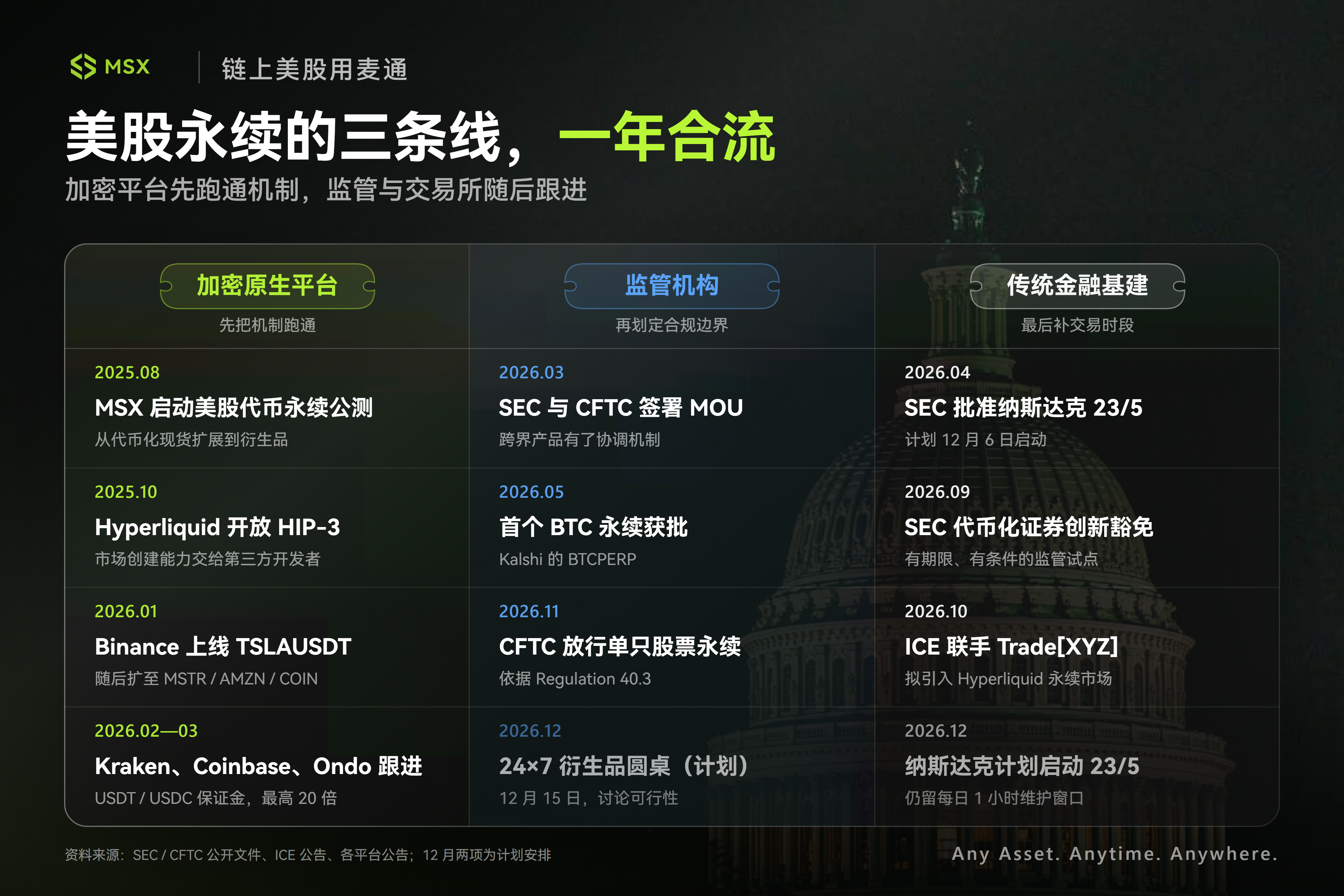
- On March 11, 2026, the SEC and CFTC signed a memorandum of understanding to strengthen coordination on financial innovation, market oversight and investor protection.
- On May 29, the CFTC approved KalshiEX’s filing for BTCPERP, the first bitcoin perpetual futures contract to enter a regulated U.S. exchange in the full sense described by the article.
- On Nov. 3, that progress was extended into traditional securities.
According to Selig, single-stock perpetual futures are being treated as security futures products under the Commodity Futures Modernization Act of 2000. That means they must comply with both the Commodity Exchange Act and federal securities laws, and they fall under the supervision of both the CFTC and the SEC.
Venues that want to list them must hold CFTC registration as a designated contract market and also qualify as a national securities exchange authorized through SEC notice registration to trade security futures products.
The regulatory shift has already turned into live products. On Nov. 3, Kalshi began offering four stock perpetual contracts tied to Amgen (AMGN), McDonald’s (MCD), Qualcomm (QCOM) and Costco (COST), with leverage of about 4.9x at the top end.
For the U.S. market, that means more than one additional trading tool. It means a mechanism first built out by crypto exchanges is now being recognized inside the traditional regulatory framework.
A year of convergence across regulators, TradFi and crypto platforms
If the CFTC’s move shows regulators opening the door to perpetuals, crypto-native platforms had already spent the past year testing the product set. Looking back across the timeline, tokenized U.S. equities have been moving toward a fuller system that includes spot trading, perpetuals, leverage and cross-asset collateral.
On Aug. 11, 2025, MSX launched a public test for tokenized U.S. stock perpetuals, extending its earlier tokenized equity spot business into derivatives.
In October 2025, Hyperliquid rolled out its HIP-3 mechanism, opening market creation for perpetuals to third-party developers. That pushed the product universe beyond BTC and ETH into stocks, indexes, commodities and foreign exchange.
By 2026, more major platforms had joined the trade.
- On Jan. 28, Binance listed the TSLAUSDT stock perpetual. On Feb. 9, it added MSTR, AMZN, CRCL, COIN and PLTR contracts, using USDT for margin and settlement and supporting 24/7 trading.
- On Feb. 3, Ondo Finance announced Ondo Perps, a plan to bring stocks, ETFs and commodities into the perpetual market and explore tokenized securities as collateral. The platform went live in July.
- On Feb. 24, Kraken launched tokenized stock perpetuals based on xStocks for eligible non-U.S. users in more than 110 countries and regions, offering 24/7 leveraged trading in names such as Nvidia, Apple and Tesla with leverage up to 20x.
- On March 20, Coinbase formally launched stock perpetuals, allowing eligible non-U.S. users to settle in USDC and trade U.S. equities and crypto assets within the same derivatives framework.
- Bitget also added Stock Perps, covering names such as Nvidia, Apple, Tesla and Microsoft as well as ETFs, with USDT settlement and near round-the-clock trading.
This expansion came as crypto-native trading volumes were still under pressure. TokenInsight said the exchanges in its sample posted about $12 trillion in total volume in the third quarter, down 27.5% from the previous quarter and marking a third straight quarterly decline. Spot volume fell 55% to $2 trillion, while derivatives volume fell 17% to $10 trillion.
Yet derivatives still took a larger share of the whole. Their share of total volume rose to 83%, up 10 percentage points from the prior quarter.
At the same time, perpetuals tied to traditional financial assets were growing quickly. Across nine exchanges tracked in the report, stock and commodity perpetuals reached a combined $2.1 trillion in third-quarter trading volume. Stock perpetuals accounted for about $1.61 trillion, or 77%, while commodity perpetuals totaled about $491 billion.
The signal is fairly direct. As growth in core crypto trading slows, traditional financial assets are becoming an important source of new demand for crypto exchanges.
Still, the article argues it would be too simple to say platforms moved into TradFi assets only because crypto volumes weakened. Large exchanges already have mature derivatives engines, stablecoin settlement systems, margin management and global user bases. Expanding into stocks, indexes, gold or crude does not require building a new trading stack from scratch.
Rather than fighting over a limited pool of BTC and ETH flow, they can extend existing infrastructure into more asset classes.
Those products have already split into two broad structures.
- One is the synthetic perpetual model, anchored to stock prices. Binance’s USDT-margined contracts and Coinbase’s USDC-settled contracts fit here. Traders get long or short exposure to price moves, but there is no delivery of the underlying shares.
- The other is a perpetual and portfolio model built on tokenized stocks. Examples in the article include MSX, which linked spot and derivatives early on, Kraken’s xStocks-based setup and Ondo’s approach that supports tokenized securities as collateral.
The two paths are not identical, but both push traditional assets beyond simple price exposure and toward broader trading and financial use cases.
Traditional finance has also started to move.
On Oct. 29, Intercontinental Exchange announced a partnership with Trade[XYZ] to bring a Hyperliquid-based perpetual market into the U.S. Under the plan described by the two companies, ICE would operate a new regulated trading venue and clearing structure and make a strategic investment in Trade[XYZ], while Trade[XYZ] would handle market design and product technology. The future product set is intended to cover stocks, indexes, cryptocurrencies, commodities and foreign exchange.
The article notes that the market would be built specifically around U.S. regulatory requirements and would still need regulatory approval.
The symbolism is hard to miss. Crypto platforms had been trying to bring traditional assets on-chain and challenge incumbent exchanges’ control over liquidity and market access. Now the parent company of the NYSE is choosing to work with a crypto-native perpetual market and invest in one of the participants.
Crypto brings flexible trading rules, stablecoin settlement and a global user base. Traditional finance brings regulatory status, clearing infrastructure and institutional resources. The contest is increasingly about who can combine those strengths first.
Weekend pricing and the rise of continuous liquidity
If the first part of the story is about products and the second about regulation, the deeper shift may be in price discovery itself.
Historically, U.S. equity price discovery has been concentrated during trading hours on venues such as Nasdaq and the NYSE. Pre-market and after-hours sessions expanded access, but weekends and holidays still left a gap of more than 48 hours.
That gap does not erase demand. Stock perpetuals are starting to fill it.
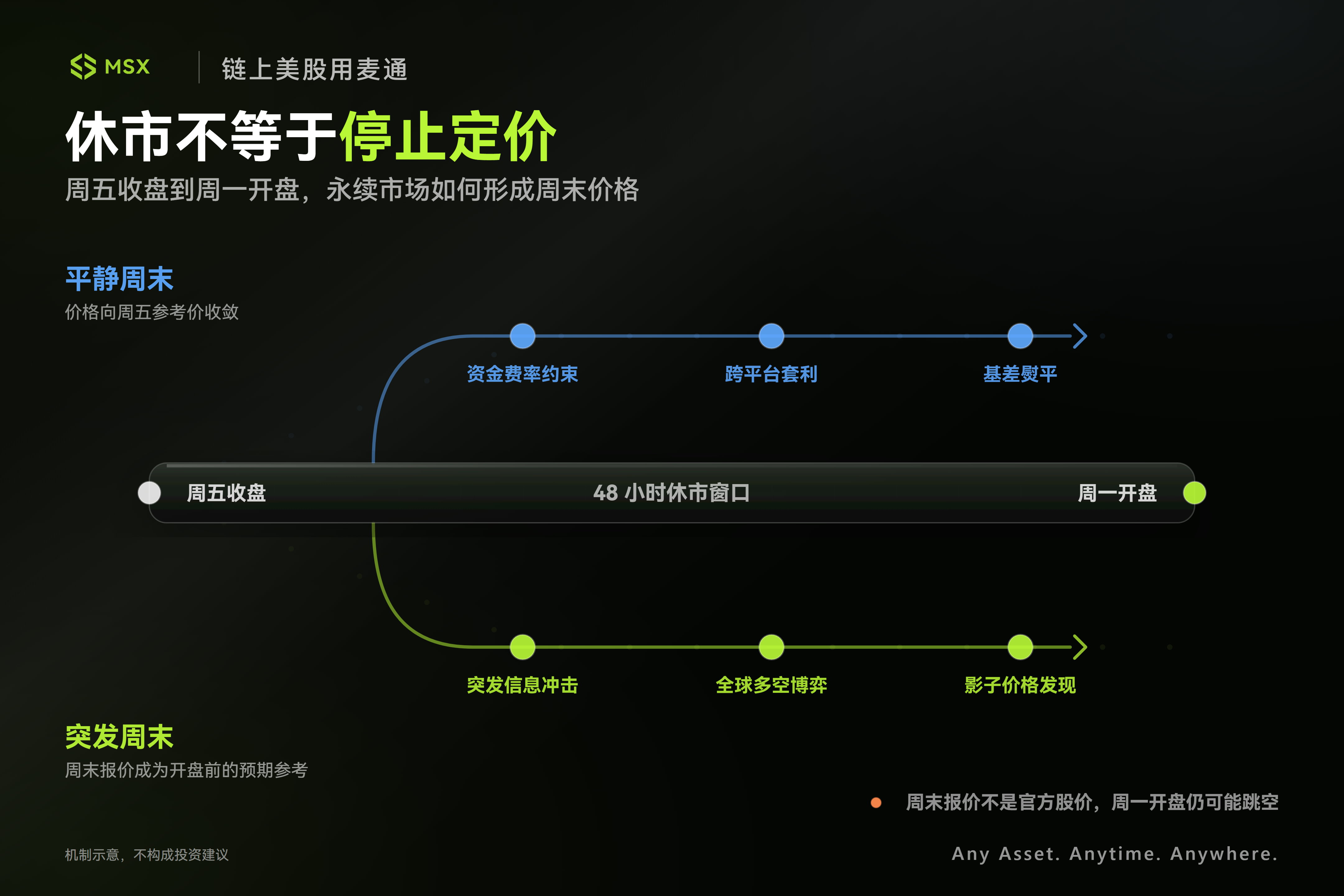
Even after Wall Street closes on Friday, investors around the world can continue trading perpetual exposure to Nvidia, Apple or Tesla on crypto exchanges and on-chain protocols. Global events, company news, macro data and weekend sentiment can all be translated into continuous price moves through those markets.
In that sense, stock perpetuals on crypto venues, especially during the weekend closure in U.S. equities, are moving beyond pure speculative quotes and becoming a market with some reference value for continuous price discovery.
How weekend prices are formed
A natural question follows: if Nasdaq and the NYSE are closed, why do Nvidia or Tesla perpetuals still print live prices on crypto venues?
The article uses Coinbase’s stock perpetuals as an example. It says pricing is built through a combination of internal indexes, perpetual order books, tokenized stock quotes and cross-platform trading.
- During normal market hours, the platform mainly uses external equity data sources such as Pyth and Blue Ocean ATS to build an index price.
- During weekends and some market-closed periods, it switches to an internal index that combines the exponential moving average of the perpetual mark price with available tokenized stock quotes to form a new reference price.
- The platform also uses price deviation limits and transition mechanisms when reconnecting to external feeds to reduce abnormal volatility during the switch.
That means weekend pricing is no longer just Friday’s close frozen until Monday. It is becoming a continuously running price-discovery system built from multiple data sources and market mechanisms.
Two forces are helping that system mature.
The first is the funding-rate mechanism built into perpetuals. When the contract price stays above the reference index, funding usually turns positive and longs pay shorts, raising the cost of holding a rich long position. When the contract trades below the reference index, negative funding raises the cost of holding shorts.
That creates an incentive for traders to keep adjusting positions, though it does not guarantee accurate pricing on its own, especially when the external cash market is closed and the reference index may itself lag.
The second force is cross-platform quantitative arbitrage. As venues such as Hyperliquid, Binance and Coinbase compete in the same products, the same stock can trade at different prices across perpetual markets.
The article gives a simple example. If Nvidia trades at $200 on one platform and $203 on another on a Saturday, and if the reference asset, contract specifications, settlement mechanics and liquidity are close enough, arbitrageurs may buy on the cheaper venue and sell on the richer one while waiting for the spread to narrow.
That is not the same as a risk-free hedge using the underlying stock. In practice, it is more of a basis trade between derivatives venues. On weekends, the traditional stock market cannot provide continuous spot hedging, so traders still face funding, margin, liquidity and Monday gap risks.
Even so, as more participants and venues enter the market, price dislocations become easier to identify and trade. Weekend prices are less likely to be set by a handful of orders on a single platform.
From shadow price discovery to an around-the-clock market
The more important point may come during major events.
In the past, if geopolitical tensions flared over a weekend, if tariff policy comments hit the tape, or if a large technology company released important product or regulatory news outside market hours, there was usually no unified market where investors could keep trading and express both sides of the view before U.S. equities reopened.
That is changing in a 24/7 stock perpetual market. Global macro traders, quantitative funds and information-driven arbitrageurs can use real capital on Saturday and Sunday to reflect the potential impact of new events in perpetual prices.
When the traditional stock market reopens, the price moves already formed in crypto markets can serve as a reference point for market expectations. In some major events, weekend perpetuals may even reflect the repricing of new information before the cash equity market does.
That does not mean Monday’s opening price will match the weekend perpetual price exactly. Weekend liquidity, the reliability of information, market-maker risk appetite and real buy and sell flow after the open can all produce fresh divergences.
And those weekend prices are still venue-specific market quotes, not official stock prices recognized by Nasdaq or the NYSE. But they are enough to change how markets are watched. During the closure of traditional equity markets, stock perpetuals on crypto platforms are becoming a new channel for shadow price discovery.
Seen from that angle, the importance of the CFTC’s approval becomes clearer. Once weekend pricing and around-the-clock derivatives liquidity have already taken shape in crypto, Wall Street has little reason to leave that part of price discovery outside its own regulatory perimeter for long.
If regulated U.S. exchanges begin offering similar stock perpetuals, traditional market makers such as Citadel Securities, Jane Street and Virtu could participate in cross-venue price discovery and hedging within a compliant framework. That would deepen the liquidity link between traditional finance and crypto markets.
Nasdaq’s 23-hour plan, SEC exemptions and the CFTC roundtable
Placed alongside last year’s discussion around Nasdaq’s extended-hours plan, the current shift looks less like an isolated event and more like part of a broader sequence.
On April 10, 2026, the SEC formally approved a rule change allowing Nasdaq to extend U.S. stock trading to 23 hours a day, five days a week, with a launch expected on Dec. 6.
On tokenized securities, the SEC also issued a temporary, conditional innovation exemption on Sept. 17 this year. That arrangement allows eligible tokenized securities venues, within a specific regulatory framework, to trade some National Market System stocks through permissioned automated market makers and liquidity pools.
The discussion is also moving toward a true 24/7 market. On Oct. 28, the CFTC said it would hold an industry roundtable on Dec. 15 to discuss the feasibility of around-the-clock derivatives trading, including market structure, tokenization, infrastructure, staffing and operational readiness.
Nasdaq is pushing 23/5 trading. The SEC is creating a new regulatory path for tokenized securities trading. The CFTC is discussing continuous derivatives markets. ICE is preparing to introduce Hyperliquid-based perpetual infrastructure. What once looked like separate industry tracks are starting to converge.
Traditional finance is extending its trading hours. Crypto is widening its asset boundary. Both are competing for the same end state: the ability for global investors to trade any asset at any time.
The narrative around tokenized U.S. equities is changing
Over the past year, the narrative around tokenized U.S. stocks has shifted several times.
At first, the focus was on mapping traditional shares such as Apple and Nvidia onto blockchains so investors could trade them with stablecoins. Then the discussion moved toward around-the-clock circulation, on-chain settlement and composability. Now, with stock perpetuals entering regulated U.S. markets, the trading instrument itself is changing as well.
For crypto-native platforms, years of experience with 24/7 trading, stablecoin settlement and global user networks remain major advantages. For traditional financial institutions, regulatory licenses, custody, institutional liquidity and clearing networks remain difficult barriers to replicate.
The two systems are moving closer together rather than simply replacing one another.
The article closes on a broader point. If financial markets are moving toward continuous trading, incumbent exchanges cannot rely only on their old trading hours and matching businesses. They have to rethink their place in issuance, trading and settlement.
Now there is a new answer to that question. As U.S. stocks begin trading through perpetual contracts, as weekend price discovery becomes more continuous, and as traditional exchanges start bringing in crypto-built trading infrastructure, the competition is no longer just about whether TradFi or crypto wins outright. It is about who can build the next all-hours trading network faster.
Crypto spent years learning from traditional finance. The next phase may involve traditional finance learning from crypto.



