
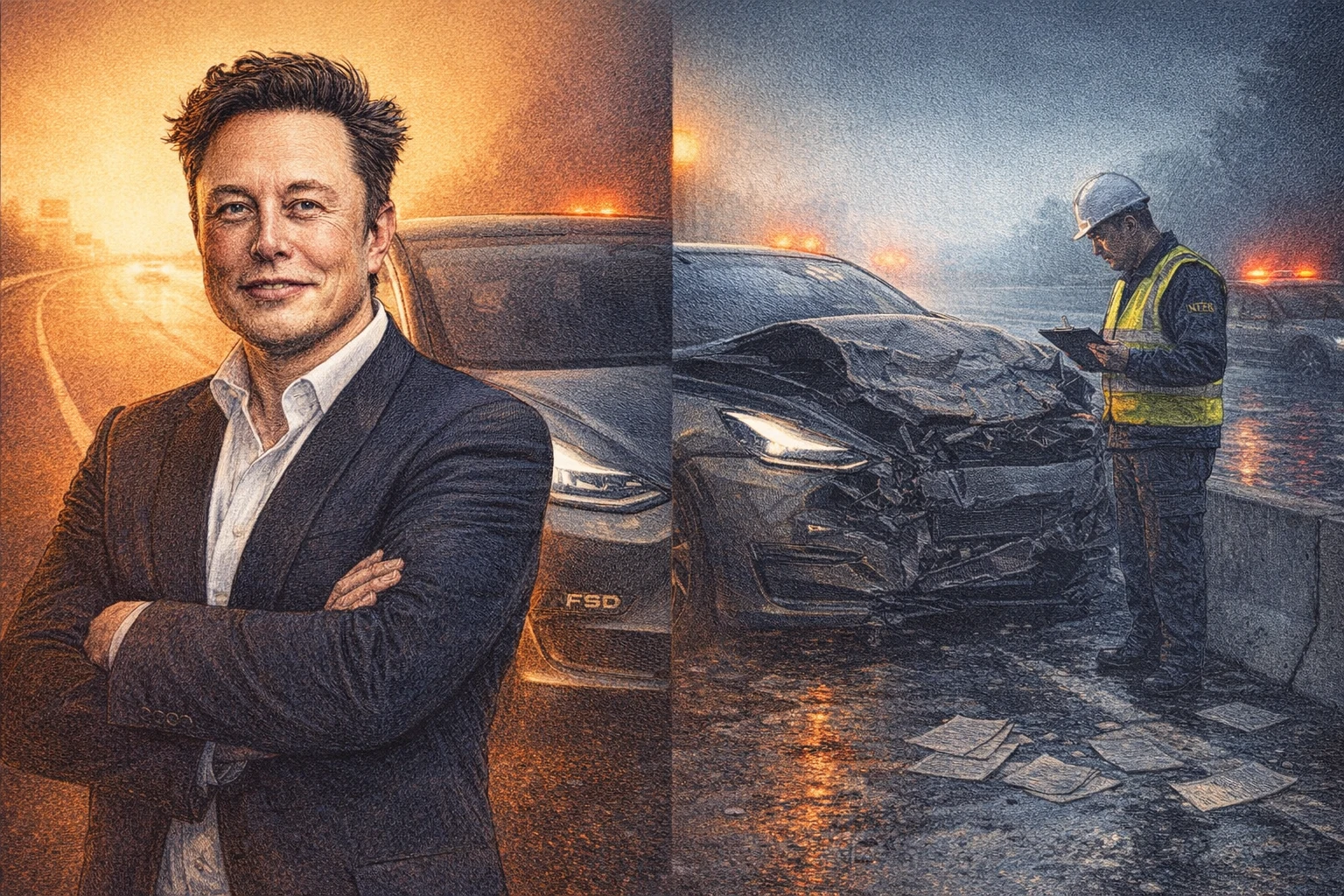
Elon Musk said on March 29 on X that Tesla’s FSD would become more than 10 times safer than human driving. The claim landed at a tense moment. Just 11 days earlier, the U.S. National Highway Traffic Safety Administration, or NHTSA, had raised its FSD investigation to an “engineering analysis,” the agency’s highest investigative stage before a recall decision, covering 3.2 million Tesla vehicles.
Musk was responding to a Tesla video showing an FSD test in which the car appeared to anticipate a pedestrian’s intent before the person stepped into the roadway and slowed down in advance. He reposted it with a short line: Tesla AI self-driving will be >10X safer than human driving. The statement was simple. The dispute around the data is not.
Tesla’s own numbers show large-scale mileage growth
Tesla has reported that FSD (Supervised) has now logged more than 8.4 billion miles. According to the company’s figures, vehicles using FSD experience one serious crash every 5.3 million miles, compared with one every 660,000 miles for average U.S. human drivers. By that comparison, Tesla’s system appears roughly 7 times safer, not 10.
The company also said FSD’s daily average mileage passed 20 million miles in the first quarter of 2026, and that the latest 1 billion miles were accumulated in just 50 days. That scale gives Tesla a large body of driving data, but it has not ended the debate over how the safety record should be measured.
NHTSA focuses on low-visibility failures
On March 18, NHTSA upgraded the case to engineering analysis under file number EA26002. The agency’s concern is centered on how FSD performs in low-visibility conditions such as rain, fog, and glare, where camera degradation detection may be insufficient.
In 9 crashes reviewed by NHTSA, the system allegedly issued warnings only at the last moment before impact, leaving little or no useful reaction time for the driver. Investigators also logged at least 80 cases in which FSD was linked to basic traffic-rule violations, including running red lights and lane departures. The issue is not only whether the system detects hazards, but when it does so.
Austin Robotaxi data points to a higher crash frequency
Separate data from Tesla’s Robotaxi deployment in Austin has added pressure. According to a Fortune analysis, 29 Robotaxis reported 14 crashes, which works out to roughly one crash every 57,000 miles. Human drivers, by comparison, are estimated at one crash every 200,000 to 500,000 miles. On that basis, the Robotaxi crash rate is about 4 times higher.
Safety researchers also raised questions about underreporting. They argue that some of the most severe crashes may destroy the vehicle’s remote communications system, making those incidents harder to capture in Tesla’s own records. Tesla’s response in such cases has been that it “never received the relevant data,” which leaves outside observers with limited ways to verify the completeness of the company’s safety claims.
On the legal side, a fatal self-driving case from Florida resulted in a $243 million damages award, and Tesla’s appeal was rejected by a judge. The ruling stands as one of the largest liability judgments tied to autonomous driving in the United States.