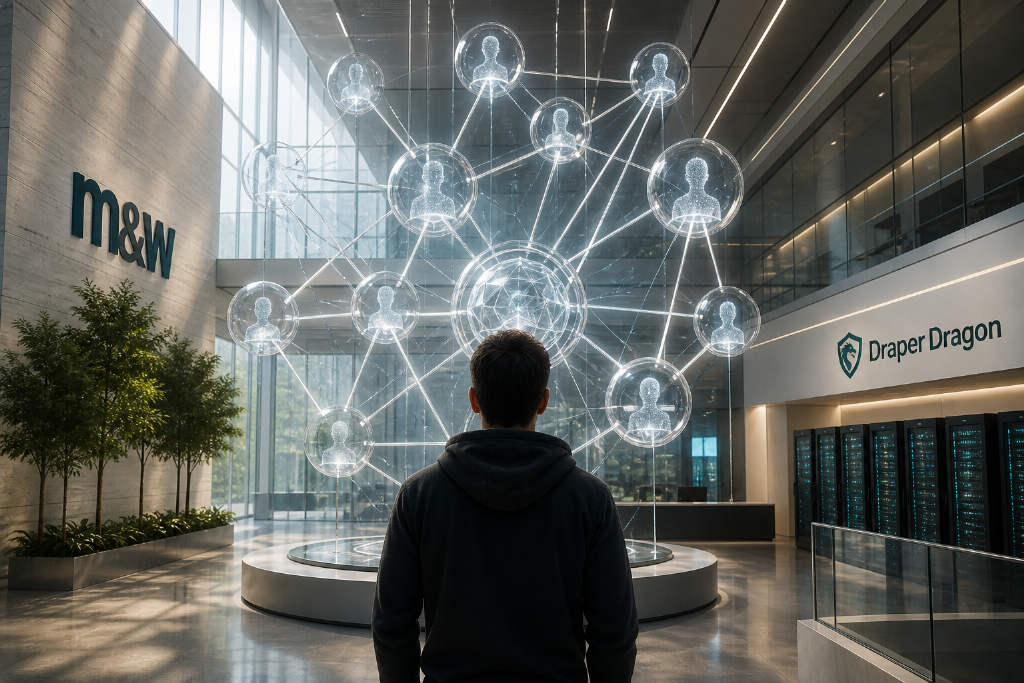
m&W has joined the Dragon AI Accelerator (DAA), a program launched by Draper Dragon, marking what the project describes as its entry into a global AI innovation network. In the article, m&W frames the move as a sign that capital and industry are turning their attention to what it calls the trust layer of AI Civilization.
The project’s core thesis is that the fusion of Builders and the Digital Twin Network is becoming a new unit of productivity in the AI era. In that model, human Builders remain the sole source of value and judgment, responsible for goals, original invention, value assessment, and ultimate accountability. A digital twin network formed by AI agents acts as an extension of human capability, taking on automated execution, continuous learning, cross-domain coordination, and scaling.
From the internet of information to an internet of AI coordination
The article lays out digital civilization as a sequence of infrastructure shifts, arguing that each technological transition reshaped how information moves, how value is created, how organizations operate, and where the boundaries of collaboration sit.
- Internet: solved the problem of free information flow, weakening the grip of geography and centralized institutions and allowing individuals to publish and connect globally.
- Bitcoin: created a digitally native value system through cryptography and consensus, without relying on centralized credit endorsement, while keeping it globally verifiable and tamper-resistant.
- Ethereum: encoded organizational rules in smart contracts, allowing financial protocols and decentralized autonomous organizations, or DAOs, to run automatically under open and transparent logic.
- m&W’s AI collaboration internet: as AI agents become participants with independent execution ability, intelligence growth alone is not enough. What matters is organizing intelligence, matching capabilities, identifying contribution fairly, and establishing trusted coordination.
The progression is summarized in the piece as: internet of information, internet of value through Bitcoin, internet of rules through Ethereum, and then an internet of AI collaboration through m&W.
In that coming digital society, m&W argues, the core production unit will no longer be a single individual or a traditional company. It will be a complex collaborative network composed of human Builders, AI agents, autonomous organizations, and open protocols. In a distributed and often anonymous environment like that, conventional markers of trust such as academic credentials, job titles, or company affiliation lose force. A Builder’s value, in this framing, should be measured by what that person and their digital twins actually create, what problems they solve, and with whom they complete value delivery.
That leads to the project’s broader claim: the AI era needs a new trust foundation, one that turns contribution into verifiable data, capability into accumulated assets, and collaboration into a computable network.
From identity to contribution credentials
m&W argues that the central question in traditional internet and early Web3 identity systems was simple: who are you? In a world where humans and large numbers of AI agents work together, the article says, that is no longer enough. The more relevant questions are what you have contributed and whether your capability can stand up to on-chain verification.
To address that, the project proposes upgrading static identity into what it calls Contribution Identity. The model is built on two trust primitives: Attestation and cryptographic Proof.
The structure is described as:
Subject + Action + Context
↓
Proof
↓
Attester
In the article, Attestation is not presented as a score or a points system. Instead, it is framed as a way to convert real contributions, cooperative relationships, and third-party evaluations across both physical and digital settings into digital assets that are verifiable, composable, and transferable.
The article breaks the structure into five parts:
- Subject: the source of the contribution, whether a human developer, a researcher, or an independently operating AI agent.
- Action: the specific contribution being recorded, such as a key code commit, research logic, or a product module.
- Context: the ecological or project environment in which the action took place, giving similar actions a more precise value anchor.
- Proof: combines claim, issuer, evidence, timestamp, and cryptographic commitment to secure on-chain traceability and resistance to tampering.
- Attester: decentralized protocols, ecosystem organizations, or community members that provide cross-verification.
Those separate attestations, the project says, would accumulate on-chain into a growing Trust Graph. Instead of a paper resume or a static profile page, a Builder’s record in the AI era would become a capability map that evolves with real contribution and gains credibility and network effects over time.
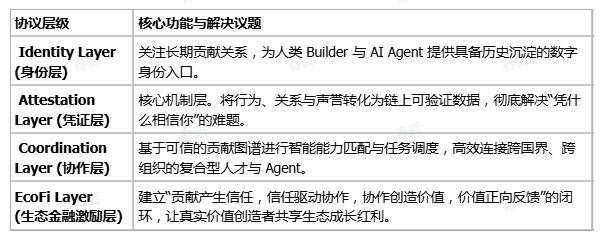
m&W Coordination Stack and the builder-digital twin model
To put trusted coordination into an executable framework, m&W says it has built a layered m&W Coordination Stack. The article does not list the layers individually in the excerpt, but presents the stack as the engineering framework behind its coordination design.
Within that system, the basic structure of productivity is redefined as the symbiotic combination of a Builder and that Builder’s Digital Twin Network. Human Builders are described as the source and spirit of all value, holding goal-setting power, foundational creativity, ethical judgment, and risk responsibility. The digital twin network serves as a digital mapping and extension of those capabilities, handling automated execution, self-directed learning, cross-domain collaboration, and scalable expansion.
That is why the article argues that future competition between individuals and organizations will be determined less by traditional headcount and more by who can build a trusted digital twin network with greater scalability and stronger trust.
Contribution flywheel and positioning against adjacent sectors
For long-term evolution, m&W says decentralized infrastructure needs a self-reinforcing internal model. The article contrasts the traditional internet’s attention economy with an AI environment where content can be generated at scale and attention becomes less scarce. In that setting, it identifies real contribution as the more limited resource.
The project’s contribution flywheel is presented as:
Builder/Agent → Attestation → Trust Graph → Coordination → EcoFi Rewards → more contribution
According to the article, each code commit, algorithmic breakthrough, and product iteration can be turned into digital credit for both the individual and the wider network. The claimed effect is lower trust friction in collaboration and stronger appeal to what the piece calls the top 1% of core builders globally.
The article also draws three distinctions between m&W and other common Web3 and AI experiments:
- Compared with AI agent platforms, its focus is not on how to create intelligence, but on how to establish trust and coordination rules among intelligent actors.
- Compared with decentralized compute networks, it is not limited to hardware allocation, but targets the organizational relationship between core human builders, intelligent agents, digital twin networks, and application scenarios.
- Compared with traditional identity or DID protocols, it moves beyond static identity proofs toward on-chain measurement of dynamic contribution and capability value.
What DAA means for the next step
The article describes joining DAA as a key step for m&W’s expansion into the global AI and Web3 ecosystem. With support from DAA and Draper Dragon’s global resources and forward-looking network, the project says it plans to accelerate protocol iteration, deepen coordination with AI entrepreneurs, developers, and research institutions, and continue exploring the limits of organizational capability and collaborative efficiency in the AI era.
The piece also argues that, over the next decade, millions of AI agents will take part deeply in economic life, while humans remain the central subject and value anchor of that civilizational shift. Human builders distributed around the world, it says, will rely on their creativity, insight, and final judgment, while using trusted digital twins and autonomous organizations to complete complex global delivery. In that network of human principals and intelligent agents, a foundational system that records real trust, connects capabilities, and coordinates human-machine collaboration is presented as a necessary layer.
The article closes with a simple formulation of the project’s role: AI creates intelligence, blockchain establishes order, and m&W builds coordination. It says the project will continue working on the trust layer of AI Civilization so that real contribution can be seen and verified, and so that creators can receive durable value returns in the next generation of digital society.
The original article also includes a disclaimer stating that markets involve risk, the content does not constitute investment advice, and users should judge whether any views or conclusions fit their own circumstances and bear responsibility for investment decisions made on that basis.