
Foresight published a market analysis article arguing that the monetary foundation of a machine-led digital economy may differ from the framework built for industrial civilization. The article is credited to Jerry, founder of m&WDAO, with research support listed as Gemini and ChatGPT.

A digital economy may need more than a transaction medium
The piece opens with a broad claim: during the height of industrial civilization, productivity was embedded in factories, contracts and the ledgers of centralized banks, while the shift between gold-backed systems and credit fiat reflected value standards designed for cooperation among physical human entities.
That framework, the author writes, is now being tested as society moves deeper into a structure described as Human ↔ Digital Twin ↔ Agent ↔ Organization. In that setting, software agents that run continuously, have no physical body and carry no KYC identity may become core productive actors in the digital economy.
The article says the dollar system and centralized stablecoins already offer a highly efficient answer for that environment. It explicitly acknowledges that stablecoins may be one of the most efficient transaction media in digital economies, especially for high-frequency API billing and machine settlement. But it draws a line between a transaction medium and an ultimate standard of value.
In the author’s view, stablecoins remain tied to sovereign fiscal expansion cycles and to the access controls of centralized institutions. The point, the article says, is not to attack stablecoins or reject the old system, but to ask a deeper question: if a digital economy is borderless, runs at machine speed and operates with a high degree of autonomy, does it also need a native standard that matches its own mode of production?
The “civilizational hypothesis” and Bitcoin as a candidate
In a section titled “The Civilizational Hypothesis,” the article says its argument should not be read as worship of a single technological totem or as narrow Bitcoin maximalism. It instead approaches the question through financial history: industrial civilization chose gold and the U.S. dollar because those standards fit the structure of physical trade and state sovereignty at the time.
The next question, as framed in the piece, is what standard best fits a digital civilization shaped jointly by humans and AI. On that basis, the author places Bitcoin and sats at the center of the discussion, not as absolute truth, but as what the article calls the most worthwhile candidate for a native standard yet to be tested in the history of human cryptography and distributed game theory.
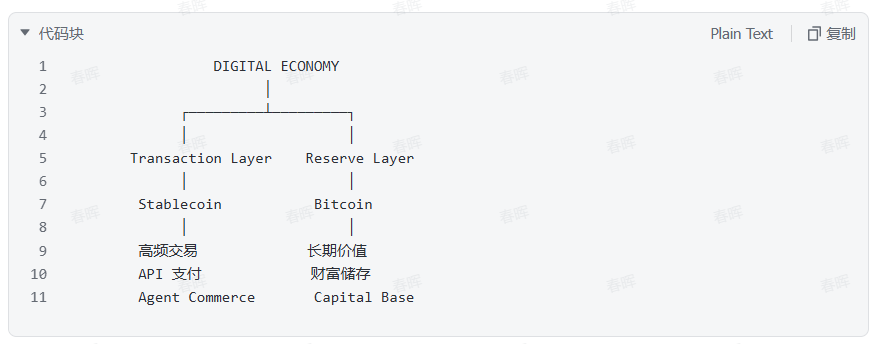
The monetary structure proposed in the article is split in two. Stablecoins would function as transaction money and provide liquidity. Bitcoin would function as reserve money and serve as the capital base. Under that framing, Bitcoin does not need to “replace fiat” or “overthrow the dollar” to succeed. The article argues that a genuine Bitcoin standard begins not when machines start using BTC, but when digital civilization begins measuring value in BTC.
It adds that once surplus and newly created wealth in the global digital economy are more naturally held in BTC as the final reserve asset and capital benchmark, Bitcoin would have moved from a payment asset to a measure of value.
Direction, coordination and value
The article then argues that if money solves only transfer and storage, the machine world could degrade into a disorderly jungle of computing power and algorithmic competition. To avoid that outcome, m&W proposes a three-layer structure: direction, coordination and value.
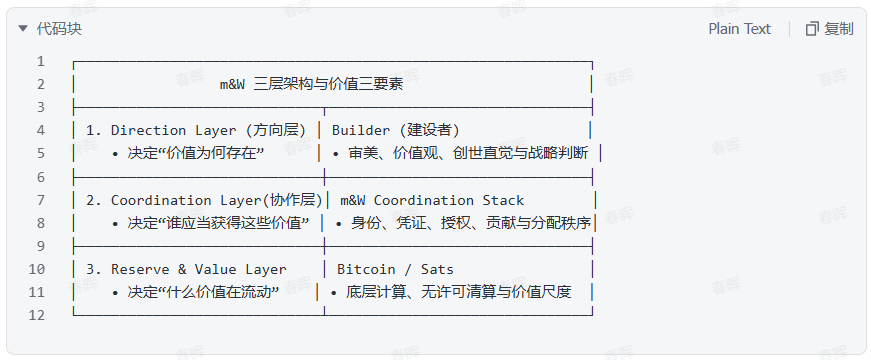
Its shorthand is direct: Bitcoin shows what value is moving, m&W determines who should receive that value, and builders determine why that value exists at all. The author says this is not literary rhetoric but a mapping between distributed protocols and human intuition. The framework is described in three parts:
- Builders provide the original source of creativity. Human aesthetics, ethical boundaries and strategic intuition set the system’s direction of evolution.
- The m&W Coordination Stack builds contractual order. Based on verifiable cooperation and historical contribution, it assigns authorization levels and resource allocation rights to digital twins and agents.
- Bitcoin and sats provide the base reference for value, enabling global settlement and long-term reserves on what the article describes as a physical-grade ledger without counterparty risk.
The section is summed up in one line: money belongs to machines, but the direction of value belongs to humans.
From a tool community to distributed order infrastructure
In “The Emergence of Distributed Order,” the article describes m&W’s development path as a move from a simple tool community, labeled 1.0 Consensus, to a division-of-labor network, labeled 2.0 Cooperation, and then to the infrastructure of distributed order for digital civilization, labeled 3.0 Order.
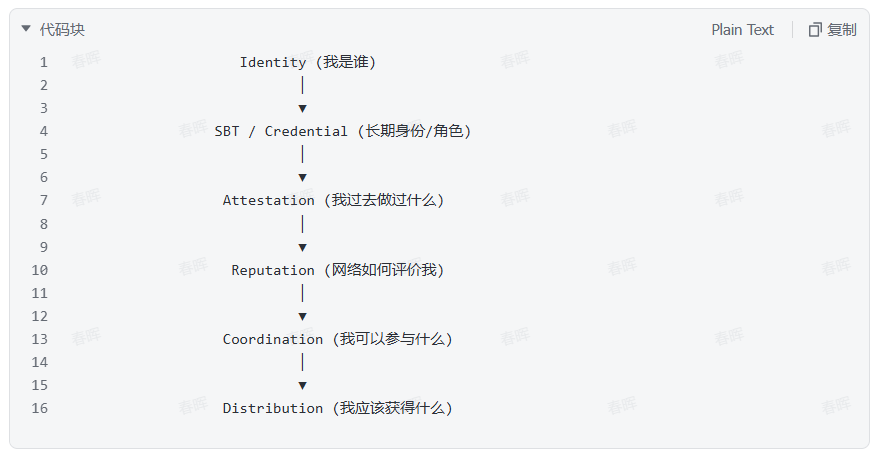
To keep that order strict, the article says identity, credentials and behavior must be treated as distinct cryptographic relationships rather than collapsed into a single form of trust. It lays out four components:
- Identity & SBT define the long-term, non-transferable attributes and contractual identity of builders and their digital twins.
- The Attestation Layer follows the structure Subject + Action + Context + Proof + Attester to record verifiable acts completed by a subject in specific time and space, such as submitting code, providing compute power or completing inference.
- Reputation & Coordination emerge from accumulated attestations, forming trusted credit that can automate agent-to-agent business negotiation, authorized collaboration and benefit distribution.
- Value Settlement receives the injection of the native standard and completes value settlement.
Under that logic, the article says, m&W is not merely a support tool built around Bitcoin. It is presented as the order hub for handling the relationship among humans, machines and value in digital civilization.
A proposal for debate, not a final answer
The closing section describes the present as a boundary between two eras. On one side sits the traditional economy, still operating on the inertia of industrial civilization and centered on physical human actors. On the other sits a fast-emerging network of machine autonomy that needs new economic institutions and a new sovereign anchor.
The article says m&W is not offering a doctrinal final answer. It is offering what it calls a civilizational hypothesis for builders to test together: machines gain a value scale native to digital civilization, builders retain the soul that decides the direction of value, and m&W builds the coordination order that links the two.
In its acknowledgments, the piece says m&W’s thinking on value standards and distributed order was shaped in part by The Bitcoin Economy for AI and its research output, “Field Notes — State of Play — For Agents.” That work, according to the article, informed its understanding of agents as economic subjects, the choice of digitally native money and the contrast between stablecoin and Bitcoin-based models. From there, the author extends the argument one step further: machine use of Bitcoin may be only the opening act, while the larger shift would be whether Bitcoin can evolve from a payment, settlement and store-of-value asset into the benchmark for measuring long-term value across the digital economy.
The original article also included a disclaimer stating that markets carry risk, investment requires caution and the piece does not constitute investment advice.