
A Bitcoin wallet that had sat idle for nearly 12 years suddenly moved about $1 million worth of BTC through a large custodian in March, got almost the same amount back weeks later, and then burned the coins in May. The onchain trail is visible. The reason is not.
Cointelegraph reported that the wallet sent 20.00010537 BTC to what Bitcoin educator Bennet described as "a custodian of some kind." Around three weeks later, 20.00006037 BTC returned to the same address, leaving a gap of just 4,500 satoshis, or roughly $3. Less than two months after that, the Bitcoin was deliberately sent to an unspendable address.
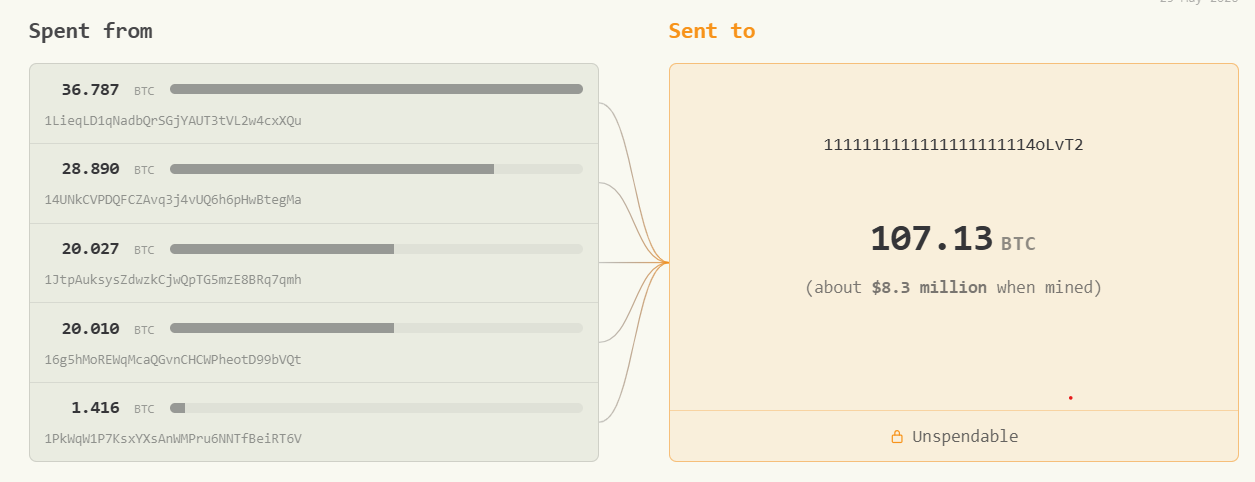
The transaction is tied to a wider mystery around 107 BTC burned in May, worth roughly $8.5 million at the time. New blockchain analysis indicates that five wallets involved in the eventual destruction of the coins were likely controlled by the same person, probably an early Bitcoin holder with funds linked to the collapsed Mt. Gox exchange.
Five wallets point to common control
According to Chainalysis, the five addresses that ultimately sent Bitcoin to an unspendable address show "strong indicators of common ownership."
All five wallets were initially funded on the same day in April 2014. Each later sent nearly the same dollar-equivalent amount of BTC to the same deposit address at a large centralized platform.
The addresses also appear to have been used in rotation. One wallet would send Bitcoin to the platform until activity stopped, then another wallet would begin sending transactions with a similar cadence and value pattern.
Chainalysis said most of the funds can be traced back to Mt. Gox, which suggests the owner was an early Bitcoin adopter.
That does not necessarily mean the coins were withdrawn directly from Mt. Gox. The exchange stopped trading in February 2014, while the five wallets were funded in April 2014.
The custodian itself has not been identified. Chainalysis said only that it was a large centralized exchange and that it does not publicly name the services it identifies.
Bennet’s analysis suggests the address functioned like a static customer deposit address at a large custodian. The address did not hold a balance. Deposits were swept into transactions containing dozens of other inputs and later consolidated into an omnibus wallet.
Once the Bitcoin entered that system, the public blockchain could no longer show whether the coins were sold, held, or moved somewhere else. That gap makes the earlier wallet activity more striking.
The repeated $10,400 pattern
One of the five addresses sent 19.6 BTC to the same custodian in 60 transactions between 2022 and 2024.
The BTC amounts varied widely, from about 0.15 BTC to 0.62 BTC. Measured in dollars, however, the transfers looked unusually consistent.
During that period, Bitcoin’s price rose more than fourfold. Even so, 58 of the 60 transfers were within 10% of about $10,400 at the time they were sent.
That means the owner was not repeatedly sending the same amount of Bitcoin. The owner was repeatedly sending almost the same dollar amount instead.
Bennet said blockchain data alone cannot prove what happened after the BTC reached the custodian, because the coins were mixed with large numbers of others in the platform’s system. The data does not show whether they were sold, held, or transferred elsewhere.
He also noted that the payment size was relatively constant, but the timing was not. The roughly $10,000 transfers appeared in clusters, which may fit someone sending fixed-dollar amounts when needed rather than following an automated schedule.
The $1 million round trip
The earlier $10,400 pattern may help explain the wallet owner’s past relationship with the custodian. It does not explain the March round trip.
After roughly 12 years of inactivity, the wallet moved its full balance of 20.00010537 BTC and later received 20.00006037 BTC back. The difference was only 4,500 satoshis, about $3.
That weakens the idea that the owner was simply trading the Bitcoin. Whatever happened inside the custodian, almost exactly the same amount returned to the chain.
The returned funds were also split into three transfers sent over three consecutive days: 7 BTC, 7 BTC, and 6.00006037 BTC.
Bennet said those round-number withdrawals are consistent with a daily withdrawal limit at the custodian. Just as important, the Bitcoin did not end up in a different wallet. It went back to the same address that had originally sent the 20 BTC out.
The transaction history also suggests the same key holder controlled the coins before and after the round trip. Bennet said spending the Bitcoin in March required the private key, and burning it in May required that same key again.
That sequence is difficult to frame as a standard exchange transaction.
Several theories, no clear answer
Several explanations have been suggested, but none fits the full record.
A liquidation theory may help explain the earlier fixed-dollar transfers, yet it does not explain why the owner would send about $1 million in Bitcoin through the same infrastructure in March and then retrieve almost all of it.
Another possibility is that the owner was testing an old wallet or custody arrangement after 12 years of dormancy, using a major custodian to confirm that the old private key and custody setup still worked. That still leaves the final burn unexplained.
Tax or compliance motives could also fit part of the picture, in the sense that someone might move an old stash through a major custodian for administrative reasons. But there is no evidence tying the transaction to any specific tax or regulatory event.
A privacy explanation is also possible. Sending Bitcoin through a custodian that sweeps deposits into an omnibus wallet makes later onchain movement much harder to trace. Even that does not explain why the coins were ultimately destroyed.
The burn itself may have been intended as a statement. Yet, as the report noted, the move was barely noticed beyond a small group of blockchain sleuths.
Burning Bitcoin is irreversible. Whoever controlled the private keys chose to send the coins to an address where they can never be spent again, rather than leaving them untouched.
For now, even specialist blockchain analytics firms do not have a definitive explanation. Chainalysis acknowledged that the blockchain can show in unusual detail what happened, but not why it happened. That remains the unanswered million-dollar question.