
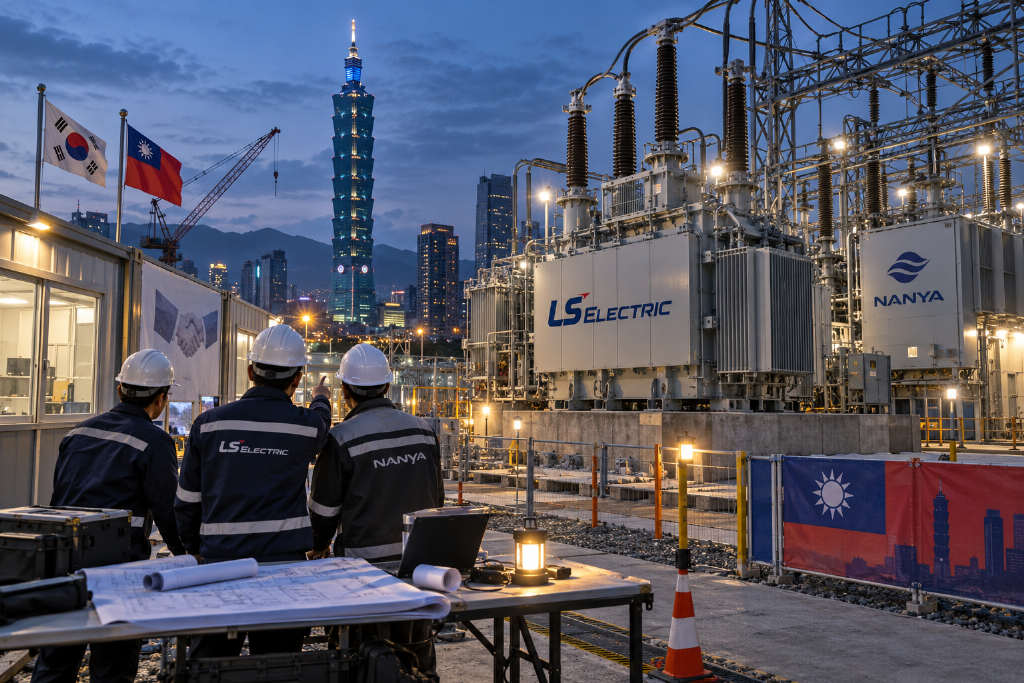
Nan Ya Plastics, a unit of Taiwan’s Formosa Plastics Group, is teaming up with South Korean power equipment maker LS ELECTRIC to launch a joint venture called Nan Ya LS, targeting power infrastructure projects in Taiwan. The move is meant to shift the business from straightforward power equipment supply to bidding, design, and direct project execution.
According to The Korea Times, the three parties signed the agreement in Seoul on Tuesday, and LS ELECTRIC outlined the plan publicly the following day.
Ownership split and partner roles
Under the structure released by LS ELECTRIC, the joint venture will be owned 50% by LS ELECTRIC, 40% by Nan Ya, and 10% by KHI, another Formosa-affiliated entity.
LS ELECTRIC is a South Korean manufacturer of power equipment and automation systems. Nan Ya, one of Formosa Plastics Group’s affiliates, operates across petrochemicals, electronic materials, and electronic products. In recent years, it has also been building out its power solutions business, expanding from distribution equipment into extra-high-voltage transmission equipment and grid stabilization technology.
KHI was established with funding from Formosa Plastics Group in 2025 to commercialize technology developed by the Korea Advanced Institute of Science and Technology, or KAIST.
The three sides are expected to bring different functions into the venture. KHI will contribute resources tied to technology commercialization. LS ELECTRIC will provide manufacturing and design expertise. Nan Ya will supply local production capacity and engineering networks in Taiwan.
From equipment supplier to project contractor
The core of the tie-up is a change in LS ELECTRIC’s role in Taiwan. The report said LS ELECTRIC and Nan Ya had already signed a memorandum of understanding in March last year, with a focus on environmentally friendly power equipment and energy efficiency in Taiwan. Up to now, though, the relationship has largely remained at the equipment supply stage.
Once the joint venture is in place, the first step will be to build local capabilities for bidding, design, and technical support for Taiwan power projects, while making use of Nan Ya’s network in EPC, short for engineering, procurement, and construction.
An LS ELECTRIC official said the company’s Taiwan business had previously been limited to supplying power equipment. Through the joint venture, that business will be upgraded into project orders combined with engineering capabilities.
Targeting grid upgrades, storage, and smart grid demand
LS ELECTRIC said Taiwan, under its net-zero carbon policy, is aiming to raise renewable energy to as much as 70% of its power mix by 2050, while also investing in environmentally friendly power facilities, energy storage systems, and digital smart grids.
A larger share of renewable energy means the grid will need to handle more intermittent power sources. That lifts demand for extra-high-voltage transmission, grid stabilization, and energy storage equipment. The report said those areas match Nan Ya’s recent strategic buildout and mark the market the new venture wants to enter.
Nan Ya is also expanding in electronic materials
Separately, Nan Ya has been pushing into upstream copper clad laminate, or CCL, supply chains through its electronic materials business as AI server demand grows.
Taiwan PCB industry analyst kokycpcb recently said Formosa Plastics Group has a relatively high self-sufficiency rate in key CCL raw materials including epoxy resin, fiberglass cloth, and copper foil. The analyst also said the group has a high degree of vertical integration and a comparatively complete supply chain.
What comes next will be whether more details emerge on the joint venture’s setup and operations, and whether LS ELECTRIC and Nan Ya can secure actual orders in Taiwan’s extra-high-voltage and grid-related project market.