
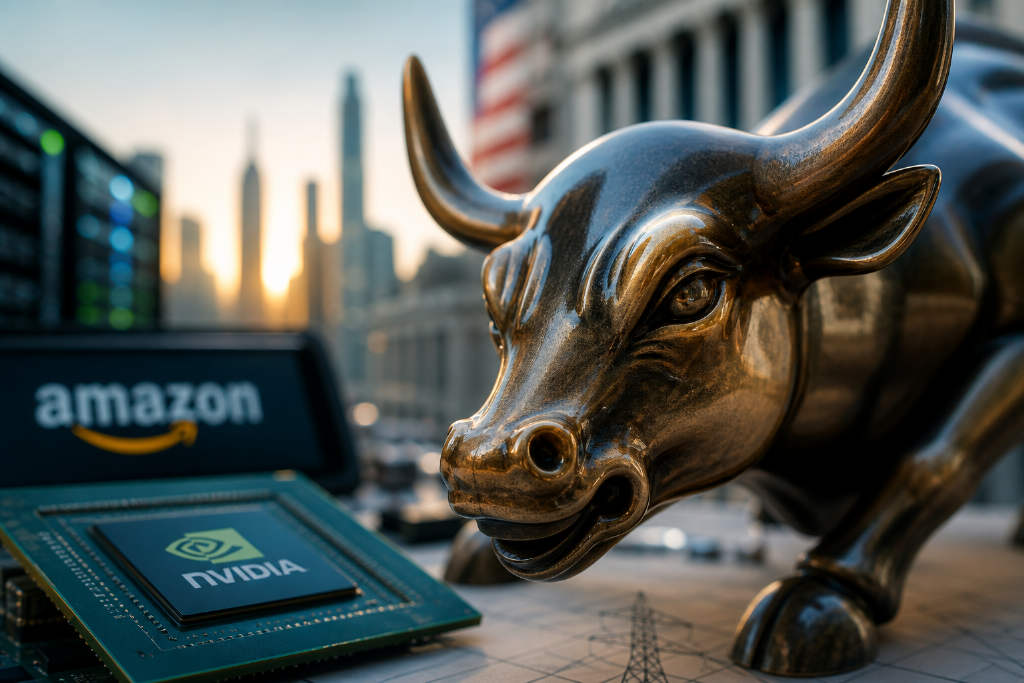
Nancy Tengler, chief executive officer and chief investment officer of Laffer Tengler Investments, said on an Aug. 12 episode of TheStreet’s podcast that she remains constructive on U.S. stocks even as the S&P 500 sits near record highs. Her second-half positioning is concentrated in four areas: AI infrastructure, growth companies she believes are trading at value-like prices, cybersecurity, and catch-up trades in financials and consumer discretionary.

The interview was hosted by Caroline Woods and originally ran under the title “Market At Record Highs — Nancy Tengler Says To Keep Buying These Names.” TechFlow’s write-up noted that Tengler is discussing names that are, in many cases, held in portfolios managed by her firm, making the remarks an interested investment view rather than independent third-party analysis.
Why she thinks this rally still has room
Tengler said the current market has more in common with the best stretch of the 1990s than with a late-stage bubble, but she drew a clear distinction between then and now.
“This is one of the best markets since the 1990s,” she said. The case, in her view, rests on earnings growth and on what she described as a technology revolution, or economic transformation, that is being driven by productivity. After listening across earnings calls, she said her team is hearing adoption of new technologies across sectors, not only cloud computing but also physical AI and power-driven solutions.
Asked why investors should not jump straight from “1990s” to “bubble,” Tengler said today’s leading companies are real businesses with clean balance sheets and unusually strong profitability. She pointed to hyperscalers as an example.
She also compared the current setup with the late 1990s using earnings and market returns. From 1995 to 2000, she said earnings grew about 60% while share prices rose 220%, a mismatch driven by valuation expansion. Cisco, she noted, once traded at 100 times earnings. Over the past five years, by contrast, earnings have grown about 80% while total stock returns have been around 85% to 90%. In her reading, that is not the same kind of valuation excess.
Her conclusion is that valuations are reasonable because growth is so strong. She added that the 10-year Treasury yield remains below its 40-year average, which is one reason she does not see the market as overstretched.
What breaks the range: broader participation
Tengler said the next leg higher depends on breadth rather than on a further narrowing into a handful of leaders. She described the recent market as concentrated, even if the summer pullback helped relieve some of that pressure.
That is why she has been moving capital toward infrastructure. Her firm already owned many AI infrastructure names, she said, and has been adding new positions while increasing existing ones. Citing Goldman Sachs, she said $7.5 trillion in capital expenditure is expected to go into compute and data centers over the next five years. She wants direct exposure to that buildout and sees it as a driver of changing sector leadership.
When Woods asked whether this widening is mostly inside technology, Tengler said breadth has already appeared at the broader market level, but future leaders are still likely to be technology-driven. As she put it, new technology is “eating” technology companies while also building out the infrastructure needed for electrification.
AI infrastructure: power, gas, and industrial exposure
On individual names, Tengler highlighted Quanta Services as one of her preferred ways to express the infrastructure theme. She said the stock has already had a run, but she still sees upside based on backlog and management’s earnings growth guidance.
She also said her portfolios hold GE Vernova, which makes gas turbines, and that the firm recently added to Williams. Tengler described Williams as a more defensive way to participate in the AI trade because it transports natural gas under fixed-price contracts, limiting sensitivity to swings in gas prices, while expanding business around hyperscalers.
Another name she mentioned was Deere. She said Deere is not a pure infrastructure play, but the company is using AI to help farmers with weeding, planting, and autonomous tractors. She framed it as a practical example of AI spreading into the physical economy.
Why Nvidia and Amazon sit in her value portfolio
Tengler made one of her clearest points when discussing Nvidia and Amazon. In her view, both are growth companies that can currently be bought at value-like prices.
She said her team first found them in growth portfolios two years ago and later moved them into a value strategy. Google went through a similar process. Tengler recalled that after Bard’s release, many investors concluded Google would never catch up. She called that launch disastrous, but said Gemini changed the picture and the stock rose more than 100%.
She used the Russell 1000 Value Index to illustrate how classifications have shifted, saying Amazon is now the index’s largest holding and that Micron was the top holding in the first half. At times, she said, “fallen angel” growth stocks can trade at value prices.
Nvidia is the standout example in her framework. Tengler said the company’s sharp dividend increase looked like a signal from management that current earnings power is sustainable. On her numbers, Nvidia trades at 16x to 18x next year’s earnings while growing earnings at 60% to 80%, depending on whether the reference point is fiscal or calendar year. That leaves the stock on a PEG ratio of just 0.25. She contrasted that with Tesla at 5, which is why she continues to buy Nvidia.
Her argument for Amazon is different. She said the market still has not moved past its older view of the company. Tengler said she trusts chief executive Andy Jassy and believes he has handled similar periods before. Her team wanted to own Amazon ahead of earnings, which she described as unusual for them. To fund that trade, they sold some Apple and bought Amazon, a switch she said had worked very well over the previous few weeks.
Asked whether she would still buy Nvidia and Amazon now, Tengler answered yes.
Cybersecurity stays in the portfolio, with a tilt to CrowdStrike
Tengler said technology does not need to keep dominating every corner of the market for equities to do well, but she still wants meaningful tech exposure, and cybersecurity remains one of the firm’s core allocations.
She said Laffer Tengler Investments owns both Palo Alto Networks and CrowdStrike. The business should continue growing, she said, though competition will get tougher and vertically integrated players such as Palantir are also moving into data security. She called that an interesting battle to watch.
In the quick-fire segment later in the interview, she chose CrowdStrike over Palo Alto Networks when asked to pick one.
Palantir, Tesla, and SpaceX as “narrative” stocks
Tengler grouped Palantir, Tesla, and SpaceX together as “narrative” stocks, a label she uses for companies whose valuations ask investors to pay for future possibility rather than present certainty.
On Palantir, she said the firm added during the summer sell-off. The stock is still down on the year, she said, though it has rebounded sharply from its lows. She acknowledged the company’s strong growth but said that buying it means buying the future, which comes with large swings. She recalled adding at $88, watching it rise to $250, and then fall back to $100, while still feeling comfortable with the position. For long-term investors, she said, volatility should be treated as a friend.
Her Tesla view is tied to execution. She said full self-driving needs to become real, and Cybercab and Robotaxi also need to launch. At the same time, she said the original attraction for her firm was Tesla’s battery storage business, Megapack, at utility scale. She added that a potential acquisition or merger involving SpaceX and Tesla would be a catalyst for Tesla shares.
Asked whether she would invest in SpaceX despite the company not being profitable today, Tengler said yes. She said her firm owned it at the IPO and added again on the recent decline. Her time horizon there is three to five years. She also said that, in her view, cost basis matters less over that span because the company represents the future and could change how people live. She mentioned a Wall Street Journal article from the prior day that said a deal could help trigger many of Elon Musk’s compensation-package targets.
Financials and consumer discretionary as catch-up trades
Outside infrastructure and tech, Tengler said her firm owns Goldman Sachs, Brookfield Asset Management, and JPMorgan. The common thread she hears on earnings calls is that these companies are using AI.
She singled out Goldman, saying the bank stated on its call that headcount would stay flat while growth would accelerate by 20% to 25%. In her view, that points to strong operating leverage.
She also likes consumer discretionary and said the firm is overweight the sector. Her team added to positions ahead of recent earnings, and she said that decision paid off. Starbucks was one of the names she mentioned, arguing that the company’s chief executive knows how to engineer a turnaround. Amazon also falls into consumer discretionary in her book.
Home Depot is another holding she now finds interesting. The stock has not done much inside the firm’s 12 best-ideas portfolio, she said, but that is normal in investing. She still believes housing will eventually recover, even if the timing is unclear.
What she is avoiding
Tengler was equally direct about the areas she does not want to own. Staples are one. She said the firm owns only one or two names there. Utilities are another, with just one power company in the portfolio. The same goes for REITs, where her exposure is less than a market weight because she sees better places to put capital.
Her reasoning is simple: in what she called a very strong growth environment, investors should stick with growth. In the quick-fire round, when asked which Magnificent Seven name she would avoid, she picked Meta.
That same segment offered a clean read on her positioning. She said new money should go to growth rather than value. The best value in the market, in her opinion, is at the sector level, and she chose consumer discretionary. Within that sector, her top pick is Amazon. Asked to choose between Amazon and Apple for upside, she chose Amazon. Between Broadcom and AMD, she chose Broadcom.
Her year-end target and the main risk to the bull case
Tengler said the S&P 500 is already up about 10% this year, and she would be satisfied if it ends the year up 12% to 15%. She specifically said she would rather not see a 20% to 25% surge, arguing that a bull market still needs pauses and resets.
She described the current cycle as a relatively young bull market, even earlier than the 1990s in some ways. Her base case is that the fourth quarter usually brings a pickup in momentum, so another push higher is possible.
As for what could prove her wrong, Tengler said she began the year focused on geopolitical shocks, but now sees two more important risks. One is a slowdown in earnings growth if companies start missing expectations or cutting guidance. The other is a break in credit markets. If credit cracks, she said plainly, then her view is wrong. For now, she sees credit spreads as still tight by historical standards. In the rapid-fire portion of the interview, when asked whether valuation or inflation is the bigger risk from here, she chose inflation.
Her quick-fire answers in brief
- At record highs, buy or wait: buy, if you are a long-term investor.
- Trade early or late: early.
- If handed $10,000 today, lump sum or stagger in: lump sum.
- Bigger mistake, chasing or waiting on the sidelines: waiting.
- New money in value or growth: growth.
- Best value now, stock or sector: sector.
- Preferred sector there: consumer discretionary.
- Top pick in consumer discretionary: Amazon.
- Amazon or Apple for more upside: Amazon.
- Broadcom or AMD: Broadcom.
- Palo Alto or CrowdStrike: CrowdStrike.
- One Mag 7 name to avoid: Meta.
- Tesla or SpaceX over the next 12 months: Tesla.
- U.S. or international equities: U.S. equities.
- Large caps or small caps: large caps.
- For long-term investors, single stocks or index funds: single stocks.
- Cash on the sidelines, invest now or wait for a pullback: invest now.
- One word for the rest of the year: bullish.
- Up or down from here, and by how much: up, about 5%.
The through line in Tengler’s interview was consistent. She still wants to own growth, but in places where she sees durable earnings, infrastructure demand, and pricing that does not fully reflect the opportunity. That leaves AI infrastructure, Nvidia, Amazon, cybersecurity, financials, and consumer discretionary near the top of her list, while Meta, staples, utilities, and REITs remain on the sidelines.