
Nasdaq plans to start 23-hour-a-day, five-day-a-week stock trading on Dec. 6, 2026. The U.S. Securities and Exchange Commission has approved Nasdaq’s 23/5 rule change, but the market cannot go live until infrastructure such as the Securities Information Processor, or SIP, is ready and related rules are in place.
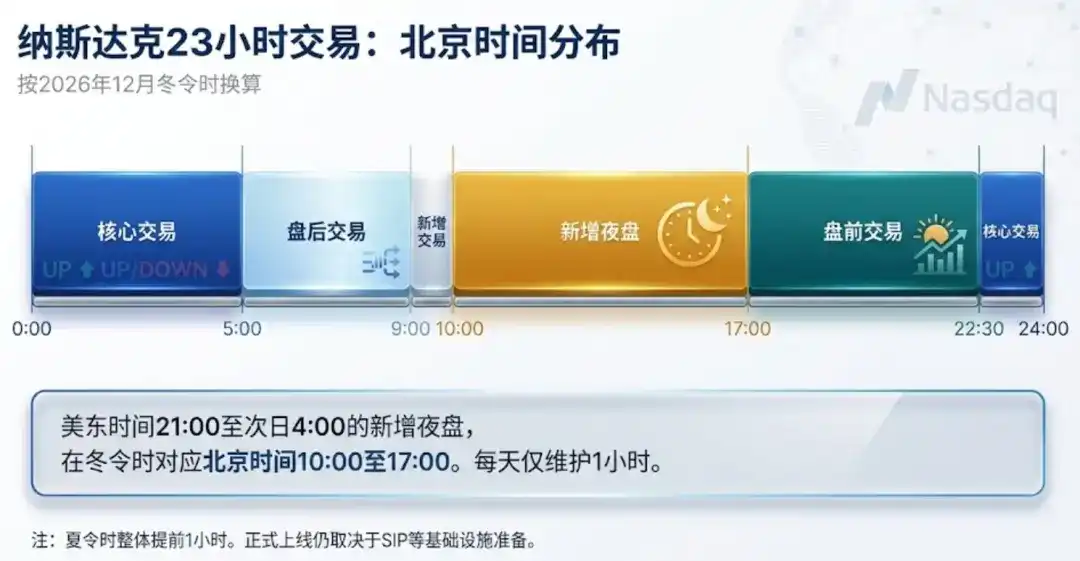
The new overnight session would run from 9 p.m. to 4 a.m. Eastern Time. In December, when winter time applies, that corresponds to 10 a.m. to 5 p.m. Beijing time, giving investors in Asia a daytime window to trade U.S. equities directly.
The article says the move may look like a simple extension of market hours, but the real contest is over order flow. Nasdaq is trying to pull executions back from overnight platforms, broker internal trading systems and other exchanges. It also wants global investors, wherever they are, to use the U.S. market first when major events hit outside New York trading hours.
In the article’s framing, the short-term target is order flow now handled by overnight ATS venues, broker internalization systems and rival exchanges. Over the medium term, the contest is over nighttime price discovery in ETFs and large technology stocks. Over the longer term, it is about controlling the daytime gateway in Asia for global asset pricing. The point is not to keep U.S. investors awake. It is to turn Asia’s daytime into part of the U.S. stock market’s tradable day.
Asia’s daytime becomes part of the U.S. overnight session
Core U.S. stock trading lasts only 6.5 hours. Pre-market and after-hours sessions have existed for years. Nasdaq’s new plan fills the gap between 9 p.m. and 4 a.m. Eastern Time, leaving just one hour each day for maintenance.
That added block lines up with daytime hours across major Asian markets. Investors in China, Japan and South Korea would no longer need to wait until late night. If the Federal Reserve changes policy, a geopolitical conflict breaks out or corporate news hits, money in Asia could react without waiting for the New York open.
Overnight trading in Asia hours is led by ETFs, not single-name stocks
The article cites a set of Nasdaq overnight trading data covering January through June 2025. Those trades took place mainly during Asian hours. The data do not identify investor nationality, and the article says not all of the activity should be labeled Asian money. Still, it is useful for showing what gets traded and what tools investors prefer during that session.
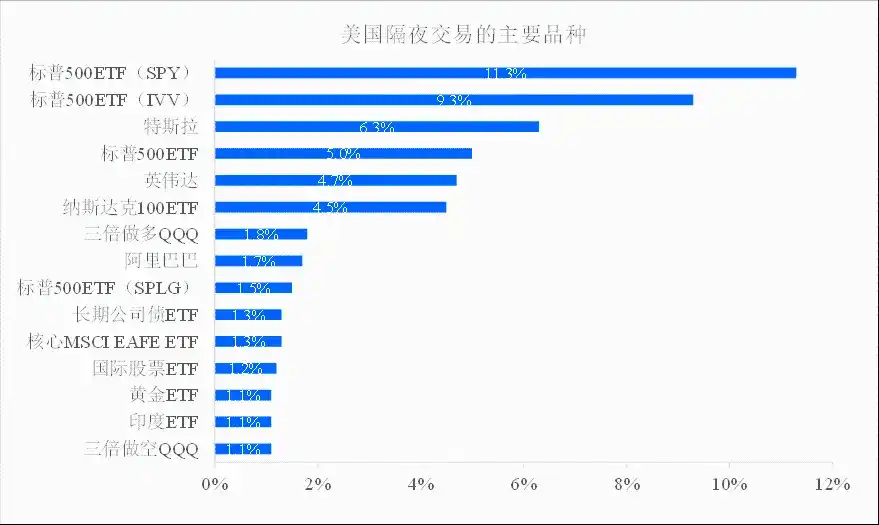
There are about 11,300 listed trading symbols in the U.S. market, but only 1,403 traded overnight. Just 644 had daily turnover above $10,000. The top 15 products accounted for about 53% of overnight trading value, which Nasdaq summarized as close to 55%. Of those 15, 12 were ETFs and only three were individual stocks. The article argues that this is not a broad migration of market liquidity. It is concentrated trading in a small group of macro risk instruments and very large-cap assets.
SPY, IVV and VOO, all S&P 500 ETFs, made up 25.6% of overnight trading combined. QQQ accounted for 4.5%. TQQQ, the triple-long QQQ product, and SQQQ, the triple-inverse QQQ product, together made up 2.9%.
The three most active individual stocks were Tesla, Nvidia and Alibaba, together accounting for 12.7%. Other active products included ETFs tied to gold, Indian equities, international equities and corporate bonds. The article includes a note that the data are for January to June 2026.
Its conclusion is straightforward: during Asian hours, investors are trading the U.S. market first and U.S. companies second. Overnight trading is driven less by company-specific research and more by risk management.
Nasdaq is competing for orders before listings
SPY, IVV, VOO and Alibaba are not Nasdaq-listed products, yet they can still trade on Nasdaq. That, the article says, shows the immediate goal of 23-hour trading is not to win listings. It is to win orders.
When U.S. exchanges close, order flow does not disappear. It moves to venues such as Blue Ocean, to broker internal systems and to other execution venues. The New York Stock Exchange and Cboe are also pushing for longer trading hours. The London Stock Exchange is preparing a new extended-hours platform starting with ETFs. Supporters argue that bringing those orders back to regulated exchanges would improve trade transparency, quote visibility and market surveillance.
Exchange revenue is not limited to trading fees. Orders generate market-data revenue, attract market makers and help form reference prices. The venue that captures the order first gets to write information into the price earlier than everyone else.
Longer trading hours could also make U.S. markets more attractive to overseas companies, but the article places that behind the battle for order flow. Companies still weigh valuation, liquidity, investor mix and regulatory cost when choosing where to list. Nasdaq, in this telling, goes after orders first and prices second. Once it has a stronger hand in price formation, it may become more attractive for issuers as well.
Who pays for a 23-hour market
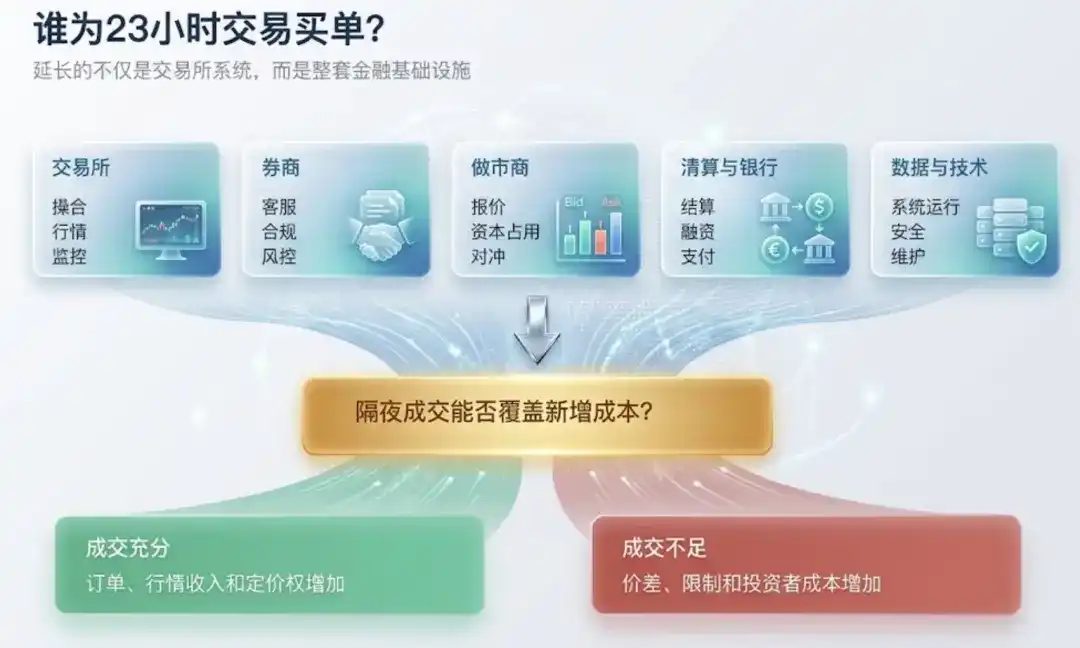
Extending trading hours means more than keeping the matching engine on longer. The broader financial infrastructure has to stay up as well.
Exchanges need to keep market data running and surveillance active. Brokers need customer service, compliance staff and risk controls. Market makers need to quote for longer and commit more capital. Clearing houses, banks, data vendors and technology providers also have to operate in step. At the same time, maintenance windows get shorter and cybersecurity risk rises.
Existing pre-market and after-hours trading already absorb part of that burden, but the added overnight session still raises spending on staffing, systems, capital and compliance. The problem, as the article puts it, is that overnight turnover is extremely thin for most stocks. A large set of institutions would have to maintain full service for a small set of ETFs and mega-cap technology names.
Those costs, it argues, eventually come back to investors. They may not show up as a dedicated overnight commission. Instead, bid-ask spreads may widen, funding costs may rise, brokers may restrict market orders and limit which products can be traded, and market makers may build capital usage and hedging risk into their quotes. The exchange is extending time; the investor is paying through the spread. Trading hours are not a free public service. They are a financial product that needs volume to cover its cost.
Faster prices do not always mean better prices
A 23-hour market improves reaction speed. It does not create liquidity on its own.
Overnight participation is thinner, market depth is weaker and trading hours for stocks, futures and options are not fully aligned. After selling stock, a market maker may not be able to hedge immediately with another instrument. Quotes become more conservative. Spreads get wider.
When major news breaks, the overnight market can print a price quickly. That price may reflect new information, or it may simply be the product of a small number of orders. Once the main session begins and more institutions enter, those overnight levels often need to be tested again.
The article says investors gain the freedom to trade at any time, but they also gain the freedom to make mistakes at any time. Overnight trading is more suitable for cutting sudden risk than for chasing short-term price moves. Limit orders matter more than market orders. Sometimes waiting for liquidity to recover is cheaper than acting immediately. A 23-hour market solves the question of whether an investor can sell. It does not settle the question of what price that sale should happen at.
The U.S. is exporting prices, not only capital
The dominance of ETFs in overnight turnover points to a broader shift. Global investors can use U.S. markets not only to trade U.S. stocks, but also to trade gold, Indian equities, global bonds and risk tied to other countries’ markets. Those assets are not necessarily American, yet trading and price formation are becoming more concentrated in the United States.
After major events, global capital can adjust positions first through U.S.-listed ETFs, even before local markets open. That means the U.S. market may already have set a reference price before the home market starts trading. The article raises the question directly: if Indian equities trade through U.S. ETFs, who is setting the international price of Indian assets? If Chinese technology stocks trade in both Hong Kong and the United States, which market reflects global expectations first? When Asian markets open, are they pricing independently, or revising an answer the U.S. market has already given?
Its answer is that the United States is exporting not only capital, but price.
Does Hong Kong need to copy Nasdaq
Hong Kong Exchanges and Clearing has already studied longer trading hours. In the cash market, there has been discussion of a 9 a.m. opening and removing the lunch break. For now, the focus remains on extending derivatives night trading. The article says Hong Kong equities are better suited, in the short term, to limited extensions and product pilots rather than a direct copy of a 23-hour cash market.
Stock Connect is presented as the biggest constraint. Southbound money accounts for an important share of Hong Kong turnover. If HKEX opens an overnight session on its own, mainland investors would not be able to join at the same time. Liquidity could end up split into two separate markets. Operating costs for financial institutions would rise regardless, while incremental order flow would not be guaranteed. A more realistic path, the article says, would be to build around derivatives night trading, ETFs, a small number of large dual-listed stocks and easier renminbi trading and settlement.
The article also argues that Hong Kong’s real edge is not its trading hours. It lies in a group of Chinese internet, consumer, healthcare and artificial intelligence companies that global investors cannot access directly in many other markets. For HKEX, the more important task is to expand the supply of quality assets, deepen connectivity and improve renminbi trading and settlement.
Nasdaq’s route is to bring global order flow into the U.S. market. Hong Kong’s route is to bring Chinese assets to global investors. Both are competing over pricing power, but not through the same playbook.
The article closes with a broader point. A 23-hour market looks like a trading-rule change on the surface, but underneath it is a contest among trading venues, financial intermediaries and major capital markets for global order flow. Trading hours are only an amplifier. If global demand is there, longer hours can add volume and expand pricing power. If demand is weak, longer hours simply raise costs and fragment liquidity. Without assets that global investors want to trade continuously, extending the day only extends illiquidity. The real contest is not over who keeps the doors open longer. It is over who gets to define the next global price.