

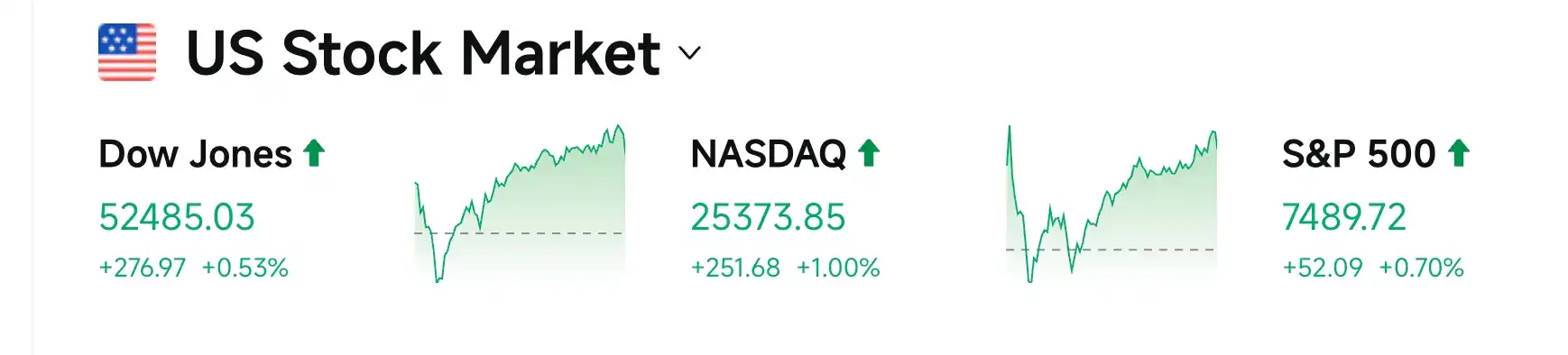
U.S. stocks staged a V-shaped reversal last Friday, with all three major indexes closing higher. The Dow Jones Industrial Average rose 0.53%, the S&P 500 gained 0.70%, and the Nasdaq Composite added 1.00%. Even so, the bounce did not erase what was still a poor month: the S&P 500 was roughly flat in July, its weakest July showing since 2014, while the Nasdaq fell 3.2% for the month, its worst July since 2004.

Oil opens sharply lower after Trump cancels planned Iran strike
The weekend brought an abrupt turn in geopolitics. Trump said he had canceled a planned new military strike on Iran after requests from Saudi Arabia, the United Arab Emirates and Qatar. He also said there was already a framework for a Strait of Hormuz agreement and that denuclearization talks would begin on Tuesday.
WTI crude fell more than 8% at Monday’s open and briefly slipped below $78 a barrel. Brent crude dropped more than 6% as well. The move followed a July surge of more than 20% in oil prices, driven earlier by Strait of Hormuz risk, Houthi attacks and damage to Russian refineries, a gain the report described as the biggest July increase in 30 years.
Supply also shifted. OPEC+ said it would raise its September oil production quota by 188,000 barrels per day. Saudi Arabia, Russia, Iraq, Kuwait, Kazakhstan, Algeria and Oman agreed to adjust production and repeated their commitment to market stability. The group’s next meeting is scheduled for Sept. 6.
The report said traders broadly see a familiar Trump pattern of threats followed by delays. Their focus now is whether shipping through the strait and the denuclearization details are actually implemented.
Gold edges higher in July, stays near $4,050
Gold rose 0.91% in July. According to the report, prices have fallen about 30% from their January high in 2026 as expectations for tighter policy strengthened amid conflict involving the U.S., Israel and Iran, money flowed into hot technology shares, and some central banks reduced holdings. Gold is now trading around $4,050 an ounce.

Short term, analysts said the metal is still being held back by the U.S. dollar index and real yields. As expectations around Federal Reserve tightening are absorbed and central-bank buying offers support, they see a period of base-building. GoldPredict technical analyst AG Thorson said gold is still in that process: a drop below $4,000 an ounce could send it looking for fresh support, while holding above that level would be treated as a shakeout within a bull market.
Over a longer horizon, the report said the themes of weaker confidence in the dollar and strategic central-bank accumulation of gold remain intact. It described the current pullback as a potentially attractive medium- to long-term allocation window and put this year’s trading range at $3,800 to $4,500 an ounce.
U.S. and Japan confirm FX intervention as long Treasuries stay elevated
Trump and U.S. Treasury Secretary Bessent both confirmed that the United States took part in last week’s foreign-exchange intervention to support the yen and said Washington would continue to work jointly with Japan if needed. USD/JPY fell quickly in early Monday trading and dropped below 156 for the first time since May 6.
The report said the intervention was aimed at preventing a collapse in the yen that could force Japan into large-scale Treasury sales and push up U.S. funding costs. James Thorne, chief market strategist at Wellington Altus, warned that if Japan’s finance ministry had to sell Treasuries to defend the currency, its shift toward being a seller would force a repricing at the long end, given that Japan is the largest foreign holder of U.S. government debt.
Inflation concerns linked to the energy shock pushed Treasury yields higher through July. The 10-year yield ended the month at 4.74%, up more than 30 basis points and marking the largest July increase since 2005. The 30-year yield rose to around 5.281%, the highest since July 2007.

De-leveraging hits chips and memory while cloud stocks pull in fresh money
De-leveraging in technology and memory names ran through July. Goldman Sachs Prime Brokerage data showed the market saw its largest one-way unwinds since November 2022 over the three trading days from the prior Friday through last Tuesday. The pressure was centered on leveraged positions in semiconductors, memory and AI infrastructure that had been built in April and May.
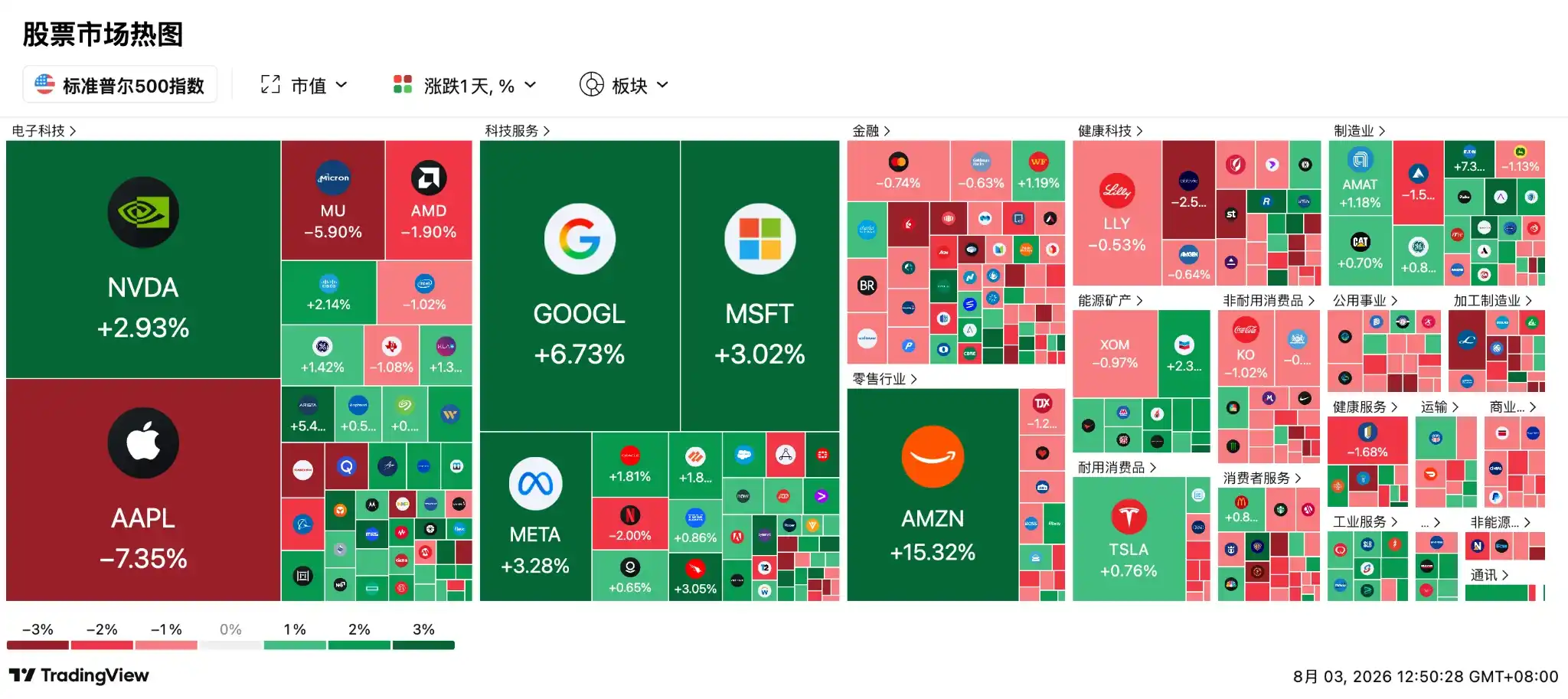
Cloud stocks, though, held up strongly. Big technology names rebounded last Friday as Amazon Web Services results beat expectations and lifted the cloud complex. Microsoft extended its rally, Google recovered post-earnings losses, and Meta snapped an 11-session losing streak. Combined market value added by the major cloud names reached nearly $1.5 trillion last week, including roughly $616.5 billion for Microsoft, about $425.6 billion for Amazon, and nearly $445.0 billion for Google.
Storage names and parts of the semiconductor sector faded after earlier gains, while Apple sold off sharply on supply constraints and a softer outlook. The report’s read is that investors are not abandoning AI. They are rotating within it, pulling money from crowded storage and hardware trades and moving it toward cloud leaders and application-layer companies seen as turning capital spending into cash flow more effectively.
Amazon surges, Apple drops, storage names retreat
Amazon jumped 15.32%, its biggest one-day gain since 2012. AWS revenue grew 36.7% year over year in the second quarter, its fastest pace in 18 quarters. Chief Executive Andy Jassy said AWS is “very likely” on a path toward $1 trillion in annual revenue. The report said earnings eased investor worries that Amazon’s AI capital spending was too heavy and lacking a clear payoff, as AWS growth reaccelerated and profitability beat expectations. In regulatory filings, the company also disclosed that it had completed its full cumulative $50 billion investment commitment to OpenAI.
Microsoft followed its record 15.5% one-day gain on Thursday with another 3.02% rise on Friday. The report pointed to disciplined capital spending, solid free cash flow, and early signs of monetization in Azure and Copilot as reasons some of the market’s concern over unchecked AI spending has faded.
Google rose 6.88%, fully recovering its post-earnings decline. DeepMind unveiled Gemini Robotics 2, a new robotics AI model that the report said achieved full-body control for humanoid robots for the first time. Meta gained 3.28% and ended an 11-day losing streak. After stronger-than-expected cloud earnings, money returned to AI platform names, and Meta drew buying interest because of its large-model exposure, ad AI and compute investment, though the report said the central question around Meta remains the timing of capital spending versus returns.
Apple fell 7.35%, wiping out more than $358.0 billion in market value in a single session, its largest one-day drop since April 2025, and surrendered the title of the world’s most valuable listed company to Nvidia. CFO Parekh said on the earnings call that memory shortages and component supply limits would weigh on fourth-quarter iPhone, Mac and iPad sales. Apple guided for fourth-quarter revenue growth of 9% to 11%, below the market’s 12.1% expectation.
Storage stocks pulled back together. Micron fell 5.9% and lost 28.7% in July, though it was still up more than 180% for the year. Sandisk dropped 5.09% and was down 46.57% for the month. U.S.-listed shares of SK Hynix fell 3.54% and were down more than 7% for the week. Kioxia’s weaker-than-expected results sent its ADR down 10.1%, adding pressure across the group. Western Digital rose 2.21% against the trend, while Seagate edged up 0.52%.
Optical communications names moved higher, with Coherent and Applied Optoelectronics both up more than 5%, and Astera Labs up more than 3%. Palantir rose 0.65% on Friday, while implied volatility climbed ahead of results due after the market close. The report said Palantir’s earnings would directly test the idea of AI moving from compute demand into software revenue.
SpaceX fell 3.41%, and Elon Musk’s net worth was down more than $600.0 billion from its June peak, according to the report. Investors are waiting for the company’s first earnings report since listing, due after the close on Aug. 5 Beijing time. Focus is on Starlink revenue and Starship commercialization. Another key date is Aug. 6, when as many as 911.5 million locked-up shares are set to become eligible for sale. At the latest share price of $108.37, the implied value is close to $100 billion.
Among other large-cap names, Nvidia rose 2.93% and drew public praise from Trump. Tesla gained 0.78% after Musk called reports on X that the company might carve out its China business to pave the way for a merger with SpaceX “fake news.” Intel fell 1.02%, was down 2.3% for the week, and posted a sixth straight weekly decline. The market is also watching whether TSMC’s work on advanced AI chip packaging technology raises competitive pressure on Intel’s packaging roadmap.
What markets are watching this week
Monday, Aug. 3
Berkshire Hathaway reports earnings. Investors will watch Warren Buffett’s cash position, share repurchases, insurance underwriting profit, rail and energy operations, and whether the company continues to trim or add to core holdings such as Apple, Bank of America and Occidental Petroleum.
Tuesday, Aug. 4
Ai4 2026 and the FMS flash memory summit run from Aug. 4 to Aug. 6 in North America, with Nvidia, Google, Microsoft, Meta and Samsung among the companies expected to attend. Hinton, Fei-Fei Li and Andrew Ng are set to appear together for the first time, and Samsung is expected to present its HBM4E roadmap.
Earnings due that day include Palantir, ON Semiconductor, Snap, Luckin Coffee, McDonald’s, Caterpillar, Pfizer, Merck, Spotify, Hut 8, Cipher Mining, HSBC Holdings and Techtronic Industries.
Wednesday, Aug. 5
At 04:30 Beijing time, SpaceX is due to release its first earnings report since going public. The market will focus on Starlink revenue, Starship commercialization, free cash flow and the pace of capital expenditure. The report said that with a large lockup expiration coming two days later, weak guidance could leave the stock facing both liquidity and valuation pressure, while strong Starlink revenue and commercial launch guidance could ease selling pressure ahead of the unlock.
At 05:00 Beijing time, AMD, Astera Labs and Arista Networks are due to report. AMD’s results will be watched for MI-series AI chip shipments, data center revenue, gross margin and second-half guidance. Astera Labs is seen as an important name in AI server interconnect and data-center connectivity chips, while Arista is treated as a gauge for AI network switching and cloud data-center capital spending.
Circle, Eli Lilly, Novo Nordisk, Disney, Sandisk, Western Digital, Applovin, IonQ and BeiGene are also scheduled to report.
Thursday, Aug. 6
SpaceX faces its lockup expiration, with as many as 911.5 million shares becoming tradable. Based on the latest share price, the potential value is close to $100 billion, making it the week’s biggest liquidity test. The report said limited selling after the unlock would support confidence in the market’s ability to absorb richly valued technology assets, while concentrated selling could weigh on the Nasdaq and on sentiment around Musk-linked assets.
At 05:00 Beijing time, Sandisk and Western Digital are due to report after the close. Their results are expected to directly shape sentiment in storage stocks, with investors focused on enterprise SSDs, NAND pricing, AI data-center storage demand, the inventory cycle and guidance for the second half.
Other names reporting that day include crypto miners CleanSpark and MARA, as well as Datadog, D-Wave Quantum, ConocoPhillips, Unity, AAOI, MP Materials, Atlassian, Rigetti, MGM China and Zai Lab.
Friday, Aug. 7
At 20:30 Beijing time, the U.S. will release July nonfarm payrolls and the unemployment rate. The report describes this as the week’s most important macro event. The market expects payroll growth of about 90,000, up from 57,000 in June, while the unemployment rate is expected to rise to 4.3% from 4.2%. If payrolls come in above 100,000, the report said markets may keep pricing in a September rate hike, lifting Treasury yields and the dollar while pressuring technology shares. A second straight downside miss, on the other hand, could cool rate-hike trades and support growth stocks, gold and long-duration bonds.
China will also release July trade data and foreign-exchange reserves that day. Export numbers will be watched for external-demand resilience, import data for domestic demand and commodity appetite, and reserve data for their effect on yuan expectations and cross-border capital sentiment.
Earnings due include Cambricon, China Rare Earth, Oklo, Vistra Energy, Under Armour and Leon Microelectronics.
Sunday, Aug. 9
China’s July CPI and PPI data are due. The market will use them to assess the path of price recovery after the Politburo meeting and to judge the pace of stabilization in domestic demand and industrial goods prices.