
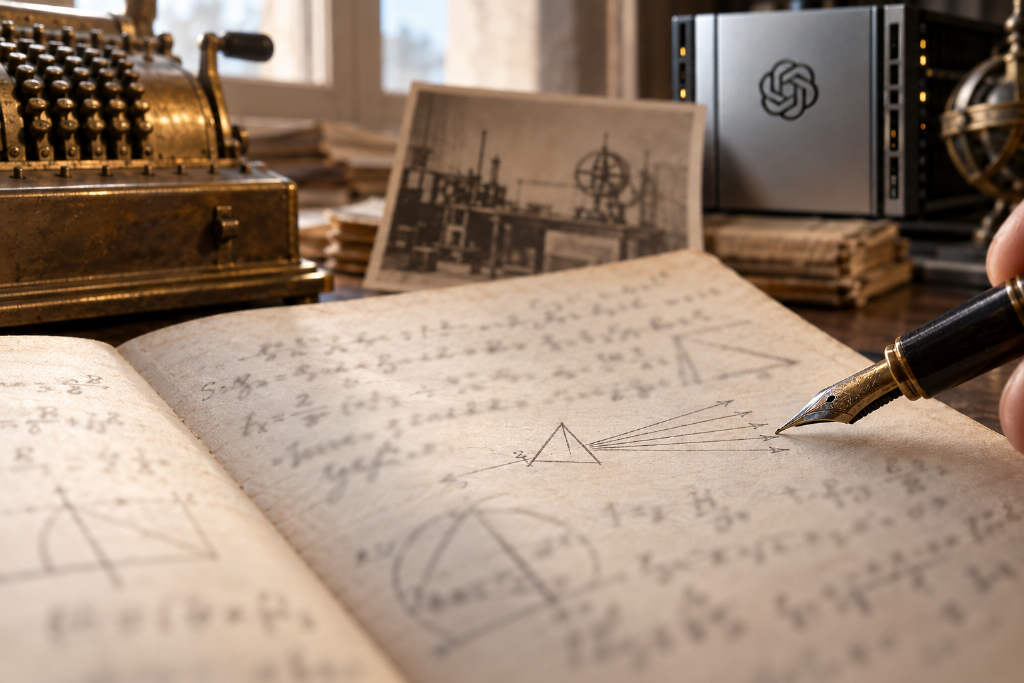
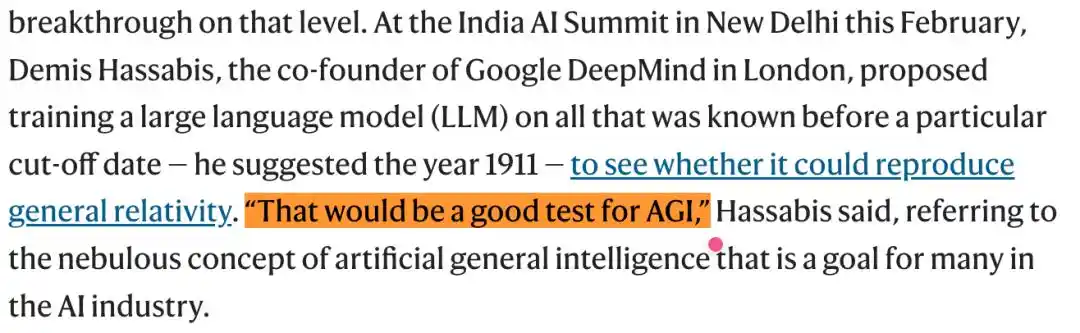
If an AI system were sent back to 1911 and allowed to know only what Albert Einstein could have known at the time, could it arrive at relativity by 1915 on its own? That question, highlighted by Nobel laureate and Google DeepMind co-founder Demis Hassabis, sits at the center of a proposed way to test whether AI can do more than repeat answers already embedded in its training data.

The point is not simple recall. Hassabis' challenge is whether a model, constrained to the scientific knowledge of a given historical moment, can confront the open problems of that era, build a new explanatory framework, and reason beyond the material it has seen. If it can, he argues, that would be a strong test for artificial general intelligence.
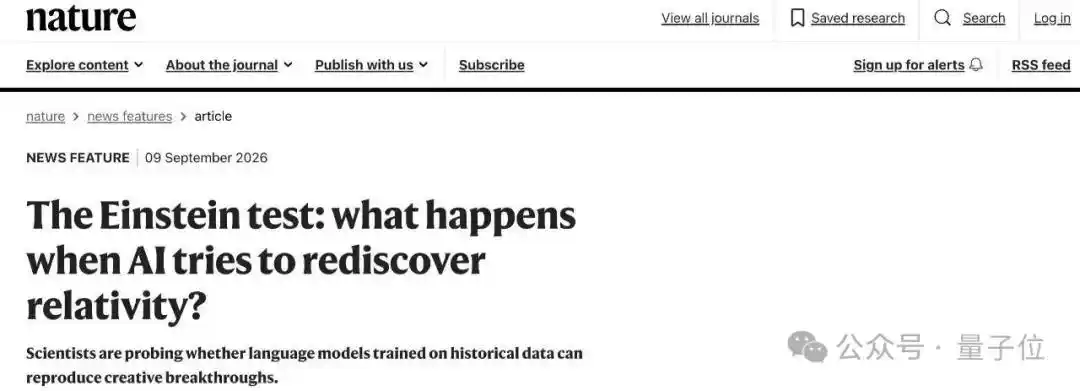
Nature described this family of experiments as an "Einstein test." The appeal is obvious: the history of science already tells us what happened, so if researchers can control the knowledge boundary tightly enough, they can compare a model's output with the historical record and ask whether it is showing reasoning that goes beyond memorization.
GPT-1900 and the attempt to build a pre-20th-century scientific mind
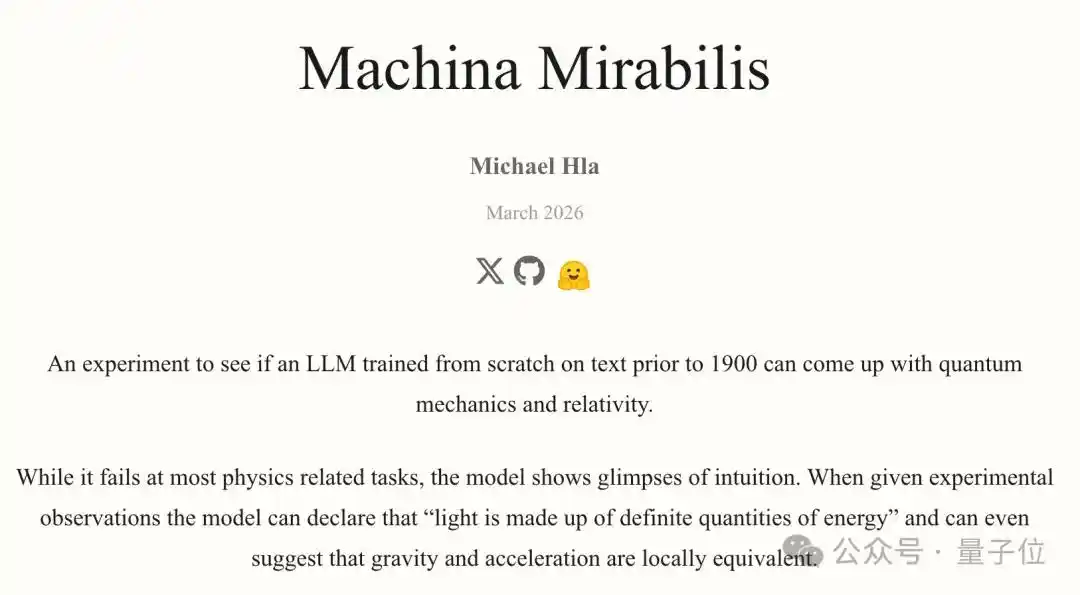
In March this year, independent researcher Michael Hla pushed the idea even further back. He set the knowledge cutoff at 1900 and trained a historical language model from scratch, GPT-1900, in an effort to see whether it could rediscover the light quantum, special relativity, and general relativity.
Hla named the project Machina Mirabilis, borrowing from Einstein's "miracle year." In 1905, at age 26, Einstein published four papers that reshaped physics, covering the light quantum, Brownian motion, special relativity, and mass-energy equivalence. That burst of work later became known as Annus Mirabilis. Hla's question was whether an AI system limited to the knowledge Einstein could access might have its own version of that moment.
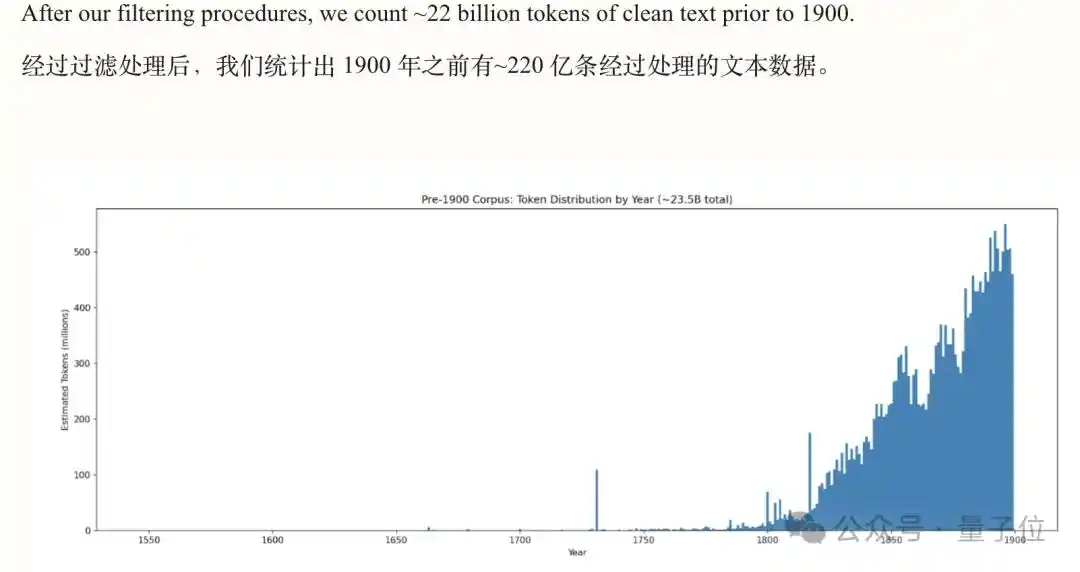
To build the model, Hla used Andrej Karpathy's nanochat training framework and trained a 3.3 billion-parameter Transformer language model from scratch. Its main pretraining material came from books and newspapers published before 1900, totaling about 22 billion tokens.
He then added a historical physics corpus of roughly 290 million tokens drawn from more than 2,600 books, journals, and scientific works, including Newton's Opticks and writings associated with James Clerk Maxwell and Michael Faraday.
Hla also tried to remove material that might leak later answers into the system. If a document contained terms such as "Einstein," "quantum mechanics," or "relativity," the entire document was removed. Modern forewords, footnotes, and vocabulary that clearly did not belong to the pre-1900 period were filtered out as well. In theory, that produced a model that did not know 20th-century physics.
A suggestive answer on light quanta, but not a rediscovery
Hla then tested GPT-1900 with a question built around the photoelectric effect: why does light fail to eject electrons when its frequency is too low, no matter how bright it is, while higher frequency gives the emitted electrons more energy?
He supplied several key clues. Below a certain frequency threshold, more brightness does not help. Above that threshold, increasing brightness mainly raises the number of emitted electrons, while increasing frequency raises their kinetic energy. He also laid out the classical assumptions of the time so the model could compare them against the observed contradictions.
Historically, Einstein resolved that tension with the light-quantum explanation: light transfers energy in discrete packets, and the energy of each packet depends on frequency. Hla wanted to see how far GPT-1900 could get.
In one response, the model produced a passage that closely resembled the logic of Einstein's 1905 paper, saying in effect that light might not be continuous but instead made up of separate parts with different frequencies. Hla described that moment as an intuitive flash.
That did not amount to an AI Einstein. Hla said plainly that GPT-1900 remained far from rediscovering the light quantum. It failed on most physics tasks, and the answers that looked impressive may have been little more than plausible word assembly rather than reliable physical understanding.
There was another limitation. In the test itself, the researcher had already selected the phenomenon, organized the contradictions, and framed the problem. The model's job was to identify which assumption might be wrong and offer an explanation. That is much easier than the work scientists actually do when they decide what problem matters in the first place. Einstein, as the article notes, did not have someone else highlighting the key points for him.
The historical sandbox was not fully sealed
The experiment also ran into a deeper methodological problem: the "1900" environment was not completely closed.
Although Hla cleaned the training data, the broader workflow still used modern AI systems. Claude Sonnet 4 and Claude 3 Haiku were used to generate instruction-answer data, and reinforcement learning relied on scoring from modern models.
That means the room was never entirely sealed off from later knowledge, even if modern content was filtered where possible. The project log itself acknowledged that the involvement of modern models made the idea of a zero-contamination setup hard to defend.

That creates a basic hurdle for this kind of research. Before asking whether AI is creative, researchers first have to show that it did not see the answer. If even a small amount of later information slips into the training process, a claimed rediscovery could turn into a hidden recall event.
Nature's broader question is therefore tougher than whether the model got the answer right. It asks whether AI can generate genuinely new ideas at all, and what still separates it from being a scientist.
Producing a theory is not the same as doing science
Google DeepMind researcher Tom Zahavy, in a position paper titled LLMs Can't Jump, divides scientific reasoning into three levels: induction, deduction, and abduction.
Induction extracts patterns from many examples. Deduction derives necessary conclusions from existing premises. Abduction is different: it invents a previously unavailable cause or explanation for an anomaly. Zahavy argues that current large language models are already strong at induction and are improving quickly at deduction, but they still lack the kind of abductive leap associated with Einstein. A model can continue along a prepared chain of logic; starting from scratch and proposing a new explanatory framework is another matter.
A similar pattern appears in other work cited by the article. Sendhil Mullainathan, studying a foundation model trained on planetary orbits, found that the model performed well on the specific orbital task it was given. Once the setting changed, however, it could not generalize Newtonian mechanics to the new case. In that account, the model looked less like a system that understood the theory and more like one that assembled temporary rules for each dataset without knowing which theories were actually correct or worth testing.
MIT computer scientist Jacob Andreas made a related point. Generating something that sounds like a relativity-style theory may not be the hardest part. The harder question is whether the system can judge which theories are correct, or at least worth experimental scrutiny.
That distinction matters because producing a theory is only the first step. Knowing which idea deserves time, funding, and a career's worth of effort is much closer to what scientists actually do. Andreas also stressed that deciding whether an idea is worth pursuing, and how important it is, marks a major divide between AI systems and human experts. Real scientific work is not the solution of a neatly prepared exercise. It is judgment under uncertainty.
Nature's conclusion goes beyond whether the model answered correctly
GPT-1900 did produce a response that brushed against the logic of the light quantum, and that gives the "Einstein test" a concrete case study. At the same time, the experiment exposed several hard limits: historical knowledge boundaries are difficult to seal completely, prompt design can shape the result in major ways, and a model that states something close to the right answer may still lack stable, testable scientific understanding.
So even if a future system were to pass an "Einstein test," the larger issue would remain. Before anyone can say AI has become Einstein, it would still need to show that, without someone else selecting the puzzle, it can identify a worthwhile question, judge its value, and then test and revise its own ideas.
Without that, the system would still look closer to a machine that restates knowledge than to a scientist in its own right.
References
- Nature: https://www.nature.com/articles/d41586-026-02804-x?utm_source=x&utm_medium=social&utm_campaign=nature&linkId=63673104
- Michael Hla blog: https://michaelhla.com/blog/machina-mirabilis.html
- Project log: https://github.com/michaelhla/gpt1900/blob/master/PROJECT_LOG.md#4-instruction-data-generation
- Tom Zahavy paper: https://www.tomzahavy.com/files/llms-cant-jump.pdf
- Related paper: https://arxiv.org/abs/2507.06952
- Nature post on X: https://x.com/Nature/status/2099077628900565498
The MarsBit article says the piece was sourced from the WeChat public account "QbitAI" and written by Wenting.