
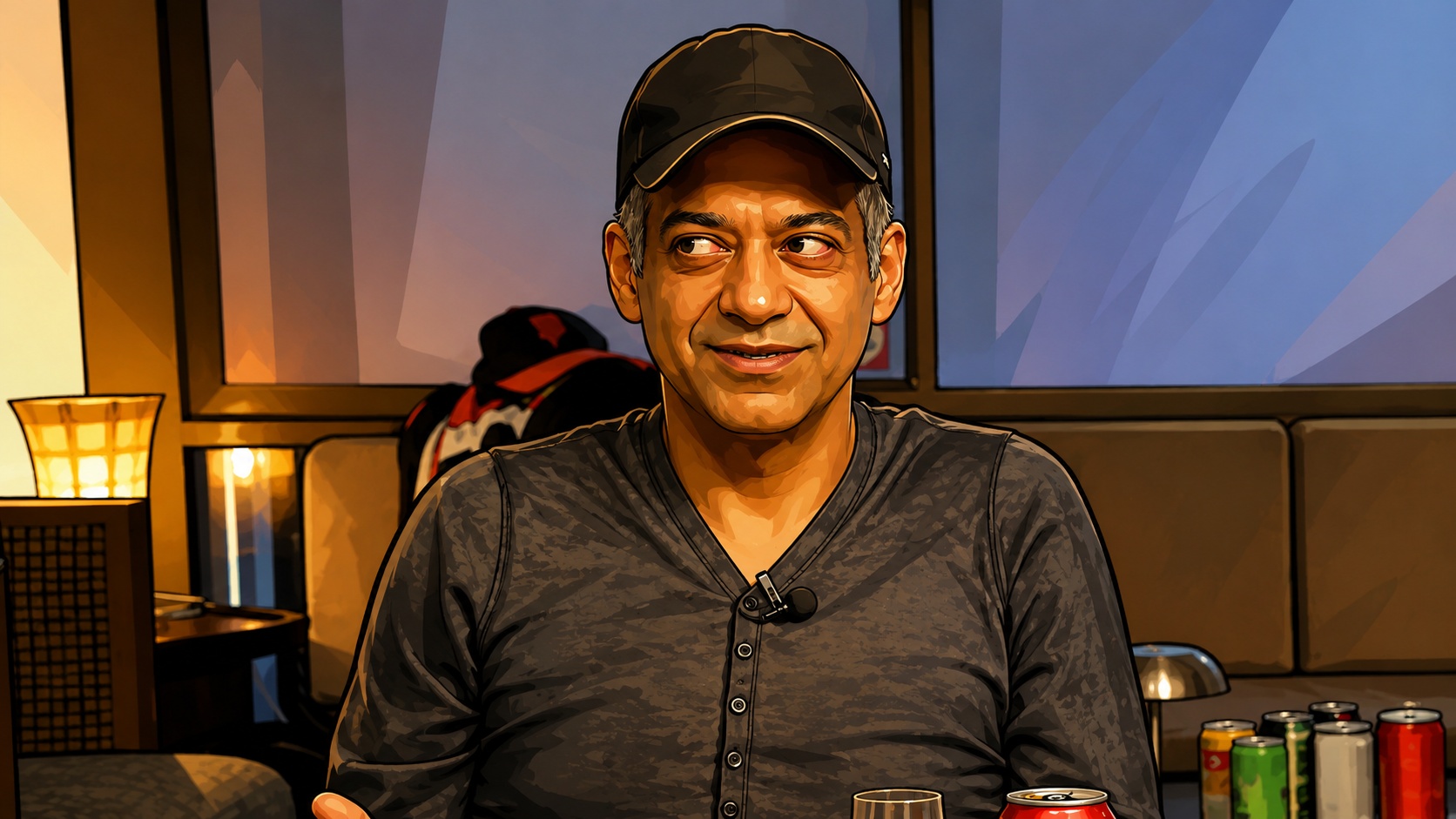
Two Silicon Valley podcasts put Taiwan at the center of discussion within days of each other, and while the prescriptions were far apart, the core view was the same: the current status quo across the Taiwan Strait is unlikely to hold indefinitely. In an episode of the Naval Ravikant podcast released on July 2, Naval Ravikant said the US cannot defend Taiwan and predicted that Taiwan would be gradually unified with China over the next 10 to 20 years. In episode 35 of Uncapped, released on June 30, Anduril co-founder Trae Stephens gave a different read on the path but not the risk, saying the probability of a blockade or major change in Taiwan’s situation within the next decade is above 90%.
Naval’s case: the US cannot hold Taiwan militarily
In the July 2 episode, Ravikant spoke with Y Combinator CEO Garry Tan, Abel founder Daniel Francis, and A-LIST founder Farbood Nivi. At 54:05, the conversation turned to the defense of Taiwan. The source article stressed that what followed was Ravikant’s personal view and was not backed by cited studies or data.
Ravikant said the Taiwanese people he knows do not want war. He also claimed that some wealthy families avoid conscription by having their children spend enough time overseas each year. He described what he saw as a broader expectation in Taiwan: a “Hong Kong model,” where economic interests come first and political assimilation happens one or two generations later. The article made clear that these remarks reflected his own impressions from his personal circles.
His military argument was blunt. Ravikant said US aircraft carriers are effectively useless against China’s land-based missile systems, and he estimated that at a level of expenditure comparable to the recent US clash with Iran, American missile inventories could be exhausted in seven days. He also said firms such as Anduril and Saronic are rebuilding parts of the US industrial base, but not fast enough to change the near-term picture.
From there, Ravikant concluded that there is no compelling reason for the US and China to fight a war over Taiwan. His forecast was that Taiwan would be absorbed by China over 10 to 20 years through a face-saving process on all sides.
Trae Stephens puts the odds of change above 90%
The second discussion came from Jack Altman’s Uncapped podcast, where the guests included Anduril co-founder and executive chairman Trae Stephens, Varda co-founder Delian Asparouhov, and Benchmark’s Everett Randle. The setting was closer to a conversation inside the defense-tech and venture capital network than a free-form roundtable.
Asked how likely it is that Taiwan faces a blockade or a major change in the next decade, Stephens answered: more than 90%. He outlined three scenarios. One was gradual “Hong Kong-ization,” in which Taiwan keeps trading and then is assimilated over time. Another was a US concession to China in exchange for access to critical supply chains. The third was a full-scale invasion that would force Washington into a difficult decision.
Stephens said Anduril’s work is aimed at making deterrence credible against that invasion scenario. The cost is already visible. According to the source, on December 26, 2025, China sanctioned 20 US defense companies and 10 senior executives over more than $10 billion in US arms sales to Taiwan. Anduril and founder Palmer Luckey were both included. Luckey later said publicly that it was “an award” he was very proud to receive.
The article also said Anduril operates with an internal “China 2027” framework. Under that view, Palmer Luckey believes China could move to blockade or invade Taiwan as early as 2027, and that assumption shapes the company’s investment and R&D priorities.
Anduril’s $61 billion valuation and the wager on deterrence
Founded in 2017 by Palmer Luckey, Trae Stephens, and others, Anduril has become one of the fastest-rising names in US defense technology. The article said that on May 13, 2026, the company closed a $5 billion Series H round, doubling its valuation to $61 billion, with Thrive Capital and a16z leading the deal. As the company’s valuation rose, so did the weight attached to Stephens’ views on Taiwan and defense manufacturing.
Still, Stephens spent much of the discussion on semiconductors rather than military timelines alone. He argued that the US gave up chip manufacturing decades ago and now most capital flows into design, which he called the relatively easy half of the business. Without rebuilding manufacturing, many strategic assumptions tied to Taiwan become much harder to sustain.
His estimate was stark: even by 2030, the US may still lack large-scale advanced-process fabs. To build one from scratch would require a founder on the level of Elon Musk, tens of billions of dollars, and active US government support to move to the front of the queue for ASML lithography equipment. Miss one of those conditions, and the effort stalls.
Different prescriptions, same countdown
The article also referred to Trump’s Beijing visit on May 14 to 15, where Xi Jinping reportedly called Taiwan the “most important issue” between China and the US and warned that mishandling it could lead to conflict or confrontation. Trump said he wanted to preserve the status quo and said the subject had occupied the talks for the whole night.
Stephens argued those statements should be taken seriously. As presented in the source, he contrasted Western political thinking, often shaped by election cycles, with authoritarian systems where leaders tie personal credibility to commitments they make. That leaves a sharp split in method, not in diagnosis. One side says the US should accept the limits of what it can do. The other is spending heavily to make deterrence real. Both are pricing in the same possibility: the countdown on the Taiwan status quo has already started.