
“When NAVI reached $1 billion in TVL in September 2025, our largest single depositor had already supplied more than $30 million.”
Elliscope, founder of NAVI, used that moment in an X Space held before the release of NAVI Prime to describe what changed as the protocol grew. For a lending protocol, $30 million is not just a larger balance. It changes the questions being asked. Smaller users may start with APY. Once allocations move into the tens of millions, the conversation tends to begin with risk limits, asset exposure and who is actually in charge.
Elliscope said the team began asking itself a harder question at that stage: if NAVI wanted to grow to $5 billion, $10 billion, or even $100 billion, large capital providers would first ask who manages the risk and where their money is being deployed.
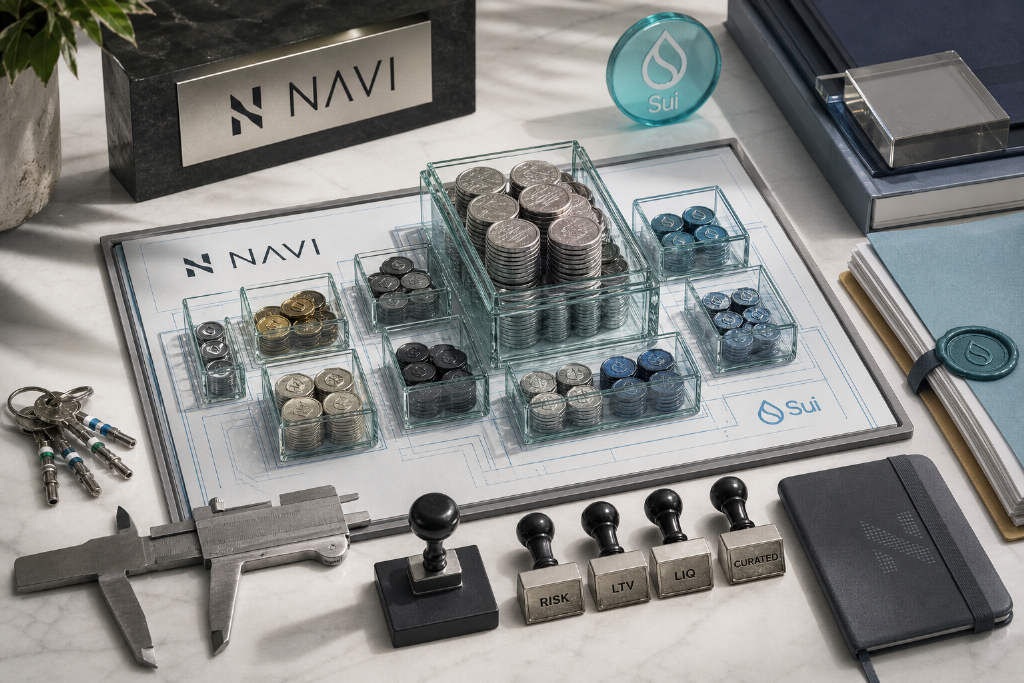
That is the problem NAVI says it is trying to address with NAVI Prime, which launched in August 2026 and is described by the project as Sui’s first modular capital market to introduce professional curators. Instead of using the shared liquidity pool structure NAVI has operated for the past three years, NAVI Prime breaks lending relationships into separate isolated markets, with curators responsible for asset due diligence, parameter design and capital allocation.
This is not being pitched as a simple expansion of yield pools. The point is more specific: as DeFi capital stops looking only at yield, a protocol needs to show users where returns come from, what risks they are taking and who is managing those risks.
After three years and a $1 billion TVL peak, NAVI is focusing on durability
NAVI is no longer an early-stage name in the Sui ecosystem. According to data provided by the project, it has processed about $30 billion in cumulative borrowing volume and about $10 billion in deposits since launching in 2023, while serving more than 1 million users. Its TVL peak topped $1 billion, representing more than 40% of Sui’s total network TVL at one point, and the protocol has run for more than 1,000 consecutive days.
Over the same three-year period, NAVI says it distributed more than $60 million in incentives and generated nearly $30 million in protocol revenue. The article notes that the two figures are not measured on the same basis and should not be read as a direct input-output comparison, but together they show NAVI’s scale in Sui’s early DeFi market.
While some contemporaries shut down, merged or were consolidated, NAVI remained one of Sui’s core lending markets. The system is supported by a team of about 20 people headquartered in Palo Alto, with members based in San Francisco and New York. Core team members came from LinkedIn, Apple, Bank of America and Sui ecosystem development teams. In 2023, NAVI raised a joint investment from Hashed, OKX Ventures and Dao5.
As NAVI Prime launched, Ryan Kim, founder of Hashed, which the article described as NAVI’s earliest investor and South Korea’s largest crypto investment firm, framed the protocol’s path as long-term building through market cycles.
“DeFi has seen dramatic volatility since 2020, but NAVI’s lending protocol has built a moat around Sui. Supporting long-term builders like Elliscope and the NAVI team who can work through market cycles is a core value at Hashed. We’re pleased to see them seize this opportunity and expand their institutional business footprint,” Ryan Kim said.
The numbers and endorsements show NAVI can attract liquidity. NAVI Prime now has to prove something different: not only that it can bring capital in, but that it can make capital understand why it should stay.
Why the shared pool model starts to break down at larger scale
Shared liquidity pools were one of the key pieces of early DeFi lending infrastructure. Users deposited assets into a protocol, and different borrowing demands drew from the same pool, improving capital efficiency.
That made sense for Sui in 2023, when the ecosystem was still young and asset variety was limited. Concentrating liquidity was more efficient than building a dedicated market for every asset.
But shared liquidity also puts many assets and borrowing relationships inside one system. Even if different assets carry different parameters, risk can still travel through shared liquidity and liquidation links. For ordinary users, that often gets compressed into a single APY figure. For larger allocators, “is the protocol safe?” is too broad to be useful.
Elliscope drew the line clearly in a recent X Space: “If I ask someone to try the product with $100,000, their first question is usually yield. But if I ask an institution to deploy $10 million or $30 million, its first question will definitely be risk management: how the platform manages risk, who else is involved, and how responsibilities are divided.”
Shaan Varia, head of onchain finance at Mysten Labs, offered a similar view in an interview. Before joining Mysten Labs, he spent five years leading product at DeFi risk management firm Gauntlet. The article says that at Gauntlet, risk management was not about labeling a protocol “safe” or “dangerous.” It meant putting onchain market data, borrower positions, asset liquidity and smart contract mechanics into simulation environments, then repeatedly stress testing parameters such as LTV, liquidation thresholds, asset caps and interest rates.
As described in Shaan’s earlier methodology writing at Gauntlet, those systems ran thousands of simulations every day to seek better parameter combinations between solvency risk and capital efficiency. The article also notes that Gauntlet’s framework has long been used in risk management for major lending protocols including Aave and Compound.
“For institutions, the core issue is risk management. When they enter the onchain world, they are usually looking for two things: broader markets that their existing capital base cannot reach, and new structured products with specific risk, return and liquidity characteristics,” Shaan said.
So when he broke down economic risk, oracle risk, smart contract risk, liquidity risk and solvency risk layer by layer in the X Space, the issue was not simply whether Sui could attract institutions. It was whether the chain had developed enough for institutions to choose assets under their own risk policies, control exposures and keep monitoring allocations over time.
That is the opening NAVI Prime is targeting. Instead of asking all capital to accept one blended risk bucket, it lets capital choose the portion of risk it is willing to take.
NAVI Prime is not just splitting pools. It is redistributing responsibility.
The structure of NAVI Prime can be reduced to three ideas: isolated markets, professional curation and modularity.
Isolated markets mean different collateral types and lending relationships sit in relatively independent markets. Each market has its own interest-rate model, collateral ratio, liquidation parameters and risk boundary. If one collateral type runs into trouble, the initial impact is meant to stay inside that market rather than spreading automatically across all liquidity.
Professional curation means markets are no longer managed entirely under one uniform protocol layer. Curators study assets, perform due diligence, set risk guardrails, choose configurable markets and keep monitoring utilization and changing risk conditions.
Modularity means those markets and curation strategies can be integrated into vaults, structured products or other DeFi protocols without rebuilding a lending stack from scratch.
Within that setup, the roles of three participant groups are more clearly separated:
- Liquidity providers choose a specific market or curation strategy, deposit stablecoins or other assets and receive lending yield;
- Curators handle asset due diligence, risk parameters, capital allocation and ongoing monitoring;
- NAVI provides the isolated markets, permission system and underlying lending infrastructure.
For users, the change is straightforward. A deposit decision is no longer only “should I enter NAVI?” It becomes “which market should I enter, which collateral risk am I willing to accept and which curator am I choosing?”
In other words, users are no longer passively inheriting a packaged blend of risk from one shared pool. They can choose their own risk profile more directly.
For capital providers, explainable yield matters more than the highest number on screen
NAVI Prime does not claim every market is safer, and it does not mean every isolated market will offer higher yield. The change addresses something else: different risks no longer have to be priced loosely under one generic parameter set.
NAVI co-founder Charles used SUI and vSUI in an X Space example. Imagine two markets. In one, users borrow USDC against SUI collateral. In the other, users borrow vSUI against SUI collateral to run leveraged liquid staking strategies. The first setup involves price movement between a volatile asset and a stablecoin. In the second, the two assets are highly correlated. The required collateral ratios and liquidation parameters should not be the same.
In a shared pool, the protocol has to balance many lending relationships at once. In isolated markets, the two strategies can each use parameters that better match their own risk profile. Based on Charles’s example, the LTV for borrowing USDC against SUI is around 70% to 80%, while in the highly correlated SUI-vSUI market, LTV can be supported at around 92% to 95%.
“The shared pool has tried all kinds of mechanisms to reconcile these differences, but isolated markets offer a clearer solution. NAVI Prime can create two separate markets, each with parameters tailored to its specific use case,” Charles said.
A higher LTV is not automatically safer, and it does not automatically produce higher returns. The real point is that once different lending relationships are separated, capital can be allocated more precisely based on asset correlation and liquidation risk.
For capital providers, the key shift is not the appearance of more yield figures on the page. It is the ability to answer four questions before entering:
- Which market will my funds enter?
- What collateral are borrowers using?
- What market and liquidity risks are attached to the current yield?
- Who sets the parameters, monitors the market and adjusts the allocation?
When yield can be explained, users can judge more easily whether it fits them. When risk can be selected, large allocations are more likely to move from trial deployment to long-term positioning.
A three-layer security framework built around visibility and control
In DeFi, security cannot be established by a promise alone. Smart contracts, oracles, liquidity, collateral prices and administrative permissions can all become sources of risk.
Charles described NAVI Prime’s risk framework as three layers.
The first is smart contract security. According to the project, the underlying isolated-market contracts in NAVI Prime are built on NAVI’s lending infrastructure, which has been running since 2023 and has gone through audits by five audit firms across more than 10 audit engagements. The curator layer completed two additional audits.
The second is collateral risk isolation. If a market accepts only specific collateral, capital providers can see more clearly whether they are taking BTC, SUI, stablecoin or other asset risk. If one collateral type behaves abnormally, the isolated design is intended to limit the range of impact.
The third is curator accountability and separation of permissions. NAVI Prime splits roles such as administrator, curator and allocator. Curators can update markets and parameters within the scope of their authorization. Allocators can move funds only across pre-approved markets. Time-lock mechanisms add extra delay for critical changes.
“These three layers are designed together to make NAVI Prime as safe as possible,” Charles said.
Still, “as safe as possible” does not mean zero risk. A more accurate description is that NAVI Prime is trying to turn a vague security claim into a checklist: whether contracts have been audited, what collateral is accepted, who controls permissions, how parameters change and how far a risk event can spread.
That is part of the product’s pitch to capital. Users are not being asked to trust the platform blindly. They are being shown, as much as possible, what exactly they are trusting.
Curators can turn risk management into a product
Another growth angle for NAVI Prime is not more collateral types, but more specialized managers.
Under the older model, risk firms usually acted as advisers, giving protocols parameter recommendations. In a curated market structure, curators can build markets around the assets and strategies they understand, set risk boundaries, allocate funds and keep managing performance.
That means a curator’s asset research, risk model and capital allocation ability can be packaged into something users can choose directly onchain.
The article gives several examples. A curator focused on stablecoin strategies could build a more conservative market. Teams that understand Bitcoin liquidity, RWA, Sui ecosystem assets or structured strategies could design independent risk-return setups around those categories. In the end, users are not only choosing a basket of assets. They are also choosing the curator’s judgment and management capability.
For potential partners, NAVI Prime is more than a market creation tool. Curators do not need to rebuild lending contracts, liquidation systems or permission frameworks. They can use NAVI’s base infrastructure and connect to its existing users and liquidity entry points.
Elliscope said in the X Space that NAVI wants to work with professional curators who understand specific markets and can manage risk, using revenue sharing to build a more collaborative ecosystem.
“NAVI Prime is more accessible to institutions capable of deploying hundreds of millions of dollars in liquidity because it provides risk isolation and manageable allocation choices. It also welcomes professional curators who understand specific markets and can manage risk. We want to share revenue and attract a broader set of skills and capital into Sui,” Elliscope said.
For NAVI, that means it will no longer decide every market on its own. For curators, professional skill can become product, brand and revenue. For users, it creates a menu of managers and risk-return profiles to choose from.
Why Sui matters in this design
NAVI’s relationship with Sui goes back to 2023, when the ecosystem was still building basic infrastructure and had to start from zero in bridging, liquidity and lending markets.
Over the past three years, Sui supported early DeFi projects with incentives, technical help and ecosystem resources. NAVI, for its part, at one point accounted for more than 40% of Sui’s total TVL. The relationship is now moving from early ecosystem construction to handling larger and more complex forms of capital demand.
From Mysten Labs’ perspective, Shaan described NAVI Prime as infrastructure capable of carrying structured products: “NAVI Prime allows teams to use Sui’s performance and scalability, along with the latest innovation in DeFi market design, to reach institutions. Users get more choice, institutions get more precise control over allocations, and more capital can enter the Sui ecosystem.”
The article says this is not just a forward-looking statement. Over the past year, Sui has been bringing in several institution-linked onchain assets and financial products. Figure deployed SEC-registered yield-bearing security YLDS on Sui. Matrixdock brought redeemable tokenized gold XAUm into the ecosystem. R25 launched rcUSD and yield-bearing rcUSDp backed by real-world financial assets. On Aug. 18, 2026, Securitize and Neuberger launched tokenized high-yield fixed-income fund HINC on Sui. At the same time, Hashi has been trying to bring native Bitcoin into onchain credit and has explicitly opened the related financial services to both institutional and retail participants.
Beyond assets, Sui has also been adding infrastructure for regulated markets. On Aug. 25, tZERO said it would expand digital securities infrastructure covering issuance, custody, transfer agency, trading and settlement to Sui. The article argues that this means Sui’s institutional push is no longer only about adding one more tokenized asset. It is beginning to cover the full lifecycle from issuance and holding to trading and settlement.
Even so, tokenized assets and infrastructure are only the first step. Putting an asset onchain does not mean a full onchain financial market already exists. The asset still has to be priced, used as collateral, given liquidity, generate borrowing demand and enter leverage, yield and structured products.
That is where lending infrastructure matters: it turns “there is an asset onchain” into “that asset can be used continuously by capital.”
Charles put the connection between RWA and lending in direct terms: “Once onchain, RWAs can also be used for lending, leverage strategies, short positions and other structured products. That opens significant room for product innovation. Lending will be foundational because many of these products need RWA as collateral.”
But institutional assets and retail assets cannot simply be mixed together. Some RWAs come with investor-eligibility requirements, KYC, geographic restrictions and redemption rules. Bitcoin, gold, yield-bearing securities and Sui ecosystem tokens also have very different pricing, liquidity and liquidation characteristics. Isolated markets let each asset have its own access rules, oracle setup, LTV, supply cap and curator, without pushing every user into the same risk bucket.
That is why NAVI Prime’s role on Sui is not to replace retail with institutional capital. It is to provide a structure in which both can coexist:
- Shared pools continue to serve open, standardized and highly liquid retail lending;
- Prime can provide independent risk boundaries for institutions, large allocations, curated strategies and restricted RWAs;
- Curated vaults aimed at ordinary users can package complex market research and allocation into products that are easier to understand while preserving onchain transparency around capital deployment and risk parameters.
Institutions may bring larger pools of assets and funding. Retail users provide broad distribution, liquidity and real use demand. They do not have to enter the same market, but they can sit within the same infrastructure stack.
At the end of a recent X Space discussing DeFi with Mysten’s ecosystem DeFi lead, Elliscope used a building metaphor to describe the role of lending in an ecosystem: “DEX and perpetuals trading volume show how fast the building is growing, but lending determines how tall the DeFi tower can ultimately become.”
Trading activity can move quickly with market sentiment. Lending supports longer-duration capital allocation, leverage and financial product formation. NAVI Prime’s goal is to let that structure grow upward with not only more capital, but also clearer risk architecture, so different types of capital can enter Sui without having to give up their own risk preferences.
The next phase
The launch of NAVI Prime does not mean shared pools are outdated. Shared liquidity still matters for standardized, large-scale and basic lending demand. Curated isolated markets are addressing a different set of needs: differentiated assets, specific risk preferences, institutional allocations, RWAs and specialized strategies.
Three years of $30 billion in borrowing volume, more than 1 million users, a $1 billion TVL peak and more than 40% of Sui network TVL at one point already show that NAVI can attract capital.
The next thing NAVI Prime has to prove is whether that scale can be turned into a two-sided market. On one side, institutional assets, Bitcoin and RWAs need controllable onchain liquidity and borrowing venues. On the other, ordinary users need a way to choose professionally managed risk-return strategies within transparent boundaries without researching every underlying market themselves.
For users, the real attraction is not a slogan about being safe and high-yield. It is the ability to see where funds go, where risk starts and ends, and where returns come from, then choose a market and manager that fit their own risk preference.
For institutions, the issue is not only a higher APY either. It is the ability to retain control over custody, access, collateral, parameters and permissions, then expand a test allocation into long-term capital over time.
For curators, the meaningful opportunity is not a one-off brand partnership. It is whether NAVI’s market infrastructure, user base and liquidity access can turn specialist capability into a product that keeps attracting funds, building an onchain track record and generating revenue.
In that sense, the broader significance of NAVI Prime for Sui is not a clean switch from a retail era to an institutional era. It is an added institutional capital track on top of an existing retail liquidity base. Shared pools and Prime, open markets and restricted markets, ordinary users and professional allocators can exist side by side with different risk boundaries.
That is the step NAVI Prime is trying to take: not only drawing money in, but making it clear why that money stays; not only issuing assets onchain, but bringing them into a financial system where they can be borrowed, allocated and composed.
This article was submitted by a contributor and does not represent the views of BlockBeats.