
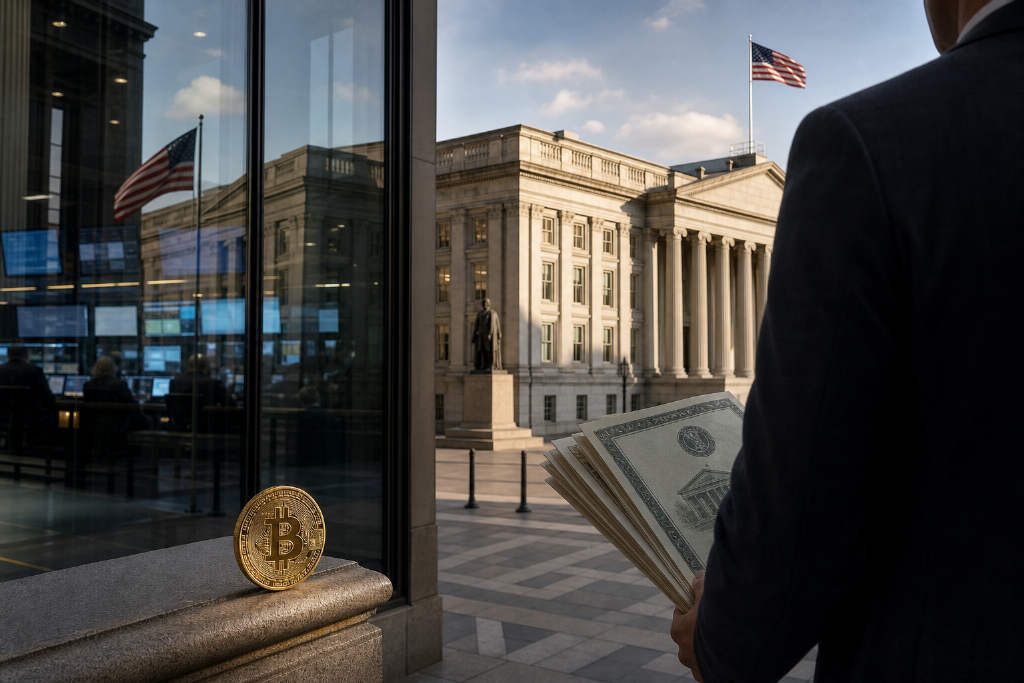
NextGen Digital Venture said in a commentary republished by WuBlockchain that Bitcoin was not lacking reasons to stop falling, but a catalyst to move higher. Less than two weeks later, the market appeared to deliver one, and from a direction the author said few had been betting on.
According to the article, Bitcoin rose 8.7% on Aug. 19, New York time, and traded as high as roughly $69,700 intraday, its first approach to the $70,000 threshold since June. On the same day, about $1 billion worth of short positions were forcibly liquidated, with some estimates putting the figure at $1.4 billion. The article described the move as a classic short squeeze: traders who had borrowed and sold Bitcoin in anticipation of lower prices were forced to buy it back as the market rose, driving prices even higher.
Treasury buyback expansion was presented as the trigger
The article said the key catalyst did not come from the Federal Reserve. It came from the U.S. Treasury.
It said Treasury Secretary Bessent announced on Aug. 19 that the government would double the scale of its long-dated Treasury buybacks. Previously, the Treasury had been repurchasing up to $2 billion of outstanding 10-year to 30-year bonds per operation. Under the new plan, each operation will be at least $4 billion, and the number of operations per quarter will rise from two to four. Execution is scheduled to begin on Sept. 9.
The background described in the piece was a sharp rise in long-end yields. It said the 30-year Treasury yield had climbed to its highest level since 2007, pushing the U.S. government’s borrowing cost to its most expensive point in 19 years. The article tied that backdrop to two forces mentioned in the text: concern that conflict involving the U.S. and Iran could escalate, and market distrust over ever-expanding U.S. fiscal borrowing.
The commentary noted that the Treasury does not control money printing, so its way of financing the operation is to issue new short-term debt and use the proceeds to buy back longer-term debt. In its words, the government is effectively borrowing short and buying long.
Wall Street split into three readings of the move
The article said the announcement immediately triggered debate over whether the operation amounted to a form of quantitative easing.
One camp said no. Citing an analyst at TD Securities, the piece argued that the Treasury cannot create money, and the funds for long-bond purchases come from short-term debt issuance. In that reading, the operation merely swaps long-duration liabilities for shorter-term ones and looks more like a Treasury version of the Federal Reserve’s 2011 Operation Twist.
A second camp disagreed and embraced the label “QE Lite.” The logic presented in the article was that the source of the money matters less than the market effect. Once the Treasury commits to buying long-dated bonds regardless of price, the long end of the market gains a standing buyer. In functional terms, the author said, that resembles QE, even if the arrangement leaves the appearance of Federal Reserve independence intact.
A third, more critical interpretation described it as a signaling exercise. The article said a long-running financial blog framed the whole process as a trick in which debt is issued, debt is bought back, and the system ends up roughly where it started, with the main practical effect being a message to traders betting against long bonds that the Treasury is watching.
The author argued that the decisive point was not which explanation was academically cleaner, but which one the market accepted. In the price action that followed, long-dated Treasury yields moved lower, the dollar weakened, gold rose and Bitcoin jumped. The article read that sequence as the market voting for an easing interpretation.
The author also made a direct judgment of his own: he sides with the “functional equivalent” view and considers the move a disguised form of QE.
A broader point: the Treasury is no longer waiting for the Fed
The article said the deeper significance lies in institutional boundaries starting to blur. Pushing down rates is normally the central bank’s job, yet in this case the Treasury acted on its own rather than waiting for the Federal Reserve.
It described that dynamic as fiscal dominance, where government borrowing needs become so large that monetary policy has to accommodate fiscal demands. Looking at the issue from a wider angle, the article argued that when a government faces borrowing costs at a 19-year high and responds not by borrowing less or cutting spending, but by stepping in to suppress rates so it can keep borrowing, that marks a departure from fiscal discipline rather than a defense of it.
The piece pointed to post-World War II America as a historical example of something similar, where rates were kept low for an extended period and inflation gradually reduced the real burden of debt. In textbook terms, it said, that is financial repression. In plainer terms, savers end up subsidizing borrowers. Each time policy reaches that stage, the article said, assets that cannot be printed tend to move back to the center of the story.
The author said this is not just a macro abstraction. It matters for mortgage rates, for the purchasing power of the dollar, and for whether the long-term cases for gold and Bitcoin still hold.
The 8.7% jump does not prove a bottom by itself
Even so, the article cautioned against treating Aug. 19 as confirmation that Bitcoin has bottomed. A meaningful share of that 8.7% move, it said, was likely forced buying from traders covering short positions rather than fresh conviction buying from new entrants.
The author compared short-squeeze rallies to fireworks: bright, but not always durable. The piece argued that the longer an asset has been falling, the more violent the squeeze can become because short interest tends to build during the decline. Once a spark appears, those accumulated positions can fuel a sudden rebound. For that reason, the first rally near the end of a bear market often looks dramatic and irrational, not because new buyers are stampeding in, but because old shorts are scrambling to get out.
Its conclusion was straightforward: one day of price action is not enough to define the nature of the move. What matters is whether real buyers show up after the short covering burns off.
The article puts more weight on volume than on price alone
The author said the more useful signal is trading volume.
According to the piece, Bitcoin spot-market volume since August has fallen to its lowest level since 2019, which it described as a seven-year low point. The author said he had previously noted how little public discussion accompanied Bitcoin’s return to lower levels this time, and now that quiet has a number attached to it.
In the article’s interpretation, deeply depressed volume means most sellers who wanted out have already sold, while buyers have not yet returned in size. The market enters a state where few participants feel any urgency to act. Looking back through history, the piece argued, major bottoming zones tend to look like this: tops are noisy, bottoms are quiet.
The same picture, it said, appears in sentiment. The last time Bitcoin was around this price area, social feeds were full of panic and liquidation talk. This time, according to the author, even discussions about whether Bitcoin is dead have become more muted. He added that recurring bearish narratives such as “Bitcoin has no value” or “quantum computing is coming” have circulated for years, but this time even those storytelling efforts seem less intense.
The article said there is another side to the “lowest since 2019” observation. The last time spot trading was this quiet was in 2019, before the prior major upcycle began. The author stopped short of saying history must repeat, but argued that volume troughs have not historically appeared at market tops. They have appeared where the asset is widely ignored.
Institutional views remain sharply divided
The commentary said the dominant tone across institutional research is still cautious to bearish.
It cited a VanEck report dated Aug. 19 that found 8 of the 12 capitulation signals it tracks had flashed, while stressing that this pointed to a bottoming process rather than a confirmed bottom. On-chain data firm Glassnode, the article said, found 45 indicators in capitulation territory, the longest such stretch since the collapse of FTX in 2022. It also said long-term holders sold 356,000 BTC over the past 30 days.
The piece added that digital-asset investment bank Galaxy expects a fourth-quarter bottom in the $40,000 to $46,000 range, with $28,000 possible in a panic scenario. It also referenced seasonal traders who note that Bitcoin has fallen every August over the past four years and are targeting $58,000 to $62,000 if that pattern repeats. Another group of well-known cycle analysts, the article said, places the bottoming window in September to October.
The bearish or cautious side has several concrete arguments in the article. Spot activity remains weak. Futures open interest is rising, suggesting that recent volatility has been driven more by leveraged short-term traders than by spot demand. And flows into U.S. spot Bitcoin exchange-traded funds are slowing, which the article took as a sign that long-term buyers have not yet returned in force.
On the other side, the article said bullish voices grew noticeably louder after Aug. 19. Their logic is simple: the liquidity thesis just passed a live market test. If Treasury action pushes yields lower, weakens the dollar and lifts risk assets, Bitcoin stands to benefit because it has historically been highly sensitive to liquidity conditions. In that framework, the catalyst has arrived.
The author said one camp believes capitulation signals have not fully played out and that one more leg lower remains ahead. The other says the turn has already begun and those waiting for a deeper pullback may keep waiting. That split, the article argued, is the most accurate picture of the market right now: intelligent participants are looking at the same data and reaching different conclusions.
What to watch if either side is wrong
Rather than urging readers to choose a side immediately, the article suggested a different approach: ask what the market would show first if either camp turns out to be wrong.
If the bears are wrong, the price will stop offering the lower levels they are waiting for. If the bulls are wrong, this rally will fade after the squeeze runs out of fuel and gradually give back ground. The author suggested writing down those conditions and letting the next few weeks supply the answer.
He also highlighted Sept. 9 as the date both camps are watching. That is when the enlarged buyback program is set to begin, turning the idea that “there is now a buyer under the long end” from a policy announcement into a recurring market operation.
“Has Bitcoin bottomed?” may be the wrong question
The article closes by arguing that “Has it bottomed?” is not the most useful way to frame the issue.
Using an analogy from an earlier piece, the author said gold and Bitcoin were standing in the same line waiting for the same examiner. Gold had already taken the test, while Bitcoin was still outside the room. On Aug. 19, in his telling, Bitcoin was finally called in, and the Treasury’s action was the exam paper handed to it. The test has started. That is a different stage from waiting outside the door.
To make the question more practical, the article breaks it into three smaller ones. First, has selling pressure cleared, meaning whether the cohort that sold 356,000 BTC has largely finished? Second, is this catalyst a real ignition point or just a false move driven by a short squeeze? Third, is there still another hidden shock left in the market?
The author said every major bottom in history has required three conditions at once: sellers no longer eager to sell, a fresh reason for buyers to step in, and no new surprise large enough to scare everyone away again. Miss one of the three and the bottom is incomplete.
The republished article did not provide the full answers in the free section. The author said he has his own conclusions, and that they differ from the prevailing institutional script, but reserved the complete reasoning and final judgment on Bitcoin’s current position for a paid portion.
It did, however, leave readers with one public tool: watch the combination of price and volume. A drift lower on shrinking volume signals weak demand but not necessarily panic. A break below the prior low on heavy volume suggests aggressive selling at any cost. The author said the distinction matters not only for Bitcoin, but also for stocks, gold and any asset with public volume data.