
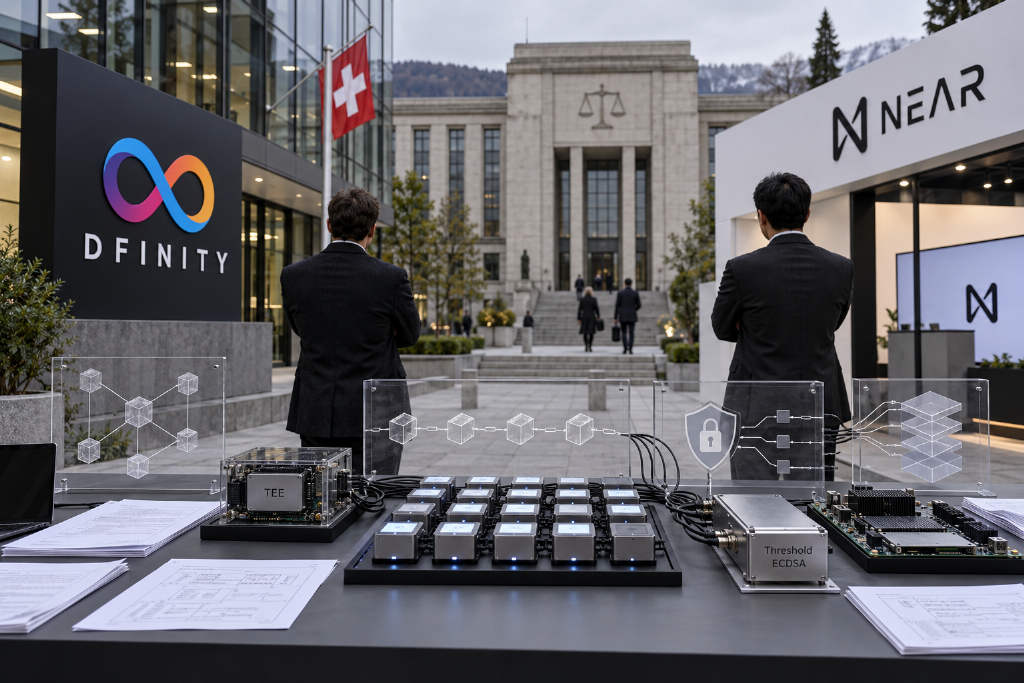
A public dispute between NEAR Protocol and Internet Computer (ICP) intensified from Oct. 21 to Oct. 23 after DFINITY founder Dominic Williams posted a series of attacks on X aimed at NEAR, its NEAR Intents product, and the network’s broader chain abstraction strategy. What began as a critique of NEAR’s privacy design quickly turned into accusations involving intellectual property, former employees and potential legal action.
The argument is not just another round of crypto community infighting. As presented in the PANews article, it cuts into several fault lines that have become increasingly important in Web3: the divide between cryptographic purity and engineering pragmatism, the boundary between open academic research and commercial defensibility, and the question of how decentralized cross-chain infrastructure needs to be before it can credibly market itself as secure.
The first flashpoint: Confidential Intents and privacy design
The first round of criticism focused on NEAR’s Confidential Intents feature. Dominic Williams argued that NEAR was marketing a privacy product built on a permissioned validator shard and a trusted execution environment, or TEE, bridge as if it were a stronger cryptographic privacy system. He described that framing as “Snake Oil.” According to the article, he shared a review from a DFINITY PhD engineer who concluded that NEAR’s confidential transaction model does not rely on what Dominic portrayed as more rigorous cryptography, but instead depends on users trusting a separate permissioned validator set and TEE-based infrastructure not to inspect or misuse sensitive information.
NEAR’s response centered on disclosure. The network and its community said Confidential Intents had always been presented as an opt-in privacy feature, mainly intended to reduce MEV front-running and support enterprise-grade multisig treasury management rather than function as a mixer. They also said the use of a permissioned validator shard and a TEE bridge was plainly described in NEAR’s public documentation from the start.
That set off a wave of mockery from the NEAR side. Developers and community members argued that DFINITY’s review had effectively rediscovered information already disclosed in NEAR’s own docs. NEAR supporters used the moment to draw a sharper contrast between what they see as product execution and what they characterize as excessive attachment to idealized technical purity. The article notes that the community even launched a meme coin called IKP to mock ICP during the flare-up.
The dispute escalates into IP and employee allegations
After the first wave of criticism drew ridicule, Dominic Williams raised the stakes on the evening of Oct. 22 and into Oct. 23. He shifted the debate from architecture choices to allegations of unauthorized use of proprietary cryptographic work and possible litigation.
The first allegation involved Threshold ECDSA presigning. Dominic claimed that a core component behind NEAR Intents and chain abstraction, including the system that lets users control BTC and ETH accounts without directly managing multiple private keys, used DFINITY’s 2022 paper on additive key derivation and presigning for ECDSA without permission. He said the method was originally developed for ICP’s Bitcoin and Ethereum integrations and that its license was limited to use on the Internet Computer network. The article says Dominic also argued that the design allows multiple devices to generate addresses and sign cooperatively without any one device holding the full private key, and that it improves signing speed by about 3x. He further alleged that NEAR had recently tried to downgrade the algorithm on GitHub to a slower version in an effort to reduce legal risk.
The second allegation concerned confidential key derivation. Dominic said NEAR’s Confidential Key Derivation, or CKD, released in 2025, was highly similar in underlying principle to DFINITY’s proprietary vetKeys technology introduced in 2023.
The third allegation involved staffing. Dominic claimed unilaterally that NEAR hired a former DFINITY employee who had been dismissed in the summer of 2021 for similar misconduct and put that person in charge of developing the cross-chain signing system. He also said NEAR had hired two additional engineers away from DFINITY.
The article points out that the legal and industry implications are more complicated than the accusations alone suggest. NEAR’s MPC code is open-sourced under the MIT license, and NEAR’s own official documentation for the technology reportedly linked directly to DFINITY’s 2022 academic paper. That raises a broader question with no clear precedent in crypto: can the ideas in a publicly published cryptography paper be treated as exclusive property controlled by a single blockchain foundation?
PANews notes that threshold signing is already common in cross-chain infrastructure and mentions Lit Protocol as one example of similar usage. Without hard evidence of software code copying or theft of trade secrets, a case built mainly on the claim that “the algorithmic logic came from my paper” would face serious difficulty in an open-source environment. In that reading, the legal threat also functions as a fight over authorship, legitimacy and technical credit.
Decentralization claims become another battleground
The conflict did not stop at cryptography and licensing. Both sides also attacked each other’s decentralization claims.
Dominic argued that NEAR’s chain abstraction signing network was not meaningfully decentralized in its earlier form, saying it relied on roughly eight servers. If those operators were compromised or colluded, he said, assets under cross-chain custody could face severe risk. The ICP community also criticized NEAR’s front-end stack for depending heavily on centralized cloud providers such as AWS, creating a potential single point of failure. ICP, by contrast, has long promoted a full-stack on-chain hosting model in which even front-end web pages run inside canister containers.
NEAR’s answer came in the form of a timing-sensitive technical update. Roughly half an hour before Dominic published one of his long posts, NEAR released a technical article saying its mainnet MPC network had expanded to 17 independent operators, with an 11-of-17 signing threshold, and that all of them were running inside hardware-level TEEs. In the context of the dispute, that announcement directly addressed the “eight servers” criticism.
Why the clash matters now
PANews argues that the timing is not accidental. The two networks are increasingly colliding not because they are far apart, but because their technical and commercial narratives are starting to overlap.
DFINITY’s stack is described in the article as Chain Fusion, Threshold ECDSA, vetKeys and full-stack on-chain AI. NEAR’s side is framed around Chain Abstraction, NEAR Intents, MPC/TEE and NEAR AI. Both are trying to tell a story about controlling multi-chain assets without relying on traditional bridges, and both are tying that story to AI infrastructure.
The article includes a comparison labeled as the latest status for October 2026. It says ICP’s real-time TPS over 30 days was 182x that of NEAR, that its per-transaction fee was 103x cheaper, and that its on-chain revenue was 1.7x higher. NEAR, by contrast, is portrayed as focusing less on raw base-layer performance and more on intent routing across chains and front-end usability.
On capital and ecosystem scale, the article says ICP’s token price was hovering between 2.70 and 2.90, down more than 99% from its 2021 opening, while its ecosystem mindshare had become marginal. NEAR, it says, had a market capitalization 4.3x larger than ICP’s, staking volume 4.5x larger, and a developer count 1.6x higher. PANews also lists several recent NEAR business developments: NEAR Intents transaction volume rising 14.6x year over year to $35.6 billion, the launch of NEAR Business for enterprise treasuries across more than 35 chains, NEAR AI staking surpassing 1 million tokens, and plans to connect with tokenized Nasdaq-listed equities liquidity.
In that framing, the dispute becomes a collision between two very different operating styles. ICP is cast as the side that prioritizes cryptographic rigor and base-layer performance. NEAR is cast as the side that packages available components into products that can attract users, liquidity and transaction flow more quickly.
PANews’ interpretation of the broader split
The article’s interpretation is explicit. It says both DFINITY and NEAR are among the blockchain teams with genuine engineering depth, but they have evolved in different directions. DFINITY is described as a kind of cryptographic maximalist, willing to spend years building threshold signing, decentralized containers and vetKeys even if ecosystem growth remains slow. NEAR is described as a pragmatic product manager, willing to combine MPC, permissioned shards and TEEs into systems that can serve institutions and retail users now, then improve decentralization over time.
PANews also argues that the dispute is unlikely to be definitively settled in court, because claiming exclusive control over ideas from a public cryptography paper would be difficult to enforce. In that view, the more realistic equilibrium lies in community positioning and market perception. For DFINITY, the fight may reopen attention to ICP’s strengths in threshold signing and real-time throughput. For NEAR, as long as there is no private-key security incident, intense scrutiny from a rival founder may end up amplifying awareness of NEAR Intents and its reported $35.6 billion in transaction volume.
The article adds that readers who want a more direct explanation of NEAR Intents, its privacy transaction logic and the design choices behind the current controversy can watch a video in which NEAR co-founder Illia Polosukhin discusses NEAR Intents, privacy and post-quantum security. Near the end, the original piece also includes the author’s personal views on ICP, Algorand, Hbar and Conflux, touching on product usability, market execution and leadership changes, while stating that the content is for informational and research reference only and does not constitute investment, trading or financial advice.
What remains unresolved
Based on the information presented in the source article, the NEAR-ICP clash has already moved beyond a founder spat. It has brought several unresolved questions into the open: whether published cryptographic research can support exclusive commercial claims, where the line sits between open-source implementation and proprietary advantage, whether TEE- and permissioned-shard-based systems are acceptable transitional architecture, and how decentralization should be weighed against product usability and speed to market.
As of Oct. 23, neither side had backed down. Dominic Williams had pushed the argument into legal and ethical territory. NEAR had answered with public documentation and updated MPC network figures. The fight over NEAR Intents, Threshold ECDSA, vetKeys, CKD and chain abstraction is likely to remain in view as long as both networks keep competing for the same narrative ground.



