

Francesco Andreoli, head of developer relations at Consensys and MetaMask, says his count of the neobank industry found 368 verified operators still active as of July 2026. He began the project six months ago after finding that neither analysts, venture investors, nor founders could give a reliable figure for how many neobanks actually existed. The dataset is being tracked publicly on neobankbeat.com.
Andreoli writes that the number that changed his view of the sector was not 368 itself, but how many companies had to be deleted to reach that total.
Customer scale is real, and Asia dominates the totals
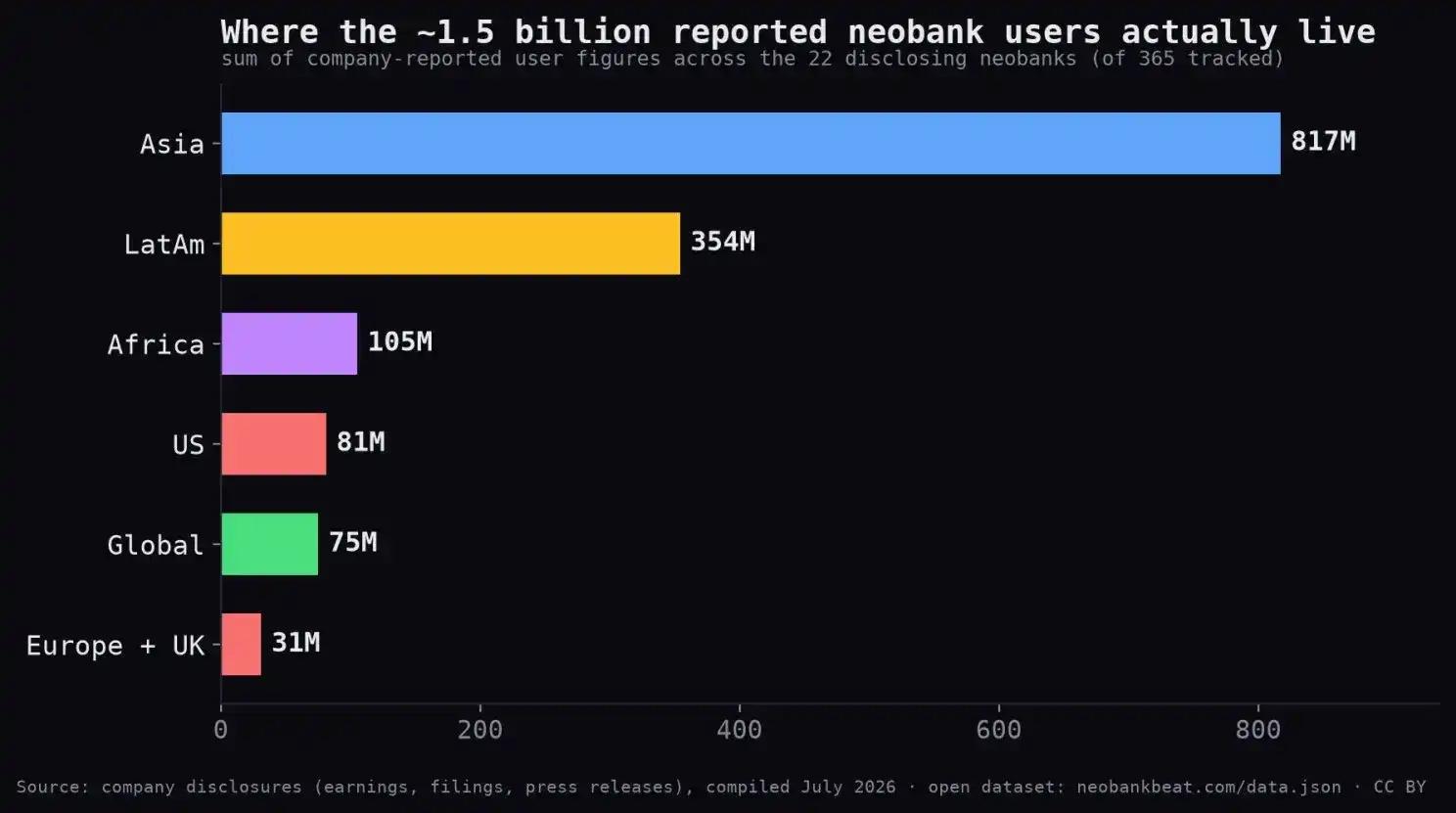
Using self-reported customer figures from the companies in the dataset, Andreoli estimates that the tracked neobanks serve about 1.46 billion people. He says that figure is based on reported customers rather than forecasts.
The geographic split is uneven. Of the total, 817 million users are in Asia. WeBank alone serves more than 400 million people, more than all neobanks in the US and Europe combined, according to Andreoli. Nubank has 131 million customers, which he says is more than the combined total for US neobanks. Revolut, one of Europe’s largest names in the segment, has more than 50 million users.
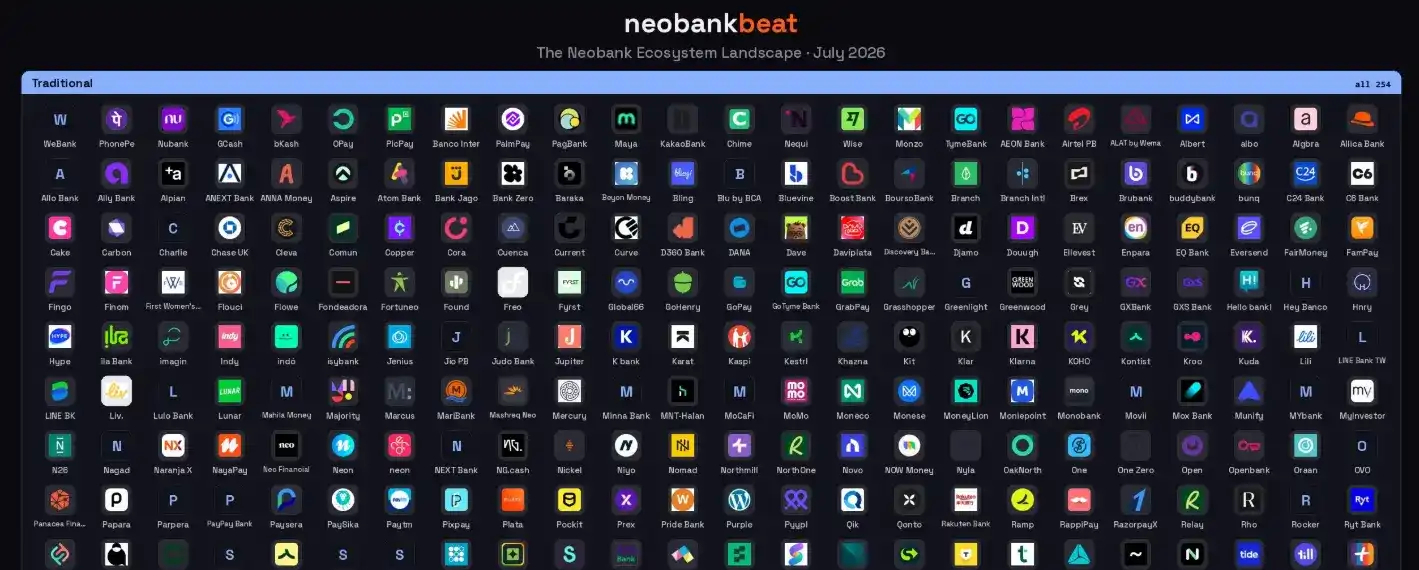
Three structurally different waves sit under one label
The census divides the 368 active firms into 254 traditional challenger banks, 58 hybrid fiat-and-crypto apps, and 56 web3-native applications. Andreoli says momentum is also shifting at the margin. Among neobanks founded in the 2020s and still operating, 30% are web3-native self-custody apps where customer balances are not held by the company. For firms launched in the 2010s, that share was 4%.
He says that, whatever view one takes of crypto, builders have already voted with where they are choosing to build. The map behind the dataset also includes 106 infrastructure providers and 219 investors.
Only 127 hold full banking licenses
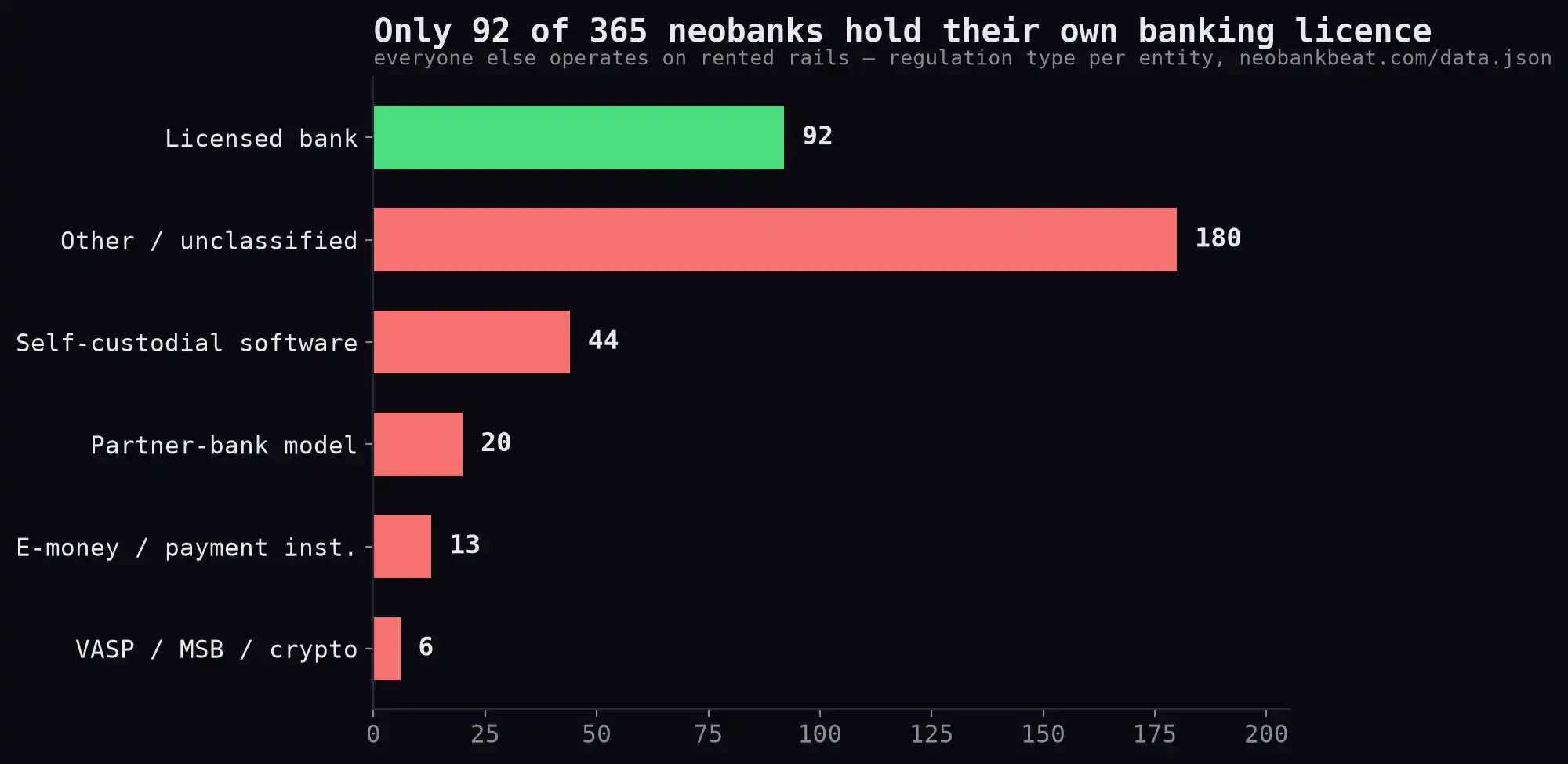
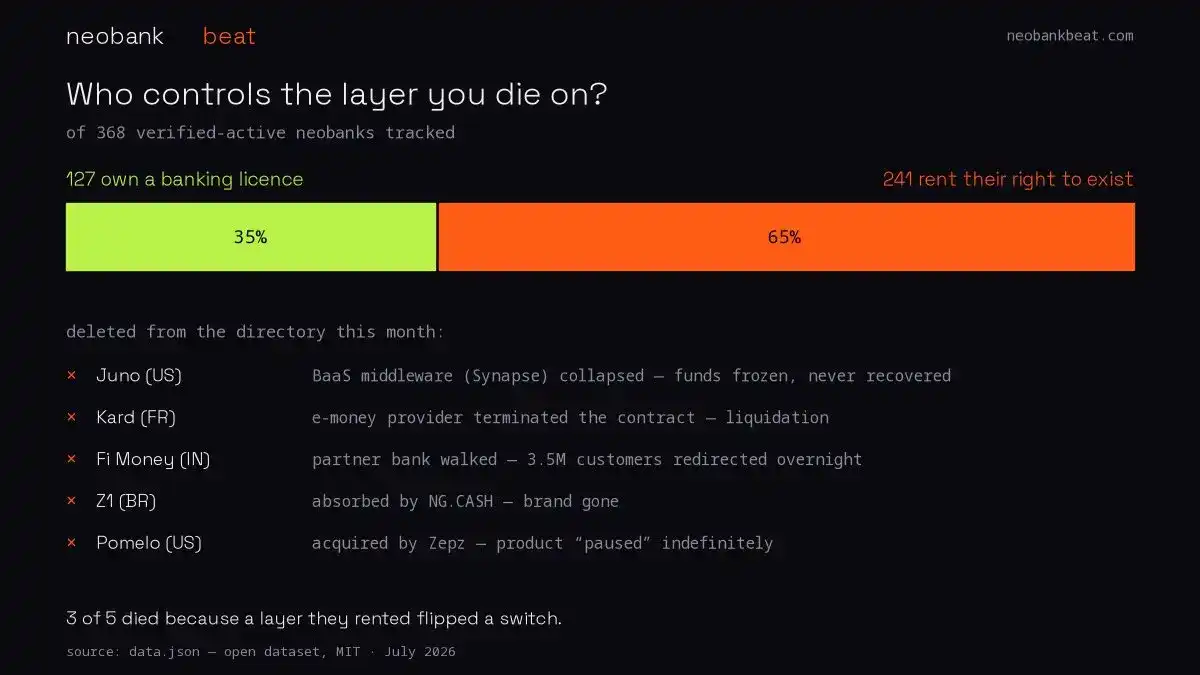
Andreoli’s central regulatory finding is that just 127 of the 368 operating neobanks hold full banking licenses.
His argument is that two-thirds of the apps presented to consumers as banks are not banks in the formal sense. Their operating rights are rented through sponsor banks, e-money structures, or card issuers that customers usually do not see. He frames that gap not as a technical detail but as the core structural risk in the sector.
WaveCrest, Wirecard, Synapse, Ready
To show how that dependence can break, Andreoli points to four cases.
- WaveCrest, 2018: Visa revoked an issuer’s access, and dozens of crypto card projects shut down overnight.
- Wirecard, 2020: a €1.9 billion hole at a payments processor froze funds for a group of European “banks” built on top of it.
- Synapse, 2024: after a banking-as-a-service intermediary collapsed, US customers found that “FDIC insured” did not mean what they thought, because the failing point was the ledger recording who owned which funds.
- Ready, 2026: Andreoli describes it as the same movie with a different cast.
He contrasts those failures with a traditional bank collapse, where deposit insurance pays out. When neobank infrastructure fails, he says, customers often end up with little more than a place in a bankruptcy queue.
Silent exits keep happening
Andreoli says the deletions have not stopped since he started maintaining the dataset. In the past month alone, five entities disappeared from the list through liquidation, absorption into other businesses, or quiet pivots.
In his telling, neobanks rarely die in a way that draws the kind of public attention seen in cases like FTX. The app stops updating, customer support goes quiet, and one day the domain redirects to a partner landing page. Customers either migrate or vanish from the system. He argues that fintech media tends to cover product launches and funding rounds, while the cemetery remains largely uncounted, which is why he records exits with the same care as entries.
Only 67 AI claims passed review
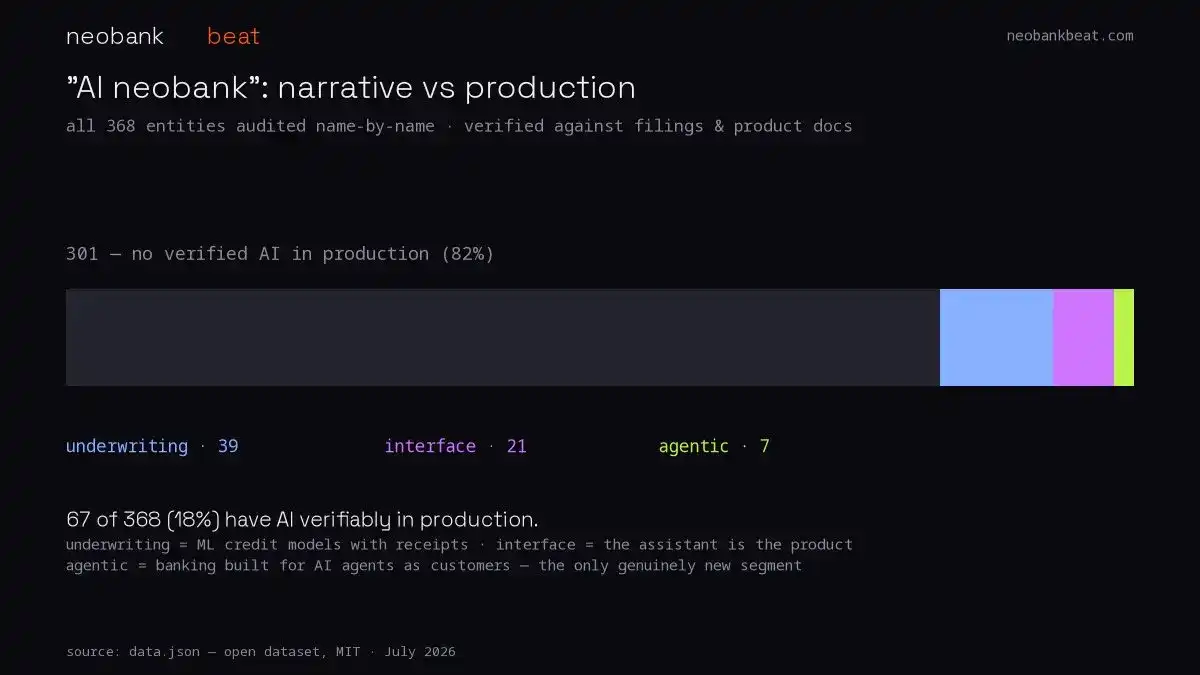
Andreoli also reviewed the industry’s AI claims. He says every neobank pitch deck now includes AI, so his team checked all 368 companies against financial statements, regulatory disclosures, and evidence of live deployment rather than marketing copy.
Only 67 passed that review, equal to 18% of the total. The remaining 300-plus firms were described as still piloting, still exploring, or presenting a partner’s model as their own.
He says some of the strongest AI lending execution is not coming from the best-known brands, but from lenders in Nigeria, the Philippines, Mexico, and Bangladesh. In those markets, where credit systems are thin, a model that can underwrite borrowers with little or no formal credit history is not an added feature. It is the basis for the business itself.
106 providers under 368 consumer brands
The infrastructure layer in Andreoli’s map includes 106 providers supporting 368 consumer-facing brands. He says a small number of sponsor banks, BaaS platforms, and card processors each carry dozens of logos above them. That concentration is mostly invisible from the customer side, but in his view it is the same concentration that can produce the next Synapse-style failure.
Andreoli describes the industry in 2026 as two things at once: a real expansion that has brought banking access through an app to about 1.5 billion people, many of them for the first time, and a structure resting on support layers most customers have never heard of, where two-thirds of companies depend on whether their landlord can survive a bad quarter.
Three predictions he says could still be wrong
Andreoli closes with three predictions that he explicitly says he may be wrong about.
- The licensing gap will narrow from both ends. Strong unlicensed players will buy or obtain licenses, while weaker ones will become deletion entries in 2027, leaving less middle ground.
- The first major AI underwriting blowup will happen within two credit cycles. He says most of the 67 production models have not faced a real downturn in their current form.
- The next customer wave will not be human. He says only seven companies today are building banking infrastructure for AI agents, including wallets controlled by agents, cards issued by agents, and machine-to-machine payments. He compares that segment to web3-native banking in 2021: small, unusual, and structural.