
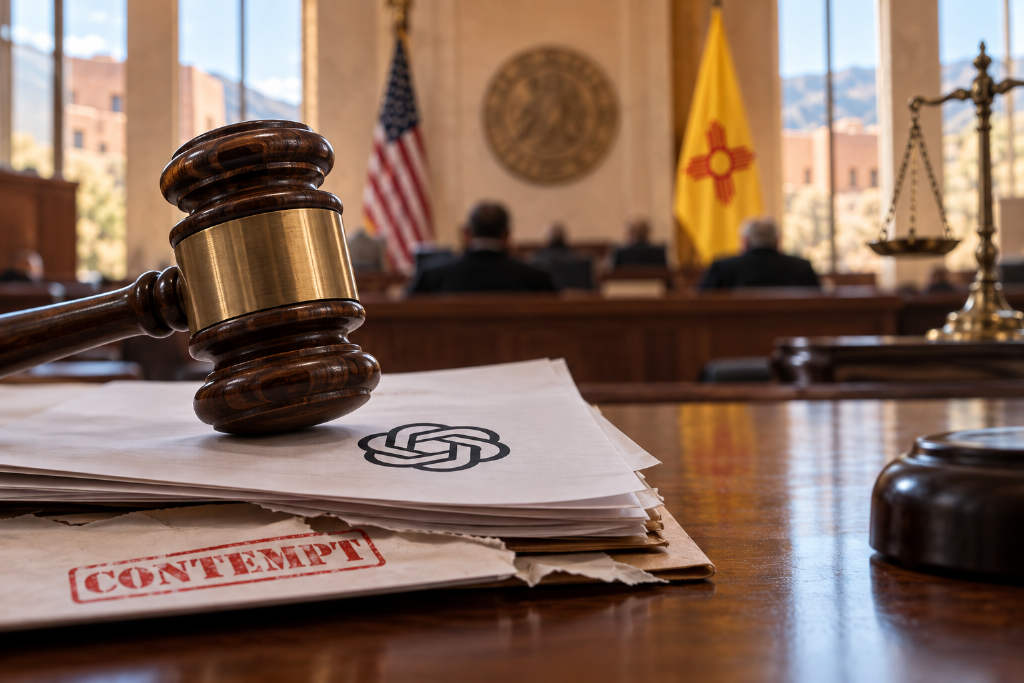
The New Mexico Supreme Court has fined attorney Stephen Aarons $5,000, held him in contempt of court, and forced a murder appeal back to square one after finding that he failed to verify facts and legal support in an AI-generated filing.
In an order released on Wednesday, Sept. 9, the court said Aarons had not checked the factual claims or legal basis contained in the filing. He was also referred to the attorney disciplinary board for investigation and removed from the case, which will now be handled by different counsel. A document that was supposed to help his client pursue a new trial instead reset the appeal process.
Filing included witnesses the court said did not exist
Aarons represented Oscar Renee Sandoval, who was accused of killing the mother of his child. Sandoval was convicted in 2025 and sentenced to life in prison. He has denied the offense.
Last year, Aarons took on the appeal. Faced with extensive trial transcripts and case materials, he organized the documents and gave them to ChatGPT, asking for a summary. He described the goal as a "bulletproof summary" that could support the appeal and save him from reviewing the record page by page.
What came back looked polished and complete, but the court found that the filing was filled with invented witnesses. It listed officer Michelle Amarillo, officer Sanchez, Manal Al-Jibury, and Teresa Marquez, names the court said do not appear in the trial record.
The filing also said witness Danny Stanton testified that the defendant had threatened him and that he took the threats seriously, while Linda Stanton testified that her husband had been threatened. It even added descriptive details about the shooter’s clothing and appearance, including dark pants and a white shirt.
The order described those statements as "false testimony from wholly fabricated witnesses." What Aarons treated as a time-saving tool became, in the court’s view, a filing built on fake testimony.
Aarons acknowledged using ChatGPT at an Aug. 21 hearing
At a hearing on Aug. 21, Aarons admitted that he had used ChatGPT and said he did not understand the extent to which AI could hallucinate.
According to Reuters, Justice C. Shannon Bacon challenged that explanation directly in court: "Lawyer, do you watch the news? Do you listen to the radio? Do you read anything about what’s going on in this world? Because this issue of lawyers relying on AI hallucinations is front-page news every day."
Not the first court sanction tied to AI errors
The report said this is not the first case of its kind. Last year, a judge criticized filings submitted by two law firms for containing large volumes of false, inaccurate, and misleading legal citations and quotations. Lawyers for MyPillow founder Mike Lindell were also sanctioned after including AI-generated erroneous quotations and fake case law in court papers.
Damien Charlotin, a legal researcher who maintains a database of AI hallucination cases, had recorded 1,668 court cases as of July 2, 2026. Of those, 1,163 were from the United States. In 653 of the U.S. cases, the responsible party was a practicing lawyer rather than a self-represented litigant.
This case went beyond fake citations
In many earlier cases, AI hallucinations appeared at the level of legal authority: fake precedents, fake quotations, or invented citations that courts could spot by checking databases.
This case was different. The alleged fabrications involved factual witnesses and testimony, and they appeared in an appeal tied to a life-sentence murder conviction.
On Sept. 2, the appeal was reassigned to state public defender Kim Chavez Cook. The appellate process must now begin again from the start.
Aarons told Reuters, "I am remorseful, but I hope the disciplinary board takes into account that this was an honest mistake." The penalty, though, extends beyond the lawyer’s own fine and disciplinary exposure. Aarons faces the $5,000 sanction and an investigation, while Sandoval faces delay and a restarted appeal.