
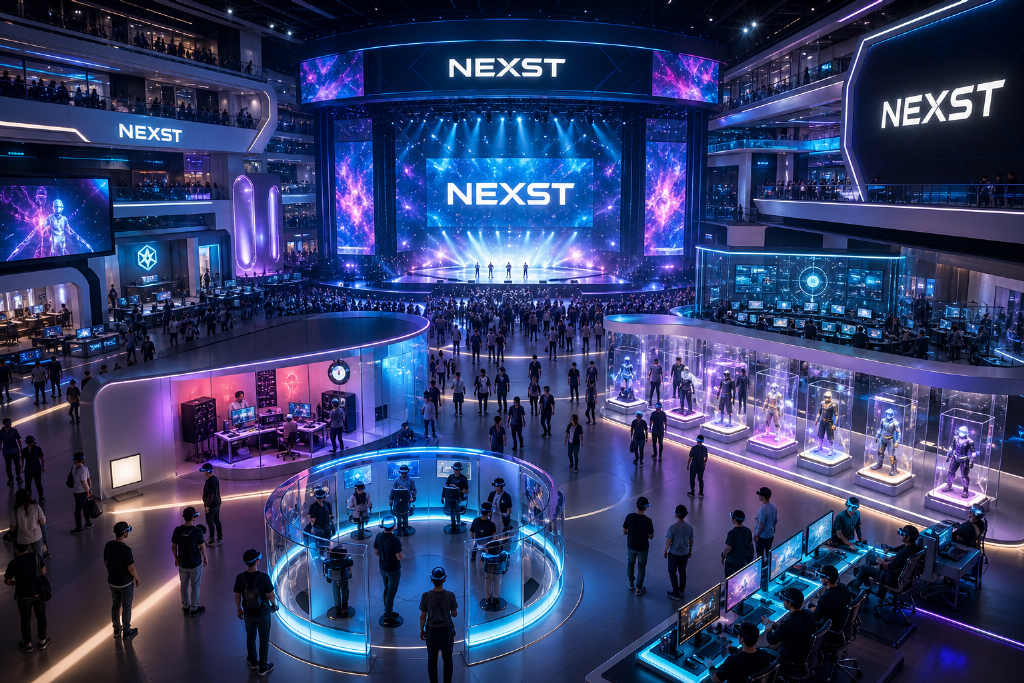
NEXST is trying to build a full-stack infrastructure for the entertainment business, using AI, VR, Web3, RWA and gaming to change how artists and fans connect over time.

In a long-form report published by TechFlow, the project is presented as a response to a structural imbalance in the global entertainment market. Fan demand is strong, but artist access is limited by time, geography and cost. At the same time, fans are often among the most loyal and highest-spending consumers, yet most of the rights or benefits they receive are one-off and fragmented, with little ability to accumulate into lasting value.
The report argues that in the traditional setup, fan actions such as voting support, merchandise purchases and fan-sign interactions usually stop mattering once the transaction is over. Even after attending 20 concerts, a fan may have little advantage over anyone else when the next ticket sale opens. In that view, the industry leaves fans with very little that can compound, which creates room for intermediaries while doing little to establish long-term alignment between artists and their audiences.
NEXST frames that gap as missing entertainment infrastructure rather than a single product flaw. The question it is trying to answer is whether the industry can move away from one-time consumption if concerts become accessible in virtual space, if AI agents can stay online around the clock to respond to fan needs, and if every fan interaction can be recorded and turned into a persistent rights-bearing asset.
From one-off spending to “Fan Continuity”
TechFlow describes the core logic of entertainment as a naturally symbiotic relationship between artists and fans. For artists, fans are the most important long-term asset and a major factor in how long an intellectual property franchise can last. For fans, artists serve as emotional anchors, and each interaction reinforces that bond.
Yet the report says that value chain breaks down at several points in the traditional entertainment model. It can produce stars, but it does not systematically solve the limits of a single artist’s time, energy or reach. It understands that emotional connection matters, but it has not built an effective system to manage, expand and preserve that connection.
NEXST calls its answer “Fan Continuity.” The idea is straightforward: passion should have memory, and loyalty should have returns. If that continuity can be established, artists are no longer building only short-term traffic that can disappear at any time. They are building fan relationship networks that can be operated over the long run. Fans, in turn, are not left with only a one-off consumption experience, but with identities, rights and participation incentives that can accumulate.
The report says that making Fan Continuity operational requires several technologies to work together:
- VR addresses how fans and artists can “meet,” removing physical boundaries and turning concerts and similar scarce experiences into shared global spaces.
- AI addresses how fans can be “accompanied,” moving from broad broadcast-style engagement to personalized relationships through always-on agents that remember who a user is, what they like, and how they have interacted with an artist.
- Web3 addresses how value can “continue,” providing a native record and transfer layer where fan participation, support and contribution can be logged, priced and carried forward.
TechFlow’s point is that technology can improve user experience, but infrastructure is what determines whether an ecosystem can actually take shape.

A full-stack entertainment stack spanning IP, content, interaction and value flow
NEXST’s proposed solution starts with breadth. The project is aiming for a stack that covers content production, fan interaction, IP operations and value circulation.
On the supply side, the article treats NEXST’s artist network as a meaningful barrier. At this stage, its IP resources are focused on entertainment-heavy markets such as South Korea and Japan. Publicly announced collaborations include UNIS, the girl group formed in 2024 through SBS audition program Universe Ticket, K-pop girl group KISS OF LIFE under South Korea’s S2 Entertainment, and Japanese idol group Nijino Conquistador.
According to the report, those relationships are tied to the team’s background. NEXST says its core members come from companies such as MTV, YouTube and Disney. That background is said to provide trust-based access to artists, agencies and labels, along with experience in global brand marketing, content distribution, fan operations, cross-media IP management and large-scale event execution.
VR: turning live shows into globally accessible digital experience assets
One of the flagship products is Xmersive VR LIVE, developed jointly by NEXST and Japan-listed XR and metaverse company monoAI technology. The article describes monoAI as known for its large-scale real-time communication engine and XR CLOUD metaverse platform, with the technical capacity to support connections at the level of tens of thousands of simultaneous users. Its customers include NTT, Sony and Konami.
Xmersive VR LIVE is designed to convert idol performances into virtual live events. In practical terms, that means taking an offline event that might otherwise be limited to tens of thousands of attendees and turning it into a digital experience that fans around the world can access. The product is already available in a Meta Quest version and an app version. monoAI handles the core system, application development and infrastructure so the experience remains stable under heavy traffic.
AI: moving fans from content consumption to co-creation
Another core product, SAI, is built on ByteDance’s Seedance and Seedream models. It is positioned as a next-generation fan social and co-creation platform. The report says fans can generate images and short videos through text prompts and share them with the community. That lowers the barrier to content creation and shifts fans from simply consuming content to producing it.
SAI is currently in beta testing and pre-registration, according to the article.
NEXST has also rolled out AI-driven marketing tools and intelligent agents intended to act as digital managers and entertainment assistants. On the artist side, those tools can support content operations, event management and fan interaction. On the fan side, they are meant to provide always-on, personalized companionship, extending each interaction beyond a single response.
The article also notes that NEXST previously announced a partnership with decentralized AI project Neura, which focuses on emotional intelligence and persistent memory. That partnership is presented as part of NEXST’s effort to strengthen its AI layer.

RWA: tokenizing entertainment rights and fan participation
In NEXST’s framework, RWA serves as the layer where behavior in entertainment can settle into durable value. The platform’s core goal is to tokenize real-world assets connected to entertainment.
The article says those tokenized assets can include physical items such as tickets and merchandise, as well as rights such as exclusive artist content or members-only communities. Fans may unlock those rights under predefined conditions. They may also participate in crowdfunding around artist projects such as tours or album releases in exchange for future royalty income.
That structure is meant to address issues the report associates with the traditional entertainment market, including ticket fraud and scalping, geographic limits and weak ownership. It is also meant to turn entertainment spending that would otherwise expire into digital assets and rights that can be held and circulated over time, deepening the connection between artists and fans while creating new revenue streams.
Gaming as the user acquisition gateway
NEXST also sees entertainment IP games as a long-term traffic entry point. TechFlow argues that, compared with more complicated Web3 products, games remain one of the most natural ways to enter the mass market. Users can encounter digital collectibles, token mechanisms and on-chain identity while playing, without first needing to understand wallets or gas fees.
NEXST’s first game, DearSt! RHYTHM STAGE, has already launched on Dapp Portal. The title combines rhythm-based gameplay, character development systems and idol fan culture, and is described as an important move in taking NEXST into mainstream entertainment markets.
In April this year, NEXST also announced that it had signed a basic business partnership agreement with Japan-listed game company CyberStep Holdings. Under the arrangement described in the article, NEXST provides immersive AI/XR/Web3 content and fan data assets, while CyberStep brings a game user base, e-commerce capabilities and physical goods distribution channels to support future titles.
Why blockchain sits at the center of the model
Once the product map is laid out, the report turns to a deeper question: why does this system need blockchain at all.
NEXST’s answer is built around four attributes: verifiable, transferable, shareable and sustainable. The article argues that each of those goals maps closely to blockchain features such as immutability, transparent auditability, programmability and decentralized ownership.
That logic leads into another item on the roadmap: NEXST Chain. The obvious follow-up is why a dedicated chain is necessary instead of using an existing public chain.

According to the report, NEXST’s answer is that no general-purpose chain on the market was designed specifically for entertainment use cases. Building a chain comes with visible trade-offs, including longer development cycles, higher ecosystem costs and a harder early launch. Even so, the project believes deep customization for entertainment is necessary to provide a better participation experience. NEXST Chain remains in the planning stage, but the article treats it as the bottom layer of the larger stack.
Above that base layer sits the $NXT token, which is used to connect value across the ecosystem. The report states that $NXT has a total supply of 600 million tokens and utility functions including staking, access to ecosystem participation, and unlocking exclusive rights.
To support long-term token value and stability, NEXST has also introduced a quarterly buyback and burn plan. Each quarter, 20% of revenue will be used to repurchase NXT on the open market, and part of those repurchased tokens will be burned and permanently removed from circulation.
The article adds that after completing its token generation event on May 12, 2026, $NXT was listed on OKX Boost, KuCoin, MEXC and LBank. The team has also previewed future listings including Coinone and Hyperliquid.
From white paper to delivery: what has gone live so far
TechFlow argues that moving from a white paper into real-world usage is one of the hardest transitions for any Web3 project. Rather than relying only on tokenomics and roadmap narratives, NEXST is trying to validate product demand in live settings first and let the token and narrative layers build on top of that.
So far, the platform has released two K-pop VR concert products for a global audience through Xmersive VR LIVE.
The first, Xmersive: UNIS, is described as NEXST’s first downloadable and paid commercial VR product. It launched on Meta Quest and then on iOS and Android in April and May 2026. The product includes four songs from K-pop girl group UNIS and is linked with PhotoEX digital photo cards, allowing users not only to watch the performance but also to collect and manage digital memorabilia.
The second, Xmersive: KISS OF LIFE from Japan Debut Tour [Lucky Day], marked a formal cross-agency collaboration and, in the article’s framing, further demonstrated NEXST’s ability to work with top K-pop acts across different labels. It also includes four songs and integrates with PhotoEX digital photo cards. Members of the Japanese fan club are offered an additional signed box lottery event.
Both productions use 180-degree high-definition VR filming and are said to deliver an immersive experience close to 8K inside VR headsets. The mobile version allows users to shift perspectives freely through gyroscope controls or touch input. The article says this gives global fans who cannot attend in person a viewing experience close to the front row. It also notes that KISS OF LIFE has more than 9 million followers across its global social media channels, and says some fans commented that VR helped make up for missing the group’s Japan tour.

Outside VR, NEXST’s game DearSt! RHYTHM STAGE was co-developed with Japanese idol management company DearStage and also works with Japanese idol group Nijino Conquistador, using their real popular songs for rhythm gameplay.
The official plan, according to the report, is to add characters and songs from other DearStage artists over time. In addition to in-game content, the companies are also planning joint promotion and tie-ins with physical rewards, aiming to connect digital experiences with real-world fan benefits.
TechFlow points out that the game is the first rhythm title on LINE Mini Dapp to be tied to a real idol IP. It runs on top of LINE’s nearly 200 million monthly active users, which the article treats as a meaningful built-in user acquisition advantage.
What to watch in the second half of 2026
According to the report, launches across VR, gaming and token circulation mean NEXST has already taken a first step from white paper to real value creation. Delivery, however, is not the same thing as full validation.
TechFlow outlines several advantages. The first is NEXST’s relatively unusual full-stack integration. Many Web3 entertainment projects enter through a single vertical, whether fan tokens, VR concerts, AI virtual idols or games. NEXST is trying to combine content, interaction, IP, games, digital assets, AI, VR and an on-chain value system inside one architecture. If that works, users would be entering not an isolated product, but an ecosystem centered on entertainment consumption, fan relationships, digital assets and value circulation.
The second is real IP traction that has already begun to show up. For an entertainment platform, artist IP is not just content supply. It is also a built-in user growth engine. The presence of UNIS, KISS OF LIFE and other actual artist IP means NEXST does not need to start from zero in educating the market, and can instead plug directly into established fan communities.
The third is the Fan Continuity model itself. Traditional entertainment often works on a “consume and reset” basis. NEXST’s version is “participate and accumulate,” with one-time spending intended to become ongoing on-chain value. The article argues that this can create stickiness and network effects, because the longer a fan’s history and the larger the rights they accumulate, the higher the cost of leaving and the more stable the platform becomes.
The challenges are just as clear in the report.
One is that a full-stack model is also a source of pressure. The more complete the ecosystem, the more moving parts have to work at once. TechFlow cites examples from other segments: Chiliz in fan tokens, AmazeVR in VR concerts, and MEET48 in AI virtual idol products. Those projects entered their niches earlier and already have product and user accumulation. NEXST now has to prove that combining more functions in one ecosystem really does produce a more integrated and smoother user experience.

Another is the depth of the artist roster and the consistency of content supply. UNIS and KISS OF LIFE can provide attention and traffic early on, but the article says long-term activity will depend on whether new artists, new content and new events continue to arrive. The next question, in its wording, matters more than the current one: not who is already here, but who comes next.
The last major issue is whether the $NXT token economy can become self-sustaining. While the token has multiple utility functions, the report says buybacks and long-term value still need real income behind them, including ticket revenue sharing, merchandise sales and genuine user transactions. If ecosystem revenue grows slowly, $NXT could remain exposed to broader market sentiment and struggle to build a self-reinforcing loop.
NEXST-Gen Alliance and the next catalyst set
One of the most important upcoming catalysts in the article is the planned NEXST-Gen Alliance.
Based on information released so far, the initiative will work with global entertainment agencies and artist resources to build a new AI-centered idol management system. The scope is expected to include AI idols and music content, as well as AI-driven production for mini films, music videos and VR concerts. The article says the $NXT Treasury will provide 10 million $NXT in funding support.
If that plan is executed successfully, TechFlow argues, the significance would go well beyond adding a few AI products. It would represent a shift in NEXST’s content supply logic, moving from reliance on external real-world IP to incubation of its own content production engine. A steady flow of new content could then feed fan interaction, digital assets, gaming and value capture for $NXT.
Beyond that alliance, the second-half 2026 roadmap is another major observation point. The article describes two tracks.
- One is product-side expansion: more artist IP, more VR content, more AI applications and more games to expand the ecosystem’s content supply, give more users a reason to enter, and provide more scenes for participation after they arrive.
- The other is token-side expansion: broader multichain support for $NXT and listings on more major exchanges so the token can become not only an internal tool, but also a broader value gateway linking more users to more ecosystem scenarios.
Both tracks are aimed at the same target: content growth and value growth moving together. New IP and applications bring in new users. New users create real behavior inside the ecosystem, which supports value capture for $NXT. In turn, the participation rights, privileges and incentives attached to $NXT are meant to improve user retention and keep engagement going.
TechFlow’s overall conclusion is measured. NEXST is still in the early stages of ecosystem construction and is not yet the answer in itself. But in trying to build a complete infrastructure stack for entertainment, it is making a case for a model where fan passion is not merely spent, but turned into an asset.
