
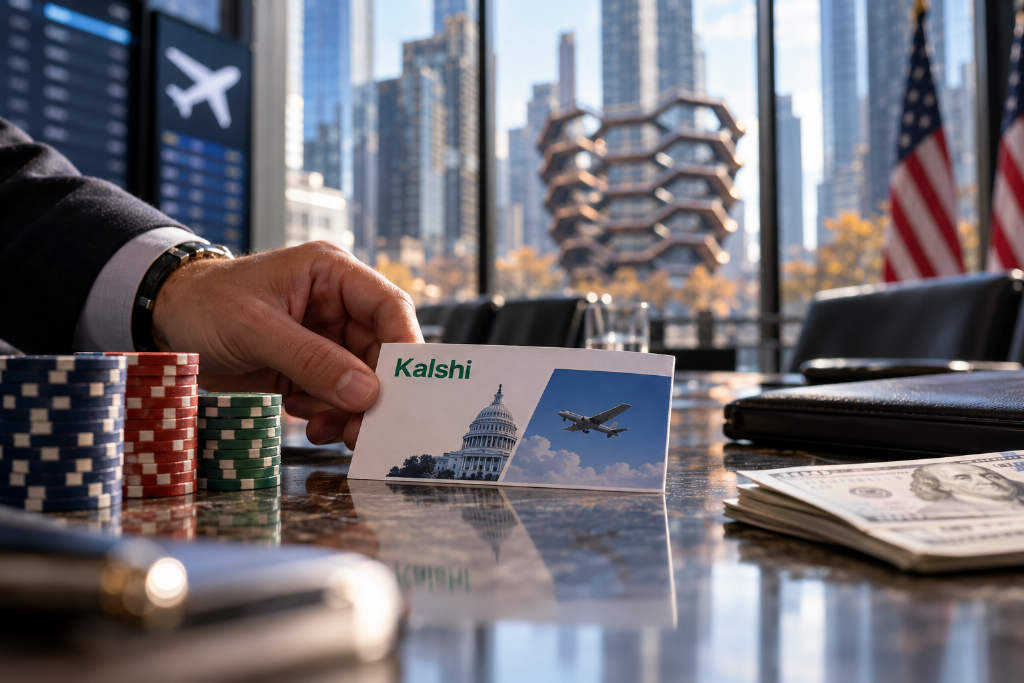
Prediction markets spent two days at the center of the conversation at NEXTPredict, held at Convene Hudson Yards in New York on October 22 and 23. The event brought together some of the industry’s biggest exchanges, trading firms and policymakers.
With less than two weeks to go before the U.S. midterms, elections dominated many of the panels. Executives, though, were equally focused on what comes after that moment.
A hedge that did not pay out
The conference opened with an example of how prediction markets can be used outside politics. NEXTPredict had paid a $12,000 premium on Kalshi for contracts tied to flight disruptions at New York’s JFK airport. If more than half of scheduled arrivals had been canceled the day before the event, the position would have returned roughly $3 million.
That did not happen.
On Thursday’s "Hedging the Unhedgeable" panel, NEXTPredict co-founder Pierre Lindh said, 「We ended up losing that trade yesterday, right? And I can only say I'm very happy that we lost that trade, because that means we're all here today.」
Lindh said traditional event insurance usually covers outright cancellation, but many force majeure scenarios do not cancel an event. Instead, they can badly damage it.
Joe Grubb, head of business development at Susquehanna, which took the other side of the trade, said the firm modeled the risk internally in about a day or two. 「It's sort of in our DNA at Susquehanna to price strange things,」 he said.
Kalshi director of business development Nicolas Hull said smaller businesses are already using the exchange to hedge specific risks. He pointed to a New York bar that used the market to cover a Knicks playoff promotion. As long as a contract is certified by the Commodity Futures Trading Commission and tied to a verifiable data source, he said, 「we can list almost anything on our exchange.」
A post published by NEXTPredict after the event gave a sense of the summit’s scale: more than 2,000 attendees in the room, 180 speakers and participants from 47 countries. The company said the New York summit was the product of months of planning and took place at Convene, 30 Hudson Yards.
Chuck Todd on whether markets can beat pollsters
Chuck Todd, the former political director at NBC News, had told Lindh before the event that he was open-minded about whether markets or pollsters would do a better job calling the midterms. By Friday’s "Who Calls the Midterms" panel, he sounded much closer to a believer.
「This is my argument of why I'm bullish on prediction markets for the future of journalism and that it should be this, in its own way, a fact checker,」 Todd said. 「With money being involved, there's more incentive to get it right.」
He said prediction markets have, in practice, replaced exit polls on election night. At the same time, he rejected the idea that polling itself is broken. 「You can still do a good poll. It just costs a lot,」 he said.
Other panelists were more restrained. Columbia University professor Rajiv Sethi said, 「Speed is not necessarily the same as accuracy.」 PredictIt CEO John Phillips added, 「it's called wisdom of crowds, not wisdom of whales.」
That caution looked justified only days later. Before Sunday’s presidential runoff in Brazil, Polymarket gave Luiz Inácio Lula da Silva only about a 20% chance of defeating Flávio Bolsonaro, yet Lula went on to win a fourth term, according to Decrypt. Experts cited Brazil’s ban on prediction markets, which left pricing largely in the hands of traders outside the country.
Beyond elections
For Robinhood, elections are only the entry point. JB Mackenzie, the brokerage’s vice president and general manager for futures and prediction markets, told CNBC’s Contessa Brewer that the focus has widened over time.
「When I started doing this two years ago, it was about elections,」 Mackenzie said. 「Then it transformed into politics and sports, and now it's moving into economics and financials.」
Brewer was one of several working journalists booked by the organizers for the program.
Mackenzie said sports remains the largest category, but contracts tied to Bitcoin, crude oil and gold are now growing the fastest. 「The simplicity of a probability is much more consumable for customers,」 he said.
Bailey Springer, who works on regulatory strategy outside the U.S. for Polymarket, said regulators in major global financial hubs increasingly recognize that prediction markets are not disappearing and that they have practical uses in investing and hedging. 「At Polymarket, our position is that these are derivatives and should be regulated as such,」 she said.
Trading the news
Speed came up again in Thursday’s "Race to Zero Latency" panel. Farokh Sarmad, president and co-founder of Decrypt Media, said retail traders are usually behind professional firms when major news breaks.
「By the time you open Polymarket or Kalshi or Myriad or all the other prediction markets, you're usually a little too late,」 he said.
His proposed fix is to remove the gap between consuming information and placing a trade. Decrypt is pursuing that idea through its Solana-based Information Exchange. 「The best way to reduce that latency is to be able to consume it and trade it directly on the same platform,」 Sarmad said. He added that for the model to work, 「everything has to move on chain.」
Institutional money and the next debate
Institutional capital was also a major theme, with Morgan Stanley leading sessions on the second day.
Lindh said he already sees the next argument taking shape for the sector. 「I think the next step will be the comparison between prediction markets and insurance,」 he said.
Decrypt disclosed that Myriad is a prediction market developed by its parent company, Dastan.



