
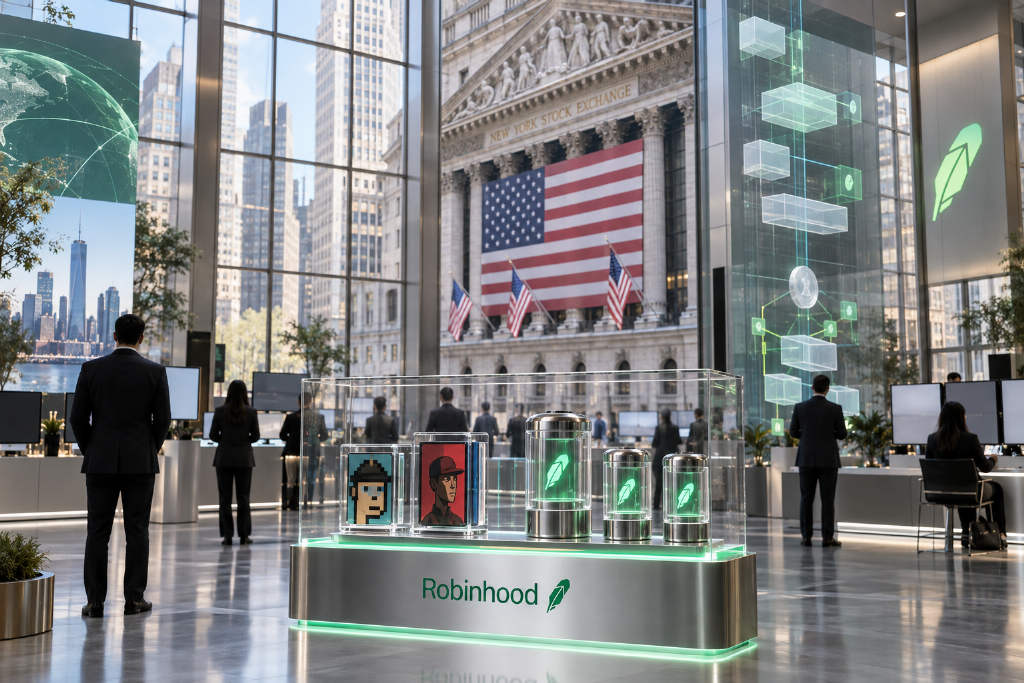
On Sept. 28, meme coin trader Ansem said in a video interview that he thinks NFTs can come back in this cycle. His take was pretty direct: art NFTs might get hot again, sure, but the bigger story is the fresh wave of experiments around the format itself—pairing NFTs with AI agents, reworking ownership structures, trying new issuance models, and finding more ways to plug NFTs into onchain products. He also said onchain capital rotation is still early, which leaves room for more invention around NFTs.
There have been a few obvious market moves. OpenSea data cited in the source shows the CryptoPunks floor climbed from about 29 ETH to about 34 ETH in the second half of September. On Solana, Mad Lads ran too, jumping from 6.6 SOL in mid-September to above 12 SOL at one point—almost a 2x.
But that does not mean the old NFT frenzy is back. Two months earlier, Dragonfly managing partner Haseeb Qureshi gave a much harsher read in a July interview. He said some things in crypto are just not coming back: “If you are still sitting there holding NFTs and waiting for the next NFT cycle, it is time to let go and put your time, capital, and talent somewhere else.” When Dragonfly closed roughly $650 million for Fund IV in February, it made that shift even clearer, leaning toward stablecoins, DeFi, and prediction markets while writing that “non-financial crypto has failed.”
Sales have rebounded from very weak levels, not returned to a broad boom
CryptoSlam data cited in the article says global NFT sales hit about $55.51 million in the seven days through Sept. 26, up 57.17% from the prior week. The previous week, through Sept. 19, came in at about $37.54 million. The week of Aug. 29 was about $63.33 million. So yes, late September looked better. Still, seven-day rolling sales were stuck in the tens of millions of dollars. That is nowhere near the NFT mania of 2021 and 2022, when single-day volume often reached the hundreds of millions. And when volume spikes now, it is often because of a handful of pricey sales, not because the whole market is lifting.
The chain mix is concentrated too. In the week of Sept. 26, Ethereum made up about $30.33 million, more than half of total sales. Polygon posted about $7.44 million, and Bitcoin about $5.13 million. In collectibles, CryptoPunks ranked first with roughly $8.24 million in weekly sales across 85 transactions, involving 62 buyer addresses and 55 seller addresses. The top end still moves. Participation, though, is thin.
Zoom out and the market looks even colder. BlockchainDose, citing CryptoSlam in July, said annual NFT volume in 2025 was about $5.5 billion, down about 37% from 2024 and more than 90% below the 2021 peak. Digital art got hit even harder. DappRadar data cited in the piece shows digital art sales falling from about $2.9 billion in 2021 to $197 million in 2024, then to about $23.8 million in the first quarter of 2025.
The market is still there. It just is not a broad retail speculation arena anymore.
Old blue chips remain, but liquidity and pricing power are weaker
Most major NFT floor prices are still far below their old highs. The article points out that ETH is now trading at $2,670, yet many flagship collections from the last cycle are still nowhere close to peak levels.
Bored Ape Yacht Club is the clearest example here. Its community once pitched it as a Web3 Disney-style NFT brand. The brand still exists. The market power does not look the same. Pricing power and liquidity have both weakened sharply. On Sept. 28, Blockstream CEO Adam Back commented on the ape Justin Bieber bought in January 2022 for 500 ETH, then about $1.3 million, saying it is now worth zero or even negative value because selling it still costs money.
Pudgy Penguins needs a split view. One part is the JPEG floor, about 3.28 ETH, which puts the collection’s total value at roughly $70 million to $80 million. The other part is the token. PENGU has been trading around $0.009, with a circulating market cap listed in the source at about $5.77, down about 86% from its all-time high in December 2024. The article’s point is simple: the liquidity tied to the brand story now sits more in the token than in the NFT itself.
Three conditions have changed
The article says Haseeb’s view matches three shifts that have already taken place.
First, the one-time setup behind the 2021 boom is gone. That cycle mashed together altcoin wealth effects, pandemic stay-at-home behavior, a broader public grasp of ERC-721, and celebrity participation that turned profile pictures into a status competition. Avatars became social currency. Floors became belief systems. Hard to recreate that mix. This time, retail attention looks more focused on meme coins and tokenized stocks than endless avatar rows on OpenSea.
Second, demand never caught up with supply. Dragonfly Fund III had NFTs, blockchain gaming, and DAOs among its themes, but Fund IV shifted toward financial infrastructure. In public comments around February, Haseeb kept making the same point: users were not pushed away only by regulation or scams. They simply did not want those consumer-facing Web3 products. Money and talent poured into gaming, social, creator tokens, and PFP brands. The demand still did not show up.
Third, liquidity in the old blue chips is now too thin to support the idea of a full-cycle return. The article cites BAYC doing three trades in a day, while Azuki, Doodles, and CloneX no longer work as blue-chip pricing anchors. If an asset class only turns over tens of millions of dollars a week, and most of that is concentrated in a few collections like CryptoPunks, then it is not sitting there waiting for a broad bull market. It is waiting for another burst of concentrated buying.
There is another route. NFTs may keep spilling into physical consumer products, IP licensing, and retail channels, with Pudgy Penguins used as a live example. In that version, the market may still price the brand while refusing to bring back 2021-style liquidity to the image itself.
The image is not dead, but capital has moved on
The article says the 2021 NFT trade was really about selling scarcity, identity, social capital, and wealth effect. Capital markets now care more about yield, liquidity, composability, tradability, and cash flow. That is the issue with JPEGs. Not that nobody likes them. They just lose on capital efficiency when stacked against financial assets.
From a wider cycle view, the piece argues NFTs are going through a brutal but needed bubble purge. It lays out three stages. In 2021, the market traded pure consensus, virality, and celebrity effect, with profile pictures acting as social currency. In 2024 and 2025, NFTs partly slid into tools for early interaction on new chains and positioning for airdrops, basically becoming accessories for token farming. Now comes the current stage. Back to basics. What is the asset actually for, and how is the financial design built?
The article sees that shift as healthy. Strip away the empty image bubble and the industry can start taking mechanism design and real innovation more seriously.
If a comeback means the exact 2021 model—celebrity profile-picture flipping, always-rising floors, and the idea that almost any JPEG should go up—then the current data does not back it. If NFTs come back, the argument is that they are more likely to return by carrying RWA, fees, and agent-related functions.
CryptoPunks is drifting closer to a digital artifact pricing model. In December 2025, the Museum of Modern Art in New York acquired eight CryptoPunks: 4018, 2786, 5616, 5160, 3407, 7178, 74 and 7899. BAYC and Azuki, by contrast, are described as brands that still have listings and occasional buyers, but not much more than that on a sustained basis.
Why Pudgy Penguins has held up better than its peers
Pudgy Penguins is presented as one of the clearest examples of an old blue-chip NFT surviving both bull and bear markets. If CryptoPunks kept its floor by dropping utility talk and leaning fully into the logic of a one-of-one digital artifact, Pudgy took another path. It got out of the narrow zero-sum game inside Web3.
Its JPEG floor still sits around 3.28 ETH, but the collection has kept a relatively high level of activity and attention over the last one to two years. The article ties that to several overlapping reasons. Pudgy Penguins ran avatar marketing campaigns with multiple crypto protocols. Historical data cited in the source includes major exchanges such as Coinbase, Binance US, OKX, and Kraken, plus major wallet and payment brands including Phantom, Ledger, and MoonPay.
That helped turn Pudgy from a simple PFP speculation vehicle into what the article calls a “super IP” with strong cultural appeal and a sense of safety. The NFT was also used multiple times by some crypto protocols as an eligibility NFT for airdrops, while gains in its token helped support heat and the floor price.
Even so, the article says that is no longer the real business picture. The stronger logic is in its push through physical consumer goods, IP licensing, and retail distribution. Pudgy toys are now sold in thousands of Walmart, Target, and Walgreens stores across the U.S., with cumulative unit sales above 1 million and physical retail revenue above $10 million.
The core move was separating liquidity from the brand. Brand narrative and high-frequency tradable liquidity shifted to PENGU, a token with a large circulating market cap and daily volume that can reach hundreds of millions of dollars, while the original NFT became a kind of “super VIP pass” at the center of the brand. While many old blue chips are still sitting around waiting for bids on OpenSea, Pudgy has already monetized through both Web2 retail shelves and Web3 token markets.
Robinhood Chain experiments: the NFT as a container, not just an image
Robinhood Chain has been pulling in meme coin traders since launch, but the article says NFT and RWA experiments are showing up there too. OpenSea data cited in the source breaks the chain’s popular NFTs into three groups: cultural or meme PFPs such as Hashcats, Cash Cats, and Rekt Tradooor; protocol or brand equity NFTs such as Chain Mancers and Goat Street; and, by trading volume, the busiest group of all—stock-container NFT-Fi projects such as Quotrons, StonkBrokers, and RH Machines.
The projects that really shifted attention away from “a new chain issuing new pictures” and toward “what else an NFT can do” were Quotrons and StonkBrokers. Their visuals are nothing alike. One looks like a 1960s Wall Street market terminal. The other looks like a pixel stockbroker. Under the hood, though, they are trying to do the same thing: turn an NFT from a transferable picture into a container that can hold assets, distribute fees, and move positions together with the token when it is sold.
That is a clean break from the old model. In 2021 and 2022, leading collections such as CryptoPunks, BAYC, and Pudgy got their value from community, avatar identity, and later IP development. The JPEG itself produced no cash flow. Then came a later GameFi wave that tried to keep holders engaged with ever-expanding game-token issuance, often ending with inflation crushing the floor. NFT-Fi protocols such as NFTX, Sudoswap, BendDAO, and Blend improved leverage and liquidity around existing picture assets, but they still did not make those assets productive by themselves.
Quotrons and StonkBrokers flip that logic around. First they define what the NFT can hold and why it receives distributions. The image is just the shell. Funding does not come from project-issued points. It comes from real onchain transaction fees, and those fees are then used to buy Robinhood-issued stock tokens on the market. The source is explicit here: those stock tokens provide price exposure, not equity in listed companies, and they carry no voting rights.
Quotrons
Quotrons has a fixed supply of 4,444 and uses ERC-404, with one fungible token matching one terminal. When a unit is first purchased, the screen is dark and it can only be traded. If the holder burns the corresponding token, the terminal becomes permanently connected, the screen lights up, and it begins receiving tokenized U.S. equities along preset tracks that include NVDA, AAPL, TSLA, GME, and SPY.
Burned tokens cannot go back into circulating supply. Every time another machine goes live, one less unit remains available to flip on the market. The terminal also gets fee flow, with part allocated to rewards and part used for buybacks and burns. The difference from a classic PFP is blunt: the buyer is not paying for a rare skin. The buyer is deciding whether to lock liquidity into a machine that can no longer be sold back into the market.
StonkBrokers
StonkBrokers takes another route. All 4,444 broker NFTs are built on ERC-6551. Each NFT receives its own token-bound account at mint, and that account is preloaded with random stocks. After activation, the NFT shares in Anvil AMM fees according to its tier. The protocol uses those fees to buy more stocks and deposits them into the accounts tied to activated brokers.
If the NFT gets sold, any unclaimed assets in the account move with the image. But the activation state resets. So the next owner has to pay a fresh activation fee to keep receiving rewards, and part of that fee is burned. A companion token, STONKBROKER, ties the NFT and token into the same exchange relation: the image can be redeemed for a fixed amount of tokens, and the tokens can be turned back into the image. In practice, what is being traded is not just an avatar. It is the broker image, the stock exposure inside it, and the right to future fee distributions.
The article says these mechanisms create three lines separating them from older NFTs. One, income rights are written into the contract instead of being promised in some roadmap airdrop. Two, supply falls with use: Quotrons through hardwired burning, StonkBrokers through activation burn and reset on turnover. Three, the transferred asset is no longer just an image plus a community ticket. It is an account with positions attached.
RWA may be the next real opening for NFTs
On Sept. 20, Ansem said he had bought his first batch of NFTs in years. His reasoning: tokenized stocks, RWA, and stablecoins are building the base infrastructure, and NFTs can sit on top of that stack as an ownership layer, access layer, and community layer. He added that hybrid models combining NFTs with fungible tokens had been tried before without success, but were still worth another look: liquid tokens can support broad participation, while NFTs can carry higher-tier rights.
The evidence for that thesis, the article says, is not in JPEGs. It is in the RWA market. Analysis from a16z crypto cited in the source says RWA perpetual volume reached $117.3 billion in August 2026, up about 44x year over year. Of that, about $101.0 billion, or 86%, happened onchain, while centralized exchanges handled about $16.0 billion. Open interest reached about $4.8 billion, up roughly 30x from $161 million in July 2025. By product mix, equities made up 48%, commodities 28%, and indices 18%.
Put differently, the ownership claims now being traded onchain are increasingly tied to stocks, bonds, commodities, and their perpetuals. If NFTs want relevance again in this cycle, they need to attach themselves to that thicker rail. The job is not to reprice profile pictures. It is to turn an NFT into a container, access pass, or dividend-bearing wrapper for those assets.
The article is blunt about it: in 2021, NFTs sold scarcity and identity, with returns dependent on the next bidder. Now a pure JPEG loses on capital efficiency to a tokenized stock that can trade around the clock. That is why an “NFT + fungible token” model may be worth trying again only because the base layer has changed. Once tradable stock tokens and real fee streams exist underneath, the NFT finally has something to hold.
RH Machines and Rare Friends Genesis are still experimental
Robinhood Chain already has collections built around that logic, though the article stresses they are still experiments for now.
RH Machines has a fixed supply of 10,000 and is described as a set of “small stock counters” on Robinhood Chain. New machines are dormant by default. To switch one on, the holder has to burn the companion token PRINTER, in a process the project calls “inking.” Once activated, the machine receives tokenized U.S. stocks bought with protocol fees, weighted by factors such as rarity, and those stocks are deposited into the machine’s built-in onchain account. The supply of PRINTER only declines. Fees are used both to buy stocks and to burn the token. The article says RH Machines’ floor rebounded from a low of 0.003 ETH to fluctuate around 0.04 ETH.
Rare Friends Genesis is another example. It is a genesis collection created by a Doodles co-founder, with a supply of 1,024. The artwork and animation are written into the contract, and each NFT comes with its own wallet. Buying the NFT does not automatically give dividend rights. The holder must pay another 100,000 RF to activate it, with half burned and half sent to the prize pool, in order to obtain a fixed weight. Selling resets activation, so the next owner has to pay again. The article describes it as more like an onchain pet with dividend rights. According to the latest OpenSea data cited in the source, its floor has dropped from 2 ETH to below 1 ETH.
OpenSea’s CMO also pointed to tokenized physical assets
Alongside onchain stock containers, some industry figures are also positive on tokenized real-world goods. In an interview in May, OpenSea Chief Marketing Officer Adam Hollander said that even though avatar collections such as BAYC and CryptoPunks had already seen their prices collapse, NFTs still work well as a technology for proving ownership of digital and physical assets. He said many buyers in the last cycle did not actually want the underlying item. In his view, the next adoption wave is more likely to come from tokenized collectibles such as Pokémon cards and Rolex watches, along with digital tickets, game items, and AI tools.
The article ends on a clear point. The version of the NFT boom built on celebrities changing profile pictures and sending assets sharply higher is over. But that may be the start of a more mature phase. Attention is shifting from speculative consensus toward cash flow and composability, and from airdrop tooling toward infrastructure for AI agents and RWAs. As long as work on ownership mechanisms keeps going, NFTs stripped of their JPEG bubble may still find a way back through structures with higher capital efficiency.