
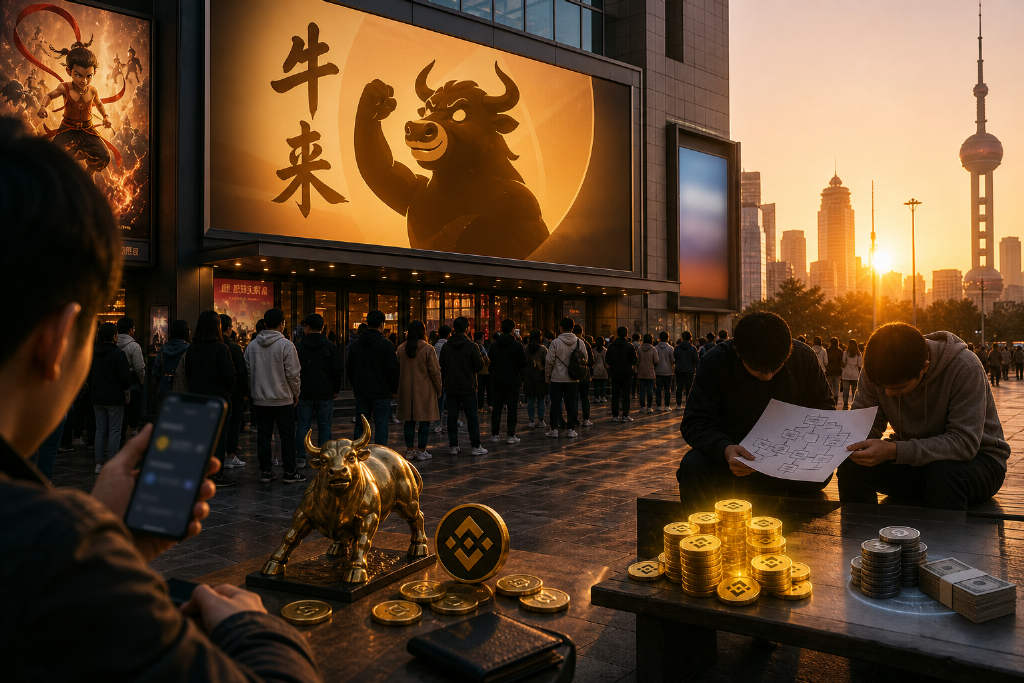
The BNB Smart Chain meme token called Niu Lai rose alongside the sudden popularity of the animated film of the same name. The source article says the token’s market cap peaked at 46M, or $46 million, and climbed 139% over 24 hours on Aug. 17, the day rumors spread that some theaters had been told to pull the film. The piece also notes that the token had already fallen sharply by the time of publication.

The film itself had become a surprise story. According to the article, the movie sold only 7,169 yuan in its first nine days after release, but cumulative box office reached 13.33 million yuan by the evening of Aug. 17. Maoyan projected a final total of 89.21 million yuan. Some theaters in certain regions received notices to remove the film, with the stated reason being concern that it could affect the city’s image. On the morning of Aug. 17, related A-share names also moved, with Luoniushan hitting its daily limit and Jinniu Chemical up more than 6%.
The developer launched four tokens in four days, but made nothing on the main Niu Lai token
The article says on-chain data points to a developer address, 0x6af3f52369c39f6ca2d9a50799723feff7ff679e, that issued two tokens both named Niu Lai within six minutes on the morning of Aug. 13. Over the next four days, the same address also launched Xiong Zou and Bandao Ti.
The second Niu Lai became the main market. Based on GMGN data cited in the report, the address did not make a single buy or sell in that token. In other words, the address that launched the winning version did not profit directly from trading it. The article reads this as a sign that the creator was not sure which version would catch on, or even whether Niu Lai as a meme concept would work at all.
The first Niu Lai, issued six minutes earlier, failed to gain traction, and the second followed almost immediately. The article says the surviving token’s market value ended up hundreds of times larger than the combined value of the other three, while the developer’s profit had little to do with it.

Profit came from the fourth token, Bandao Ti
According to the report, the same address launched its fourth token, Bandao Ti, at 11:18 a.m. on Aug. 17. The name refers to a meme from the film.
This time, the developer bought 377 million tokens in the same transaction that created the token, equal to 37.7% of total supply, spending $2,180. About 90 seconds later, the address started selling. From 11:19 to 11:21, it made 12 sales in two minutes and realized more than $10,000 in profit. The article describes the move as selling into the excitement of the first wave of buyers.
By the time the source piece was published, nearly all profit generated by the address over the previous 30 days had come from those two minutes. It also says the address never traded Xiong Zou or the first Niu Lai, and both tokens had already died out.
An Aug. 18 update added that after the original draft was completed, the creator launched two more tokens, Niu Lailai and Moo, the latter described as a meme likely mimicking a cow’s sound. The article says those two tokens each brought in more than $7,000, reinforcing the idea that the creator only started pressing harder after missing the main Niu Lai run.
The token was prepared before the film hit the trending lists
The report says GMGN history shows the wallet was created on Aug. 12. Its first incoming funds arrived at 11:47 a.m. on Aug. 13, when it received 0.0074 BNB, roughly $4.5, just enough to cover gas.

The funding address was 0xb716776de8377f7de5f65e87320655327698fd42. According to the article, that wallet was created on Aug. 1, had no other on-chain transaction history, and its only action was sending gas to the developer wallet.
Six minutes after receiving the gas, the developer launched the first Niu Lai. The film only reached the trending charts the next day, according to the article.
- Aug. 12: the wallet was created.
- Aug. 13, 11:47 a.m.: it received 0.0074 BNB, about $4.5, for gas; 11:53 a.m.: the first Niu Lai was launched; 11:59 a.m.: the second Niu Lai was launched.
- Aug. 14: the phrase about the film making 7,169 yuan in nine days hit the trending lists.
- Early Aug. 15: Xiong Zou was launched.
- Morning of Aug. 17: Bandao Ti was launched, and more than $10,000 was cashed out within two minutes.
The timeline suggests the setup was in place before public attention arrived. Less than 24 hours passed between wallet creation and token issuance, and only six minutes separated receipt of gas from launch. The article says all four tokens were created through Flap, a one-click BSC token issuance tool that can mint a token for a cost of just a few dollars.
The main liquidity pool was built by another address, which was still active
The source article says the main Niu Lai trading pool was not created by the developer wallet.

On-chain records cited in the report show that address 0x1ab7727e8817402069dc0a2c7d6fc25e76bfc953 created the main USDT pool for Niu Lai early on Aug. 15 and supplied the initial liquidity itself. The gas for that address came from 0x3a62262930534e493d7bf823608291f2544d0b01.
The latter address, the article says, has 4,861 on-chain transactions and appears to be a regular liquidity operator. After the pool was set up, it kept adding position size and collecting fees. It was still adding exposure in the early hours of Aug. 17 and was still signing approvals for Niu Lai around 2:30 p.m. that day. The article says it had not exited.
The author also checked whether the developer wallet had any direct fund transfers with either of the two pool-related addresses. After reviewing 33 transactions from the developer wallet, the article says there were no transfers between them at all, leaving the three addresses on parallel tracks.
The report offers one possible reading: the developer handled the initial token launch and made quick money from its own short-term plays, while a separate player may have been responsible for the larger Niu Lai pool and deeper liquidity. The article notes that the launch-side profit was a little over $10,000, while the pool being maintained by the other side reached $1.24 million in liquidity at its peak.
Bots grabbed 33.9% at launch and later split holdings across many wallets
The article also says sniping bots used bundled transactions to grab 33.9% of the supply at launch. Those tokens were then split up and moved across dozens of addresses, making individual wallets look more like retail holders. As a result, the current holder structure appears relatively dispersed on-chain.

Still, the report argues that this dispersion looks manufactured rather than organic. It does not go beyond that with a forecast, but it notes the large bot-controlled positions could still become a factor if they are sold in sync.
Film takedown rumors and token gains fed the same trade
The article closes with the backdrop that gave the token extra momentum. On Aug. 16, some theaters in certain regions were told to pull Niu Lai, with the reason described as concern over the city’s image. Reports that the film faced a nationwide scheduling halt then spread more widely. In that setting, some market participants framed the token as part of a resistance narrative, and the token rose 139% in 24 hours, according to the report.
The source also compares the movie’s box office with other films. It says Niu Lai had already outgrossed several better-funded productions. A Man and A Woman, directed by Guan Hu and starring Huang Bo and Ni Ni, with investment of about 200 million yuan, had total box office of 3.85 million yuan. The Silent Friends, led by Tony Leung, stood at 5.2 million yuan.
The article quotes one online remark: 「One man and one woman are not worth as much as a single cow.」 It ends on a blunt note. Whether Niu Lai signals any broader bull market is unclear, but attention driven by rebellion and curiosity has already arrived.