
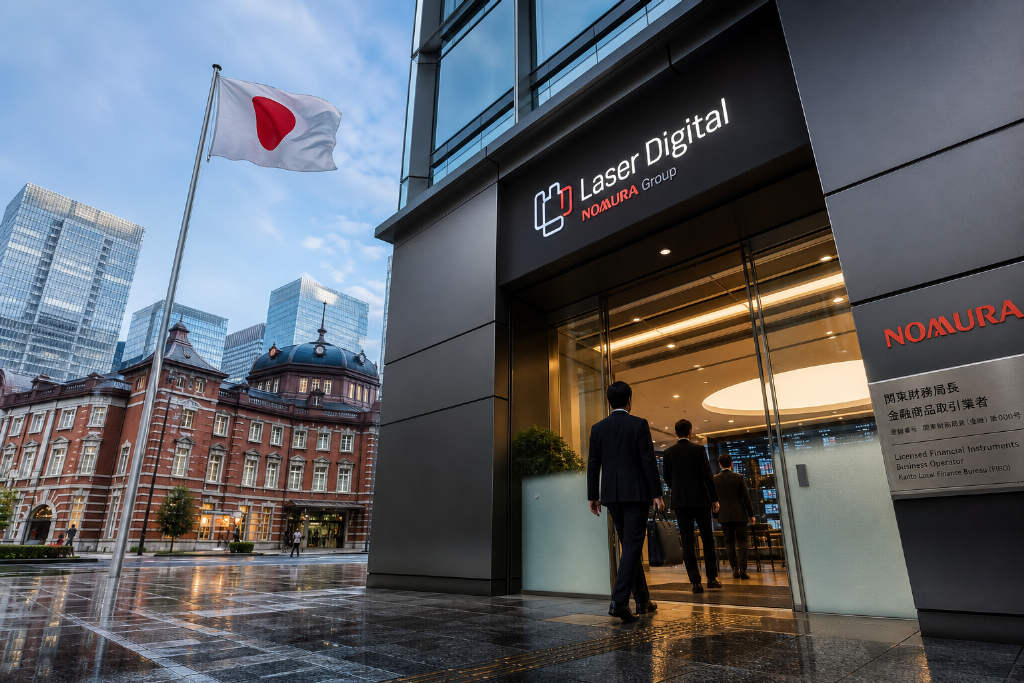
After nearly four years without a new name on Japan’s list of licensed crypto trading operators, Laser Digital Japan, a subsidiary of Nomura Holdings, completed its registration as a crypto-asset exchange service provider on Aug. 21. It is the first newly added crypto trading institution in Japan since 2022.

Laser Digital Japan is not taking the usual route associated with consumer-facing crypto exchanges. Under its current plan, the company will begin by serving licensed domestic crypto service providers in Japan, supplying liquidity to those platforms before expanding into digital asset trading services for institutional investors.
That is why the bigger story is not simply that Japan has one more licensed player. The more important shift is that the country’s crypto market is moving toward a new division of roles.
From early mover to a market with no new entrants for years
Japan was one of the first countries to build a formal regulatory framework for crypto trading. Back in 2017, it formally introduced a registration regime for crypto-asset exchange businesses, requiring companies that provide services such as exchanging crypto assets and fiat currency in Japan to register.
After large-scale asset theft incidents at platforms including Coincheck, the regulatory approach moved quickly toward risk control. In reforms introduced in 2019, Japan tightened rules on customer asset management, advertising and marketing, trade monitoring, and market manipulation. It also required customer crypto assets, in principle, to be managed through methods such as cold wallets. Those reforms raised the operating bar for exchanges and shaped the Japanese market for the years that followed.
Running a full crypto trading institution in Japan involves heavy costs in compliance, system security, asset management and internal governance. Market entry is not just about presenting a matching engine or a trading interface. A company also has to show that it can meet risk-management standards that are close to those applied to financial institutions over the long term.
That has produced a licensed market with limited numbers and strict entry requirements. Existing players have been able to expand their products and services, but it has been hard for new operators to enter directly.
Laser Digital’s own timeline reflects that reality. Nomura established its digital asset subsidiary Laser Digital in 2022 and set up its Japan entity in 2023. Even with the backing of one of Japan’s largest securities groups and an established global compliance and risk-management framework, the company did not secure access quickly. From laying out its presence in the Japanese market to completing registration as a crypto-asset exchange business in August 2026, the process took close to three years.
That makes the next question more important than the approval itself: how Nomura intends to use a scarce license.
Why Nomura is choosing institutions over retail
The most obvious use of such a license would be to launch a retail trading venue. Laser Digital is going another way. Based on the plan currently disclosed, Laser Digital Japan will first serve domestic VASPs in Japan, using its trading capabilities to provide liquidity to those platforms. It will then move further into digital asset trading services for institutional investors.
Retail has long been one of the most profitable customer segments for crypto exchanges. Individual trades may be small, but user numbers are large, trading is frequent, and fee rates are usually higher than those charged to institutional clients. Coinbase offers one clear comparison: in 2025, consumer transaction revenue was about $3.3 billion, while institutional transaction revenue was below $500 million, even though institutions generated far more trading volume.
For Nomura, though, the question is not simply which segment produces more revenue. It is which business line fits the strengths it already has.
Japan’s retail crypto market is mature after more than a decade of development. Platforms such as Coincheck, bitFlyer, bitbank, SBI VC Trade, GMO Coin and Binance Japan have been operating for years and already control users, apps, brand recognition, payment channels and operational systems. If Laser Digital tried to fight for retail customers from scratch, it would need to build marketing, user acquisition, customer service and retention systems and spend heavily on incentives.
The institutional market works by different rules. When an asset manager, a corporate treasury or a family office wants to allocate capital to digital assets at scale, the priorities are usually market depth for large orders, counterparty reliability, custody arrangements, and whether internal compliance and risk teams can approve the setup.
Those are areas that sit much closer to the core skill set of a traditional investment bank. Revenue in institutional business is not limited to transaction fees. It can also come from market-making spreads, block trading and order execution, and then extend into asset management, custody and other digital asset services.
Laser Digital’s global business already spans secondary trading and asset management, while Komainu, a Nomura-affiliated company, has built a position in digital asset custody. Compared with constructing a full retail platform from zero, the institutional market is the cleaner fit for Nomura’s existing strengths.
Native crypto exchanges usually start with users and then add more financial products around that customer base. A traditional financial group such as Nomura comes from the other direction: it already has institutional clients and wants to add crypto to the services it already provides.
Earlier this year, Nomura surveyed 518 investment professionals across domestic institutional investors, family offices and public-interest corporations in Japan. The results showed that 65% of respondents see crypto assets as an opportunity for portfolio diversification. Among those considering entering the crypto market within the next three years, 79% already had investment plans. Valuation methods, price volatility, regulation and counterparty risk remained the main obstacles.
For Laser Digital, those obstacles are also commercial demand. Nomura does not need to build another retail exchange in the style of Coincheck. It can provide liquidity to existing trading platforms, execute block orders for institutional investors and continue serving those same clients across asset management, custody and derivatives.
In that sense, Laser Digital is trying to carry Nomura’s institutional trading model from traditional capital markets into crypto.
Policy changes are opening more room for traditional finance
Laser Digital is still only one case, and the license on its own has limited meaning. What makes it notable is the wider policy backdrop in Japan.
As crypto assets are increasingly held as investment assets, the question of how they fit into the country’s capital-market regulatory system has become a major reform issue.
In July 2026, Japan’s parliament passed amendments to the Financial Instruments and Exchange Act and the Payment Services Act, setting a direction for moving oversight of crypto-asset trading from the Payment Services Act to the Financial Instruments and Exchange Act. Crypto assets will not be treated directly as securities such as stocks or bonds, but trading in them will be supervised more through capital-market rules covering disclosure, unfair trading and investor protection.
Tax policy is changing at the same time. Japan’s fiscal 2026 tax reform proposals state that, provided the relevant regulatory reforms take effect, gains from qualifying specified crypto-asset trading would be subject to a separate 20% tax rate, and related losses could be carried forward for three years.
Until now, gains from personal crypto investing in Japan have largely been taxed as miscellaneous income under a comprehensive taxation system. For higher-income investors, the effective tax rate has been materially higher than for financial products such as stocks. That gap has long been viewed as one of the main constraints on the development of Japan’s crypto market. If the new framework is formally implemented, the tax gap between crypto assets and equities would narrow significantly.
There is another change as well. The framework for electronic payment instruments and crypto-asset service intermediaries, introduced in June this year, lowers the cost for financial institutions to connect to crypto services from a different angle.
Under the new intermediary mechanism, a company that only acts on behalf of a licensed institution to provide customers with intermediation for crypto-asset transactions, without directly taking on full exchange functions such as custody, may not need to obtain a full crypto-asset exchange license itself.
That means bank group subsidiaries, securities platforms and internet finance platforms may be able to plug crypto services into their existing customer channels without building a complete exchange stack on their own.
The combined effect of these regulatory changes is to reduce the interface cost between crypto and the traditional financial system. As crypto assets become easier to distribute through securities companies, easier to allocate through institutional capital, and easier to connect with existing custody, settlement and asset-management systems, large financial institutions with licenses, customer networks and capital strength are in a better position to extend their existing businesses into crypto.
That could produce a structure closer to traditional finance: one set of firms controls customer access, another supplies liquidity, another handles execution, another safekeeps assets, while others package those capabilities into funds, ETFs or other investment products.
In the past, large financial groups typically entered crypto by acquiring or operating crypto exchanges. In the next phase, the areas they compete for may center more on liquidity, institutional brokerage, asset management, custody, stablecoins and settlement networks. Laser Digital’s new license places it in the trading and liquidity layer of that system.
For traditional financial institutions, the opportunity set is no longer the same as it was a few years ago. When crypto was viewed mainly as a high-risk emerging trading market, the usual advantages of major banks and securities firms were less decisive. Once the market starts to revolve around investment products, institutional trading, custody, stablecoins and settlement, licenses, capital, customer networks and risk-management capabilities begin to matter much more.
As Japan redesigns the connection points between crypto and the traditional capital markets, one of the key questions in the next round of competition may be who secures those positions linking capital, products and clients first. Laser Digital has already shown Nomura’s answer.