

Lazarus is widely believed to have close ties to North Korea’s Reconnaissance General Bureau, setting it apart from ordinary cybercrime groups. U.S. law enforcement agencies have repeatedly said North Korea uses stolen crypto assets to obtain foreign currency and, in some cases, fund weapons programs under international sanctions.
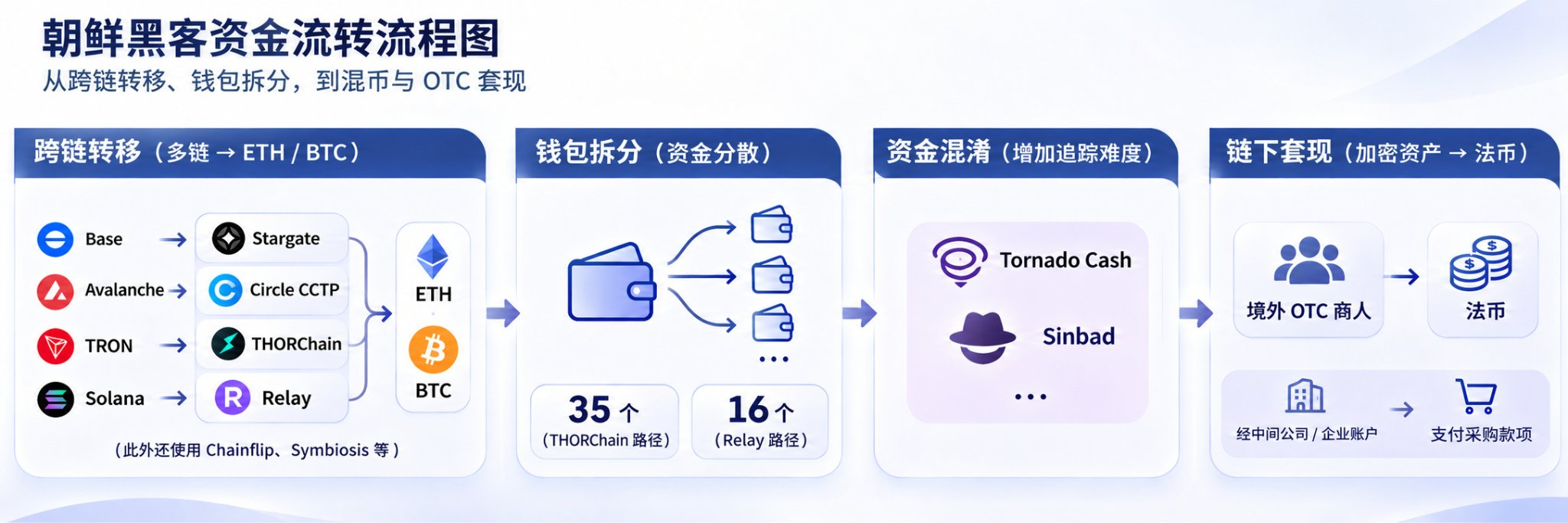
After the Binance theft, the hackers moved quickly again. Recent on-chain tracking, together with older cases such as Ronin and Bybit, outlines a familiar route: deal with freezeable assets first, consolidate funds across chains, split them into fresh wallets, and then push them toward off-chain cash-out networks.
Stablecoins were the first assets they tried to unload
On Oct. 29, North Korean hackers stole about $6.3 billion in assets from 17 Binance hot wallets across nine blockchains, including Ethereum, Bitcoin, Tron and Solana.
A large share of the haul consisted of centralized tokens such as USDT and USDC. Those assets carry issuer freeze risk, and some Layer 2 networks also retain emergency administrative powers that can force the movement of tainted funds. That helps explain why the attackers rapidly sent stablecoins through multiple intermediary wallets and swapped them on decentralized exchanges into native assets such as ETH and TRX while the transfers were still underway.
Even so, a large amount could not be moved in time. According to Bitquery, about $2.7 billion in assets was frozen or otherwise brought under the control of issuers and related entities. Of that total, about $729 million in USDT was transferred before freezes were imposed.
Cross-chain routing pushed funds toward Ethereum and Bitcoin
Once the first round of swaps was complete, the hackers began using cross-chain protocols to move funds scattered across different networks onto Ethereum, Bitcoin and other major chains, then split the balances again across a large number of new wallets.
Tron provides the clearest example. The attackers first swapped about $234 million in USDT into 638 million TRX, then distributed that balance across multiple wallets and routed it through at least six cross-chain protocols, including THORChain. As the funds moved, they were repeatedly split and swapped, with most of the value ultimately ending up as ETH on Ethereum.
Similar patterns appeared on other chains:
- Some assets on Base were bridged to Ethereum through Stargate and eventually consolidated into about 1,187 ETH.
- Assets on Avalanche were first converted into USDC, then sent to Ethereum through Circle CCTP and finally exchanged into about 7,243 ETH.
The hackers also selected protocols such as Relay, Chainflip and Symbiosis based on liquidity depth on different chains, moving funds in batches to reduce slippage from large conversions.
The money did not go straight to exchanges after bridging. It was split again across many fresh wallets. One batch of ETH obtained through THORChain was dispersed to 35 addresses. Another batch moved through Relay, swapped into ETH through CoW Swap, and then spread across 16 more wallets.
Elliptic said the process showed a high degree of automation. A main Tron distribution wallet used by the hackers completed more than 1,100 transfers between Oct. 30 and Nov. 1, and newly funded addresses usually sent funds out again within two minutes. Some failed bridge attempts were retried.
FBI asked for intervention, but protocol responses varied
On Oct. 31, the FBI, the U.S. Secret Service and IRS Criminal Investigation published an advisory listing addresses tied to the North Korean hackers. They called on THORNode operators, RPC node operators, instant swap platforms and DeFi service providers to block the transactions.
Some protocols responded.
- Symbiosis said it detected attempts to move the funds through its protocol and contacted Binance.
- Relay has address risk-screening tools, but on-chain activity still showed the funds moving through the protocol.
Among the entities singled out by the FBI, THORChain drew the most scrutiny. The network behind THORNode has already faced repeated criticism for processing funds linked to hacks.
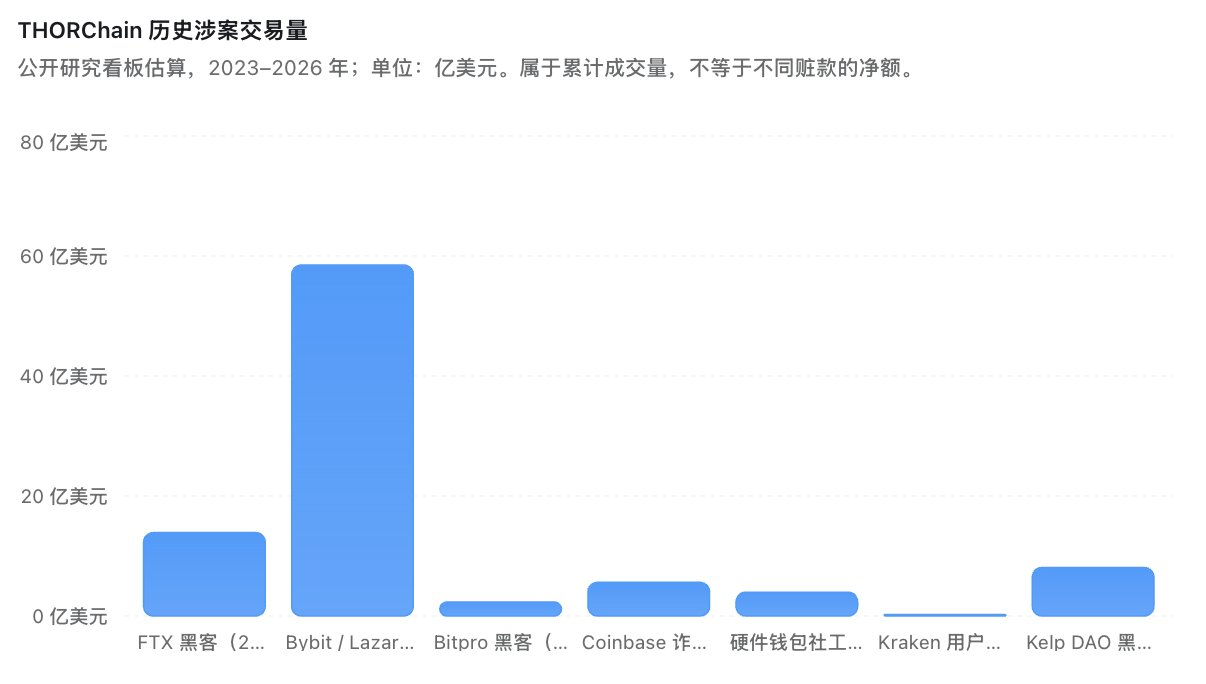
From 2023 to 2026, THORChain generated about $9.27 billion in volume and $12.47 million in fees across seven hack or scam cases involving FTX, Bybit, Kelp DAO and others. In the 2025 Bybit theft alone, it generated about $8.63 million in fees.
In the Binance case, THORChain again became a route for cross-chain transfers. Responding to the FBI’s request, co-founder Chad Barraford, known on X as @CBarraford, said node data is already public and no subpoena is needed.
In a twist, the event that halted most THORChain cross-chain transactions was not the FBI request but an abnormal 10 ETH refund. On Oct. 31, an Ethereum block reorganization triggered an emergency pause mechanism. As of Nov. 1, related transactions on 10 chains, including Bitcoin, Ethereum and Tron, were still affected.
Cross-chain transfers are only one part of the laundering chain
Past North Korean operations suggest bridging is only one stage. The next steps often involve mixers to make tracing harder, followed by underground OTC brokers that convert crypto into fiat.
In April 2025, Bybit CEO Ben Zhou said about 28% of the stolen assets had become difficult to trace. Those funds mainly moved through mixers and cross-chain bridges before ending up in P2P and OTC conversion channels.
In October that year, the Multilateral Sanctions Monitoring Team, or MSMT, a group formed by 11 countries, disclosed more details about the off-chain cash-out network.
The investigation found that by April 2025, North Korean operatives had arranged the cash-out of more than $100 million in Bybit proceeds through an intermediary in Hong Kong. Separately, they converted at least $60 million in crypto assets through intermediaries in Russia, including part of the Bybit funds.
Cambodia played a different role. Investigators said North Korean operatives worked with a North Korean national living in Cambodia to move crypto into designated wallets, gather it for later conversion, and then arrange cash-outs through other locations, including Hong Kong.
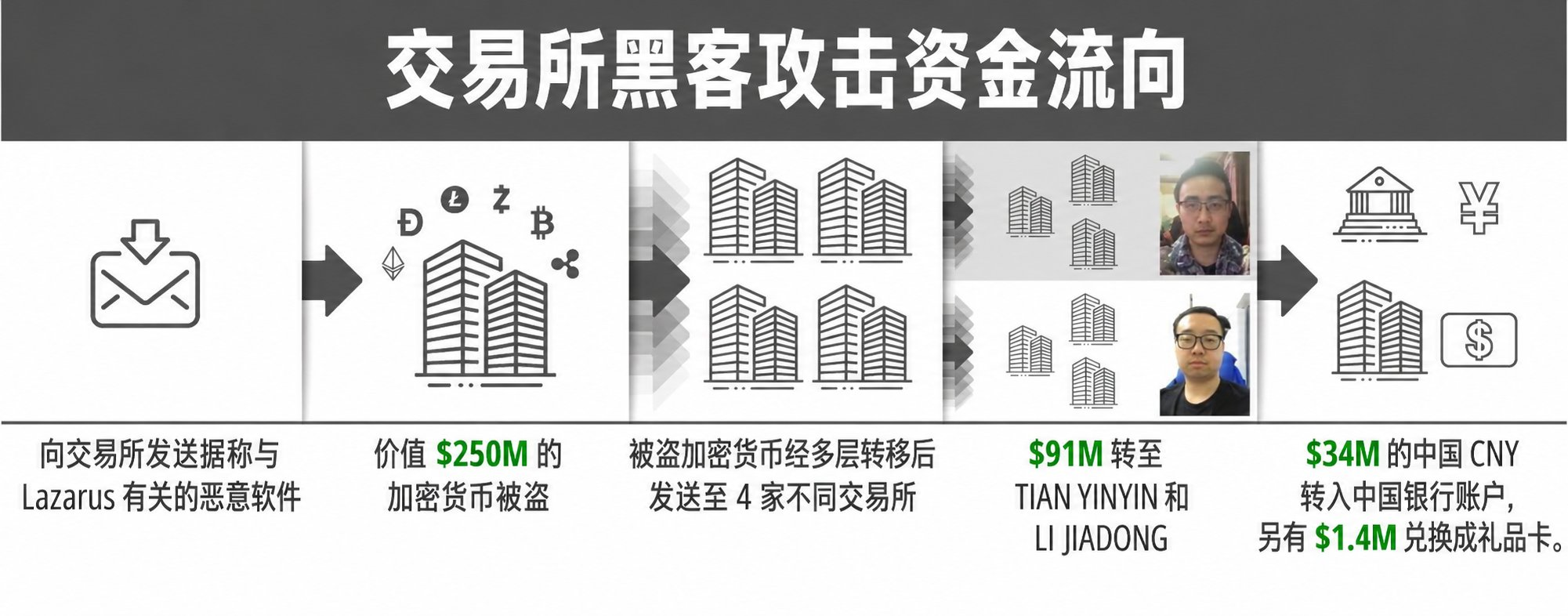
A similar pattern appeared as early as 2018. That year, Lazarus stole about $250 million from an exchange and then sent about $91 million of it to two Chinese intermediaries. The U.S. Treasury later found that one of them moved more than $34 million through bank accounts and converted some BTC into Apple iTunes gift cards.
The Binance funds are still on the move
In the current Binance case, the hackers are still swapping assets, bridging funds and splitting wallets. Past cases suggest North Korea has already built a relatively mature off-chain cash-out network.
Over more than a decade, the crypto industry has gone through multiple bull and bear cycles, while exchanges and DeFi protocols have come and gone. Lazarus has remained active throughout. The source material notes that these operators may pose as job seekers, investors, business partners or even ordinary online contacts who have been in touch for months. A routine meeting invitation or a work file can be the starting point of an attack.



