
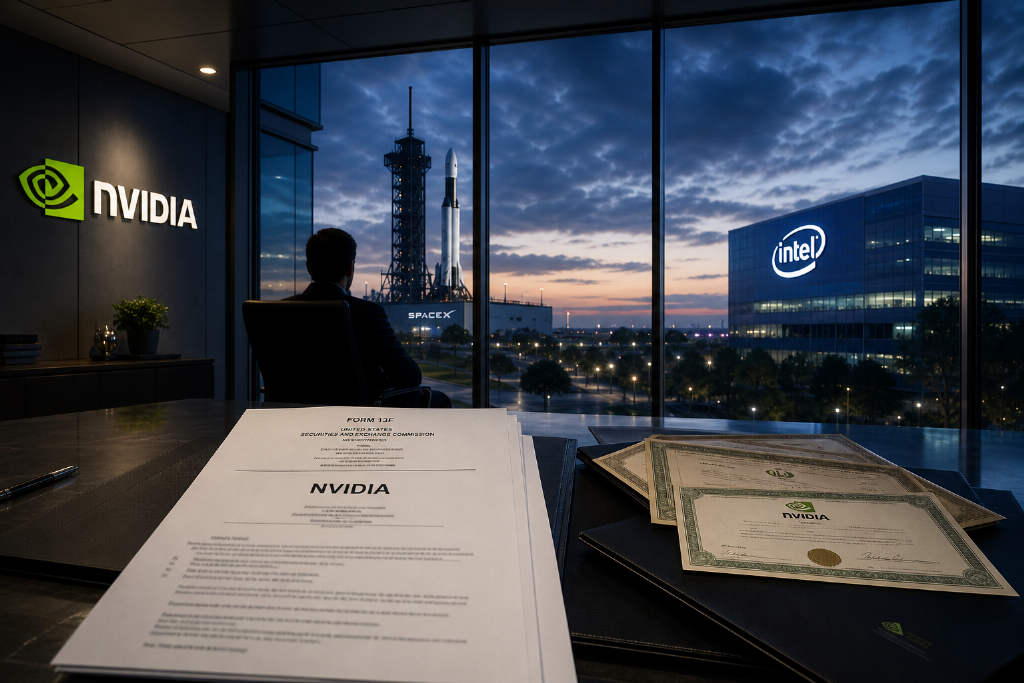
BlockBeats reported on Aug. 16 that Nvidia disclosed its latest Form 13F for the quarter ended June 30, reporting holdings in eight U.S. stocks with a total market value of about $63.44 billion. That compares with $18.37 billion at the end of the first quarter, an increase of roughly 245%.
Intel remained the largest position, while SpaceX appeared for the first time
Intel stayed as Nvidia’s biggest disclosed holding. The company held 215 million shares with an end-of-quarter value of about $29.99 billion, or roughly 47.3% of the 13F portfolio.
SpaceX appeared in Nvidia’s 13F filing for the first time. Nvidia reported holding 123 million shares valued at about $20.98 billion at quarter-end, making it the second-largest position and about 33.1% of the portfolio. Intel and SpaceX together accounted for about 80.3% of Nvidia’s reported holdings.
The filing also listed six other holdings
- CoreWeave: 47.21 million shares, valued at about $4.70 billion
- Coherent: 7.79 million shares, valued at about $3.07 billion
- Nokia: 166 million shares, valued at about $2.21 billion
- Synopsys: 4.82 million shares, valued at about $2.15 billion
- Nebius: 1.19 million shares, valued at about $330 million
- Generate Biomedicines: 830,000 shares, valued at about $14.06 million
The jump in reported value did not mean Nvidia bought $45 billion of stocks in Q2
On portfolio changes, SpaceX was the only new addition to the 13F. The share counts of the other seven stocks were unchanged from the end of the first quarter.
That indicates the sharp increase in the portfolio’s reported value came mainly from the first-time inclusion of the SpaceX position and higher market values for existing holdings. It did not mean Nvidia made roughly $45 billion of net stock purchases in the secondary market during the second quarter.
According to BlockBeats, Nvidia’s SpaceX stake came from its earlier investment in xAI, rather than from direct purchases in the secondary market after a SpaceX listing.
What the 13F does and does not show
A 13F filing only reflects reportable securities holdings at the end of a quarter. It does not disclose when the positions were acquired, the investment cost, or any trading activity after the quarter-end date.