
NVIDIA open-sources Alpamayo 2 Super
Artificial intelligence is moving from digital and virtual settings into physical-world use cases. NVIDIA has open-sourced Alpamayo 2 Super, its latest inference model for autonomous driving and embodied AI, also referred to as Physical AI.
The model carries 34 billion parameters in total. It combines a 32 billion-parameter NVIDIA Cosmos 3 Super Reasoner visual-language reasoning engine with a 2 billion-parameter Diffusion Action Expert.
NVIDIA says Alpamayo 2 Super goes beyond systems that mainly rely on image recognition. It adds Chain-of-Causation, or CoC, reasoning, allowing the model to simulate edge cases in a virtual physical world within milliseconds and work through optimal decisions. On the LingoQA autonomous driving benchmark, the model scored 79.2.
Jensen Huang says physical AI is the next wave
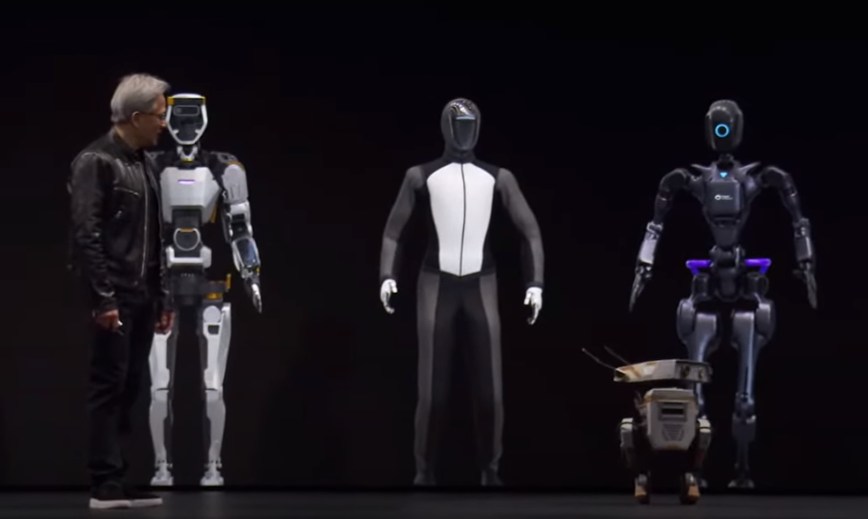
NVIDIA CEO Jensen Huang said the next major wave in AI will center on physical AI and robotics. He described self-driving vehicles as robots with four wheels, arguing that both autonomous driving and robotics rely on the same Vision-Language-Action, or VLA, foundation that combines perception, semantics, and action.
With Alpamayo 2 Super, AI systems can interpret the physical environment and carry out more complex instructions. NVIDIA expects physical AI technology to spread into factory automation, logistics, and daily-life scenarios over the next one to two years.
Taiwan supply chain roles come into focus
The report cited senior media professional Chang Yu-hsuan as saying Taiwan’s tech supply chain is showing clear division of labor as NVIDIA expands its physical AI ecosystem.
On the compute side, TSMC is identified as the exclusive foundry partner for key chips including Thor and Jetson. Foxconn and Quanta are named for system integration and large-scale assembly. In industrial computing, Advantech, ADLINK, AAEON, and Nexcom provide edge control systems, while Solomon focuses on 3D AI vision sensing for environmental recognition in robots.
Precision components and power systems support robot movement
The report said robot motion still depends on precision mechanical components. HIWIN, Global PMX, and HIWIN Mikrosystem supply ball screws, linear guideways, and vibration-control parts to support movement stability. Mirle provides pneumatic control, while Delta Electronics is positioned in lightweight, high-endurance power modules.
Taken together, the companies named in the report form a broad hardware support network for the sector.
TAIROS 2026 could lift attention on the sector
The article also pointed to the 2026 Taiwan Automation Intelligence and Robot Show, or TAIROS, which is scheduled to open on Aug. 19. Combined with recent strength in NVIDIA shares, the report said the event could help drive another wave of attention toward robotics.