
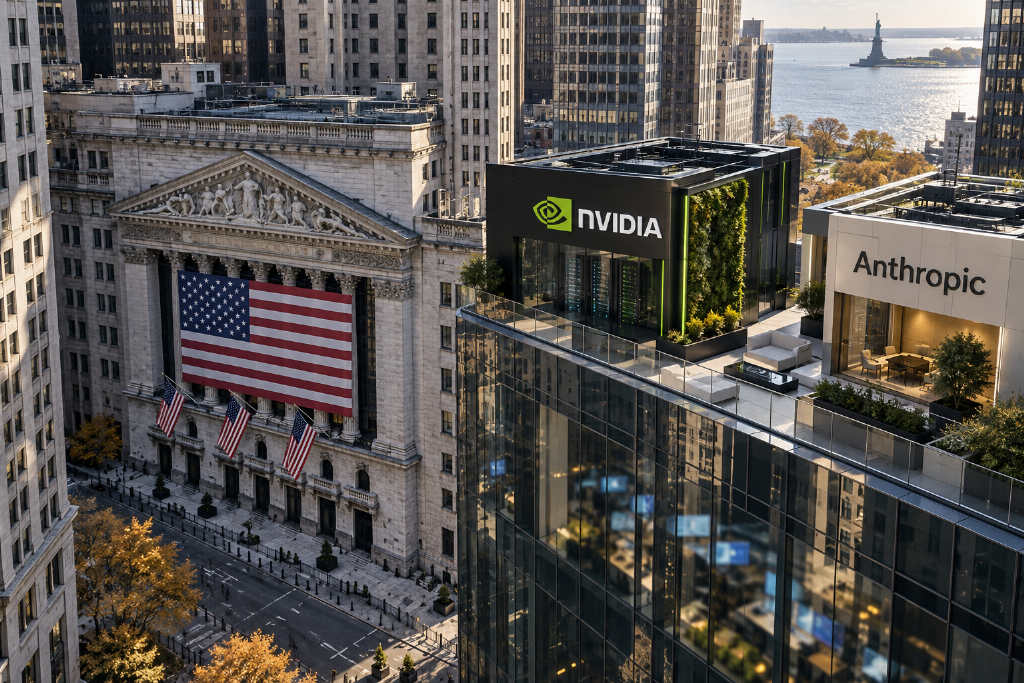
Nvidia is in talks to invest up to $10 billion in Anthropic’s planned initial public offering as an anchor investor, according to an exclusive Reuters report that cited two people familiar with the matter.

Reuters said Anthropic is aiming to raise as much as $100 billion in the offering at a valuation approaching $2 trillion. If the deal goes through at that size, its fundraising would exceed the $75 billion IPO record set by SpaceX in June. Based on the figures cited in the report, Anthropic alone would account for roughly 73% of the $137 billion raised across the U.S. IPO market, excluding SPACs, in the first eight months of the year.
The discussions are ongoing and the terms could still change, Reuters reported. Anthropic declined to comment, while Nvidia did not immediately respond. The IPO is expected to be completed before the U.S. midterm elections in November this year.

Anchor investor role in focus
The report said Nvidia is considering taking part as an anchor investor, a type of institutional buyer that commits to purchasing shares before the public roadshow begins.
It pointed to previous examples. Nvidia and Amazon served as anchor investors in Arm’s listing, while Saudi Arabia’s Public Investment Fund, or PIF, played a similar role in SpaceX’s IPO.
Nvidia’s existing financial and supply relationship with Anthropic
Reuters’ report, as summarized in the source text, described a relationship that already extends beyond a possible IPO purchase. Anthropic depends on Nvidia GPUs to train and run its Claude models, and Nvidia has already invested heavily in the company.
In November 2025, Nvidia invested $10 billion in Anthropic, according to the article. In exchange, Anthropic committed to buy $30 billion in compute on Microsoft Azure, with that infrastructure running on Nvidia chips.
If Nvidia adds another investment of up to $10 billion during the IPO, the capital link between the two companies would stretch from the private market into the public market.
Amazon and Google also tied in as backers and compute suppliers
The article said Nvidia is not the only major backer with a dual role. Amazon and Google were also described as both investors and infrastructure suppliers to Anthropic.

In April, Anthropic said it would spend more than $100 billion on Amazon Web Services over the next 10 years and use more than 1 million Amazon Trainium2 chips. The company also signed what the source described as a multi-gigawatt TPU expansion agreement with Google and Broadcom.
The report presented that structure as a clear example of how money flows through the AI sector: model companies raise capital, then direct a large share of that money back into chips and cloud capacity.

Revenue growth and valuation step-up
The valuation target is being supported by Anthropic’s growth curve, the article said. Anthropic’s annualized revenue was about $9 billion at the end of 2025, then climbed to more than $65 billion by the end of July 2026, an increase of more than sevenfold in seven months.
Reuters had previously reported that Anthropic expects revenue to reach $190 billion to $200 billion in 2028.
In May this year, Anthropic completed a $65 billion financing round at a $965 billion valuation. A public offering near $2 trillion would imply another sharp jump in valuation within a matter of months.
Rising compute demand and custom chip efforts
The article also said demand for Claude has grown so quickly that Anthropic’s existing compute capacity is under strain. To reduce its dependence on outside chip suppliers, the company has formed an internal team to work on custom chips.
IPO market backdrop
As of the end of August, the U.S. IPO market had raised $137 billion, a record high for the period, according to the source text. The year is still ongoing.
Against that backdrop, the report cast Anthropic’s listing plan as a major moment for AI assets entering public markets. It also said Anthropic and OpenAI are viewed as the two companies most likely to reach artificial general intelligence first, and that both are expected to list on Nasdaq in sequence.

The article added that total global AI-related spending has reached $2.6 trillion.
The core report cited in the piece was Reuters’ Sept. 11 exclusive. The MarsBit page said the article was sourced from the WeChat account "Xinzhiyuan," written by "Xinzhiyuan," and edited by Solomon.