

A policy controversy around leveraged exchange-traded funds in South Korea set the backdrop for a volatile two-day stretch across Asian equities. According to the report, a senior policy official in the South Korean presidential office is facing criminal accusations over the "hasty introduction" of leveraged ETFs. These products embed 2x or 3x leverage, magnifying gains on the way up and losses on the way down, with forced liquidation risk once losses deepen.

The article says leveraged ETFs became a major amplifier in the latest swing from a surge to a slump in Korean stocks. From peak levels, the sector’s size has already shrunk by about 70%. On the same Monday that Korean equities dropped again, Morgan Stanley upgraded South Korean stocks to overweight in a research note and set a 9,000-point target, citing among other reasons that hedge fund deleveraging was about three-quarters complete.
Aug. 3: Korean stocks slide and China’s semiconductor chain comes under pressure
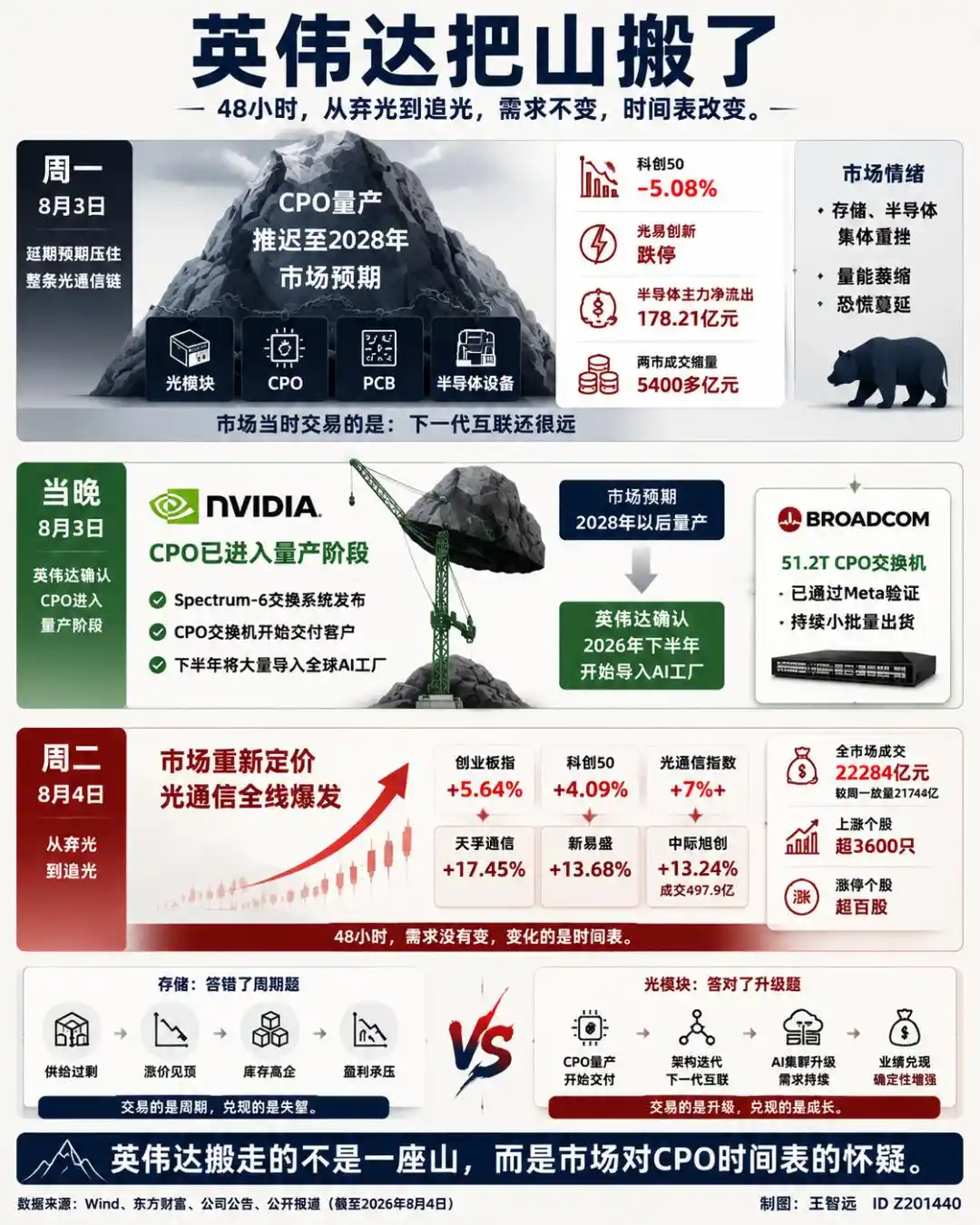
The sequence started on Monday, Aug. 3. Before the open, Asia-Pacific markets had already begun to price in the shock from South Korea. The KOSPI opened lower, stayed weak through the session and closed down 5.12% at 6,257.
Deleveraging pressure then moved through the semiconductor supply chain and into China’s A-share market. The STAR 50 Index closed down 5.08% at 1,552.89, its largest single-day drop in the recent period. The Shanghai Composite lost 0.59%, the Shenzhen Component fell 0.96%, and the ChiNext Index dropped 1.24%.
But the index tape alone did not capture the whole session. More than 4,000 stocks rose and 83 hit their daily upper limit, showing a sharp split between weak large-cap heavyweights and stronger smaller names. The main damage was concentrated in storage and semiconductors.
GigaDevice illustrated the pressure. The company had just announced over the weekend that it planned to repurchase 1 billion yuan to 2 billion yuan of its own shares, with a buyback ceiling of 750 yuan. Even so, the stock fell limit-down on Monday with 23 billion yuan in turnover. Demingli fell more than 9%, Zhongke Feice dropped more than 12%, and the STAR Semiconductor ETF lost nearly 10% in a single day. Using East Money data, the article said the semiconductor sector posted 17.821 billion yuan in net main-force outflows, the largest across all industries.
Trading activity also retreated. Combined turnover in Shanghai and Shenzhen shrank to 2 trillion yuan, down by more than 540 billion yuan from the previous Friday. The source article described it as the harshest day of clearing in computing hardware in the past week.
Wall Street reverses, and Nvidia changes the market’s assumptions
The turn came later that day in U.S. trading on Aug. 3 Eastern Time. Stocks in the U.S. opened higher and closed higher. The Nasdaq gained 2.13%, the S&P 500 rose 1.48%, and the Dow Jones Industrial Average added 1.32% and set a closing high.
The Philadelphia Semiconductor Index was down as much as 3% intraday before ending in positive territory. Sandisk was down 8% at one point and finished up more than 6%. That kind of deep intraday reversal usually points to a clear shift in expectations.
In the article’s telling, Nvidia was the reason. The technical centerpiece was CPO, short for co-packaged optics. Put simply, it combines the optical engine and the switching chip in one package and is seen as a key answer for next-generation AI cluster interconnects. Market chatter in earlier research reports had suggested mass production of CPO could be delayed across the board until 2028, weighing on valuations for optical module makers.
This week Nvidia released the Vera Rubin platform and the Spectrum-6 switching system. More important for sentiment, senior vice president Shainer said at a technical forum that CPO has already entered mass production, that switches co-developed with supply-chain partners have started shipping to customers, and that deployment will expand in the second half across global AI factories.
The article also noted that Broadcom’s 51.2T CPO switch has passed Meta validation and is continuing in small-batch shipments. Taken together, those signals undercut the market narrative that CPO adoption had been pushed far out.
Citi added another data point: capital expenditure at four major U.S. cloud providers rose 79% year over year in the second quarter, and the group slightly raised full-year guidance, giving demand visibility out to 2028. Nvidia rose nearly 3%, bringing its market value back above $5 trillion. Lumentum and Coherent both climbed more than 9%, Kioxia ADRs gained about 14%, and Corning rose more than 6%.
Aug. 4: A-shares pivot from abandoning optical names to chasing them
That setup fed directly into Tuesday, Aug. 4, in mainland China. The main indexes opened higher and pushed up through the day. The ChiNext Index jumped 5.64% to 3,488.97. The Shenzhen Component rose 3.25%, the STAR 50 advanced 4.09%, and the Shanghai Composite added 0.33% to 3,822.28.
Total market turnover reached 2.2284 trillion yuan, up 217.4 billion yuan from Monday. More than 3,600 stocks rose and more than 100 hit limit-up.
Optical communication was the center of attention. Tianfu Communication climbed 17.45%, Eoptolink rose 13.68%, and Zhongji Innolight gained 13.24% to close at 1,021.99 yuan. Zhongji Innolight alone traded 49.79 billion yuan for the day.
CPO-related names saw a wave of limit-ups. Guangku Technology, Accelink Technologies and Cambridge Technology were among more than 10 stocks to close at the daily limit. On the PCB side, more than 20 stocks hit limit-up. On the Beijing Stock Exchange, Hengdong Optic rose 20.83%, while Dingtong Technology and Sharetronic Data both gained more than 17%. The optical communication concept index rose more than 7% for the full session, making communications the best-performing sector in the market.
Institutional money was visible in the leaderboard as well. The top institutional buy on the Dragon and Tiger list was Shijia Photons at 829 million yuan. By the close, A-shares had five stocks trading above 1,000 yuan: Lianxun Instrument, Zhongji Innolight, Cambricon, Yuanjie Technology and Kweichow Moutai. The first four moved higher together, while Moutai fell 2.25%.
Older heavyweights stayed under pressure. China Merchants Bank lost 2.68%, Ping An Insurance fell 2.92%, and banks, baijiu, airport shipping and automakers clustered on the downside list. The SSE 50 Index slipped 0.29%, leaving a 593-basis-point gap versus the ChiNext’s gain.
The source article framed the past 48 hours as a move from abandoning optical names to chasing them again. Demand had not changed, it argued. What changed was the market’s preferred question: not who spends the most on AI, but who can turn that spending into profits.
Not all money flowed equally, and Hong Kong told a different story
The 2.2 trillion yuan in turnover was not spread evenly across the market. Shanghai accounted for 1.01 trillion yuan and Shenzhen for 1.21 trillion yuan, showing a clear concentration of flows toward Shenzhen. The CSI 300 rose 1.27%, while the Beijing Stock Exchange 50 gained 1.62%.
Hong Kong equities showed two different moods over the two days. On Monday, while Japan and South Korea sold off, Hong Kong rose against the trend and the Hang Seng Index moved back above 26,000, helped heavily by Alibaba’s gain of more than 7%. On Tuesday, the Hang Seng gave back 0.60%.
Still, the optical communication rally crossed into Hong Kong. Zhongji Innolight’s H shares rose 17% and Cambridge Technology’s H shares gained nearly 20%. Autos and mainland banks lagged, with XPeng down more than 4% and both CCB and ICBC down more than 3%. The article’s summary was blunt: A-shares had already rushed into the trade, while Hong Kong was still standing at the door.
CXO stocks rise after WuXi AppTec lifts full-year outlook
Optical names were not the only strong theme. CXO stocks also posted solid gains, though with less noise.
After the close on Aug. 3, WuXi AppTec released its interim report. Revenue came in at 28.897 billion yuan, up 38.93% year over year, while net profit attributable to shareholders reached 11.08 billion yuan, up 29.43%. More important for the market, the company raised its full-year revenue guidance from 51.3 billion yuan to 53 billion yuan up to a new range of 58.5 billion yuan to 60.5 billion yuan. It also announced a cash dividend of 5.1 yuan for every 10 shares.
On Aug. 4, WuXi AppTec’s A shares hit limit-up and closed at 141.35 yuan with 10.5 billion yuan in turnover. Its H shares rose 11.17%, and WuXi Biologics added 4.28%. The CRO concept ranked among the day’s top gainers.
The report compared that move with the earnings preview from Advanced Micro-Fabrication Equipment Inc. China, or AMEC. The company said first-half net profit would rise 282% to 311%. But the source article broke down the result and said 1.982 billion yuan of that came from fair-value changes and investment income tied to equity investments, compared with just 168 million yuan a year earlier. Revenue from the core equipment business, by contrast, grew by about 35%. In other words, a large part of the profit surge came from investment gains rather than operating growth.
Policy signals, AI model pricing, and oil’s drop on Middle East headlines
Several policy and macro headlines from the weekend through Aug. 4 also shaped the tape.
On Aug. 1, China’s central bank held its second-half work conference and reiterated an appropriately accommodative stance. It said it would make comprehensive use of policy tools and adjust them in a timely way to maintain ample liquidity and support domestic demand. The article said the wording was not new, but at this point in the cycle it still served as a stabilizing signal.
That same weekend, the State Council approved four nuclear power projects covering eight reactor units. Public reporting cited in the article estimated total investment at more than 170 billion yuan. On Monday, nuclear power and controllable nuclear fusion became standout themes, with more than 26 stocks hitting limit-up, sharply contrasting with the bleeding in semiconductors.
In the AI model market, the article put two developments side by side. On Aug. 3, Alibaba released its new foundation model Qwen3.8 with 2.4 trillion total parameters. According to the article, it ranked behind only Anthropic’s Claude series on the Arena leaderboard and is set to open-source full weights next week. Pricing was also aggressive, with the international input price at just 24% of Opus 5.
Then on July 31, OpenAI cut the price of GPT-5.6 Luna by 80%, reducing input cost per million tokens from $1 to $0.2 only three weeks after launch.
Citing reports from National Business Daily and CNBC, the article said that on API aggregation platform OpenRouter, the share of tokens U.S. enterprises routed to Chinese models has stayed above 30% each week since February this year and reached as high as 46%. In the first half of 2025, that figure was only 4.5%. The article’s conclusion was that the toll booth in the model business is being dismantled, and the main beneficiaries may be cloud providers that already control computing power, customer relationships and distribution.
The Middle East picture remained muddy. On Aug. 3, Trump said talks with Iran had started and would proceed in two stages, reopening the Strait of Hormuz first and pursuing denuclearization second, with the strait to reopen no later than the following day. Iran’s foreign ministry responded the same day that there had been no talks with the U.S. and that it was only talking with Oman. A military adviser to Iran’s supreme leader added that any deployment of U.S. warships would be treated as a target.
The market chose to trade Trump’s version. On Monday, WTI crude dropped more than 5% back toward $80 a barrel. The war premium built in July unwound quickly, and OPEC also decided to increase output by another 188,000 barrels per day in September. Gold, meanwhile, held above $4,050.
On Aug. 4, China released three more policy items. The China Securities Regulatory Commission unveiled 10 measures for cooperation between mainland and Hong Kong capital markets, including support for Hong Kong-listed companies to list on the mainland and faster registration for standard stock ETFs. Revised rules on the protection of integrated circuit layout designs were published and will take effect on Oct. 15, with stronger compensation for infringement. A new five-year plan for building a modern power system was also released, targeting more than 40 million charging facilities by 2030.
Fund flows and the next dates on the calendar
On the money side, Wind data showed net inflows into stock ETFs reached 477.836 billion yuan in July, a record for a single month. The equity private fund positioning index also climbed to its highest level in nearly 52 months. A CICC research note said A-shares may enter a repair phase in August following the large pullback.
The article then listed several immediate watch points. One was a White House meeting later that night, with the Trump administration set to bring together OpenAI, Anthropic, Google and Meta to review the final version of an AI regulatory framework. According to the article, companies may need to submit information to the government before launching new models.
Another was earnings from AMD and SpaceX after the U.S. close. With storage and optical module stocks rebounding for only one day, the article said AMD’s numbers would directly affect whether the semiconductor chain keeps rallying or starts digging a new hole the next day.
Beyond that, the market was watching whether the Strait of Hormuz would actually reopen on the timeline Trump described. Later dates include Aug. 7, when CATL’s interim dividend record date will be set at 14.11 yuan per 10 shares, and Aug. 26, when Nvidia reports earnings, a date the article called the next verification window for the broader AI supply chain.
The reference section of the source article said A-share market data came from Zhiyuan proprietary market tracking, company figures came from official filings, policy information came from official releases, and overseas market moves, research views and Korean media reporting were incorporated in the analysis. The original piece was published on the WeChat public account Wang Zhiyuan, ID Z201440, and credited to Wang Zhiyuan.