
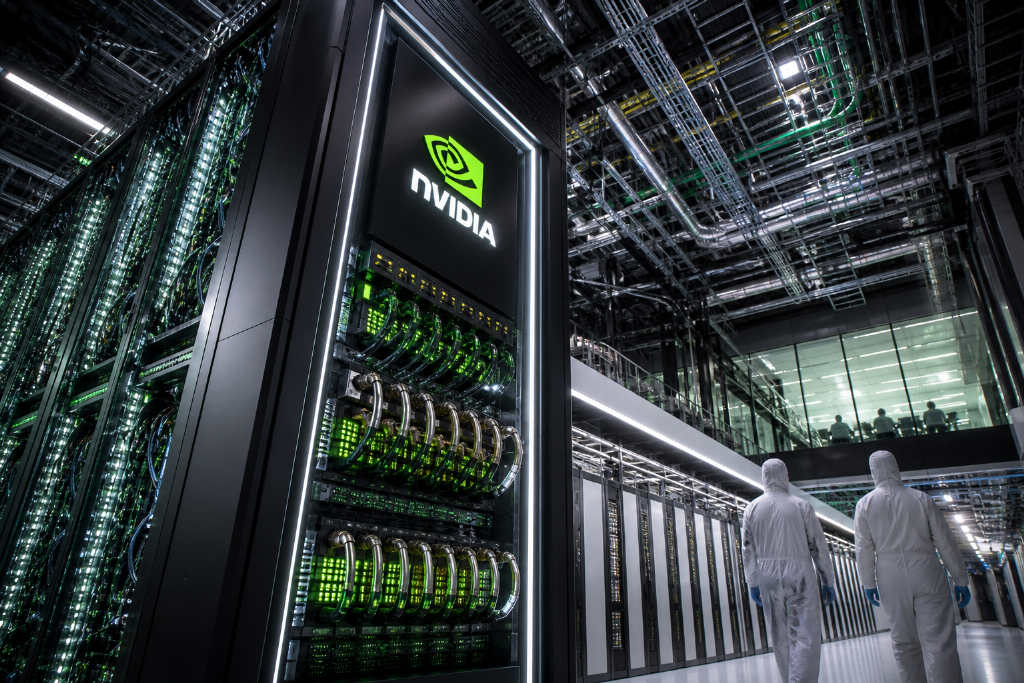
AI commercialization is still translating into bigger demand for computing capacity. The latest WhiteLine Daily roundup put Nvidia, DeepSeek, Anthropic and Salesforce in the same frame, showing revenue growth, long-term compute commitments, margin pressure and enterprise AI monetization moving at the same time.
Nvidia posts $96.22 billion in quarterly revenue
Nvidia reported FY2027 second-quarter revenue of $96.22 billion, up 106% from a year earlier and 18% from the prior quarter. Data center revenue came in at $89 billion, up 117% year over year.
The company said third-quarter revenue is expected to be about $108 billion. That guidance does not include China data center compute revenue. Gross margin was 75% in the second quarter and is expected to slip to about 74% in the third quarter. Management said fourth-quarter gross margin is projected to fall again, to 71% to 72%, because prices for memory and other components have risen sharply.
Nvidia also said its next-generation Vera Rubin platform has entered full-scale production, and the company expects the new products to keep driving data center growth in coming quarters.
WhiteLine Daily's takeaway was direct: demand for AI compute remains strong, but higher memory prices are starting to eat into Nvidia's margins.
DeepSeek reports strong revenue growth, high API margin
According to The Information, citing people familiar with the matter, DeepSeek generated about RMB 475 million in revenue in the first seven months of this year, roughly 10 times its full-year 2025 revenue. Its overall gross margin for the same period was 44.6%, while API gross margin reached 82.9%.
The report said DeepSeek posted a net loss of about RMB 715 million in the first seven months of the year, compared with a net loss of about RMB 935 million for all of 2025. DeepSeek has not publicly responded to the reported financial figures.
WhiteLine Daily said the high API margin suggests model efficiency is directly improving the unit economics of AI services, giving low-priced APIs more room to scale commercially.
Anthropic said to commit $45 billion to lease compute
Bloomberg reported that Anthropic agreed to pay about $45 billion over the next six years to cloud infrastructure company Nscale to lease computing capacity from its data center in West Virginia. The arrangement involves around 460 MW of power capacity.
Nscale is set to deploy Nvidia Vera Rubin chips, with the related compute expected to come online starting in late 2027. Bloomberg also said Anthropic and Nscale declined to comment on the deal to Reuters.
WhiteLine Daily said the six-year agreement locks in next-generation compute capacity for Anthropic while also providing longer-term demand visibility for Nvidia's Vera Rubin platform.
Salesforce raises full-year outlook after 11% growth
Salesforce reported FY2027 second-quarter revenue of $11.35 billion, up 11% year over year. Current remaining performance obligation, or cRPO, reached $33.5 billion, up 14%.
Annual recurring revenue from Agentforce and Data 360 was nearly $3.9 billion, rising more than 210% from a year earlier. Agentforce ARR alone exceeded $1.5 billion, up more than 240%.
The company raised its full-year revenue guidance to $46.1 billion to $46.4 billion, about $200 million above the prior range. Of that change, about $100 million came from organic growth, another roughly $200 million was tied to the pending acquisitions of Contentful and Fin, and about $100 million was offset by foreign exchange headwinds.
WhiteLine Daily said Agentforce is producing fast revenue growth, but Salesforce's overall top-line expansion is still running at about 11%, showing that agent commercialization is adding to traditional SaaS growth rather than pulling the whole company back to a high-growth profile.
WhiteLine Daily's main theme for the day
WhiteLine Daily summed up the day with a simple line: AI commercialization is still turning into larger compute demand, with Anthropic's long-term lease and Nvidia's revenue growth standing out as the clearest examples. At the same time, as compute scales up, model efficiency, memory prices and financing costs are having a more visible effect on profitability.