

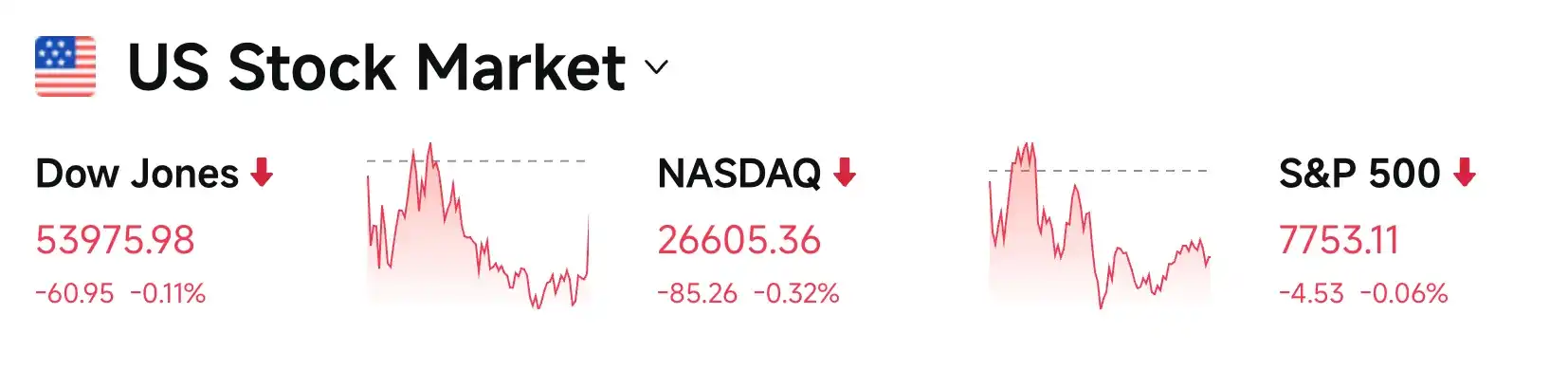
Wall Street stepped back from record highs on Monday as geopolitics and AI financing concerns hit sentiment at the same time. The Dow Jones Industrial Average fell 0.11%, the Nasdaq Composite lost 0.32%, and the S&P 500 slipped 0.06%. The Philadelphia Semiconductor Index dropped nearly 3%, with all 30 components ending in the red, while the semiconductor ETF fell 2.28%.
The dovish reaction that followed Friday’s unexpectedly negative nonfarm payrolls report faded quickly as oil prices rebounded. Market focus swung back to geopolitical risk after expectations for a reopening of the Strait of Hormuz cooled. According to the report, Donald Trump publicly demanded that Iran compensate for the war and related casualties and said that request would be part of future negotiations. Iran, for its part, continued to insist on conditions including lifting the blockade and compensation for losses, leaving less room for talks. Interactive Brokers analyst Jose Torres said the deadlock has unsettled Wall Street and that earlier optimism around a narrowing path to a deal is breaking down.
Oil, gold and yields all moved higher
Brent crude rose more than 5% at one point and settled above $87. WTI climbed back above $82 and moved back through its 50-day moving average. Refined products followed, with U.S. diesel prices rising and European diesel futures jumping more than 10% after settlement. Europe’s benchmark natural gas futures also surged more than 10% intraday, with inventories at only about 59%, well below the five-year average and raising the risk around winter restocking.
U.S. strategic petroleum reserves fell by another 6.1 million barrels last week, taking total reserves below 300 million barrels to the lowest level since 1983 and close to the operating floor. The Trump administration also extended a Jones Act shipping waiver by 90 days in an effort to speed energy transport between ports and ease the pressure of higher oil prices on voters and inflation.
Precious metals rallied as inflation and haven demand built together. Spot gold moved above $4,400 an ounce, its highest since June 5, while silver rose past $66. In base metals, LME aluminum added nearly 2% for a sixth straight session of gains and hit a seven-week high. LME copper also rebounded and posted a record closing high.
In rates, the 10-year U.S. Treasury yield rose about 6 basis points to 4.71%, while the 30-year yield touched 5.25%. Markets lifted the implied probability of a September rate hike to roughly 54%. Cleveland Fed President Beth Hammack said one rate increase would be far from enough and that it may take “several” to bring inflation under control, adding that the current rate range has not yet become meaningfully restrictive. Morgan Stanley’s Chris Larkin said fears around additional hikes could intensify if this week’s inflation data fail to come in below expectations.
Nvidia financing structure becomes the market’s pressure point
The biggest debate inside the technology sell-off centered on Nvidia. The company was reported to be working with Apollo, Blackstone, BlackRock GIP, Brookfield, Goldman Sachs, and KKR on a financing platform designed to mobilize more than $500 billion in third-party capital over time for AI chips, power infrastructure, and data center buildouts.
The report pushed Nvidia shares down more than 3% at one point. Its 5-year CDS spread also widened by about 5.3 basis points to 77.215 basis points, marking the biggest one-day increase in two weeks. The concern in the market was not simply whether the $500 billion figure was real. Traders were asking whether a capital structure of that scale could create a reinforcing loop between demand assumptions, financing availability, and valuation.
Nvidia CEO Jensen Huang later said the $500 billion figure refers to the total amount of third-party capital that these platforms may mobilize in the future, not Nvidia revenue, not the size of a single fund, and not committed money from one customer. He said the financial institutions involved would independently assess customers, utilization, cash flow, and residual value, while Nvidia in some projects could provide residual value support of as much as roughly 25%.
That explanation was meant to move the conversation away from “circular financing” and back toward securitization of AI infrastructure assets. For traders, though, one issue remained unresolved: whether those AI factories can ultimately generate enough cash flow to cover their cost of capital.
Semiconductors and optical names take the hardest hit
Chipmakers and AI infrastructure stocks broadly sold off. Nvidia closed down 2.86%. Separately, the company is also planning to invest as much as $3 billion in power infrastructure company Lancium, which is involved in the electricity buildout for the OpenAI and Oracle Stargate project in Texas.
Across semiconductors, Rambus fell 5.55%, ARM lost 5.21%, Marvell dropped 4.65%, AMD declined 2.6%, Micron fell 1.89%, and Broadcom slipped 1.25%. Intel fell more than 4% after announcing an offering of about $20 billion in common stock, with demand topping $100 billion. Semiconductor research firm SemiAnalysis said equity financing is currently Intel’s lowest-cost route to raise capital for its bet on physical AI and advanced packaging, though near-term dilution weighed on the shares.
Optical communications was the worst-performing AI subsegment. Coherent plunged more than 14%, Lumentum fell more than 8%, ALAB lost 5.07%, CRDO dropped 3.98%, and Corning fell more than 4%. The move reflected how extended the group had become after earlier gains; once Nvidia’s financing model came under scrutiny, optical modules, optical communications, and high-speed transmission names were among the first to be sold.
Software and energy names hold up better
Software stocks moved the other way. Microsoft rose 1.21%, Amazon gained 1.32%, and Palantir added 1.85%. The software group is now up more than 60% from its April low. Cloudflare climbed 3.44%, Datadog jumped 11.48%, ServiceNow rose 2.05%, and Figma added 9.02%.
Microsoft is also planning to launch its next-generation Maia 300 as early as the fall and is in talks with Taiwan Semiconductor Manufacturing Co. over capacity contracts for more than 300,000 chips in 2027, with the eventual target possibly exceeding 1 million units. Among other large-cap tech names, Google rose 0.9% and Meta gained 0.48%. Mark Zuckerberg also said a 30 billion-parameter lightweight open-source model called Muse Glimmer will be released soon.
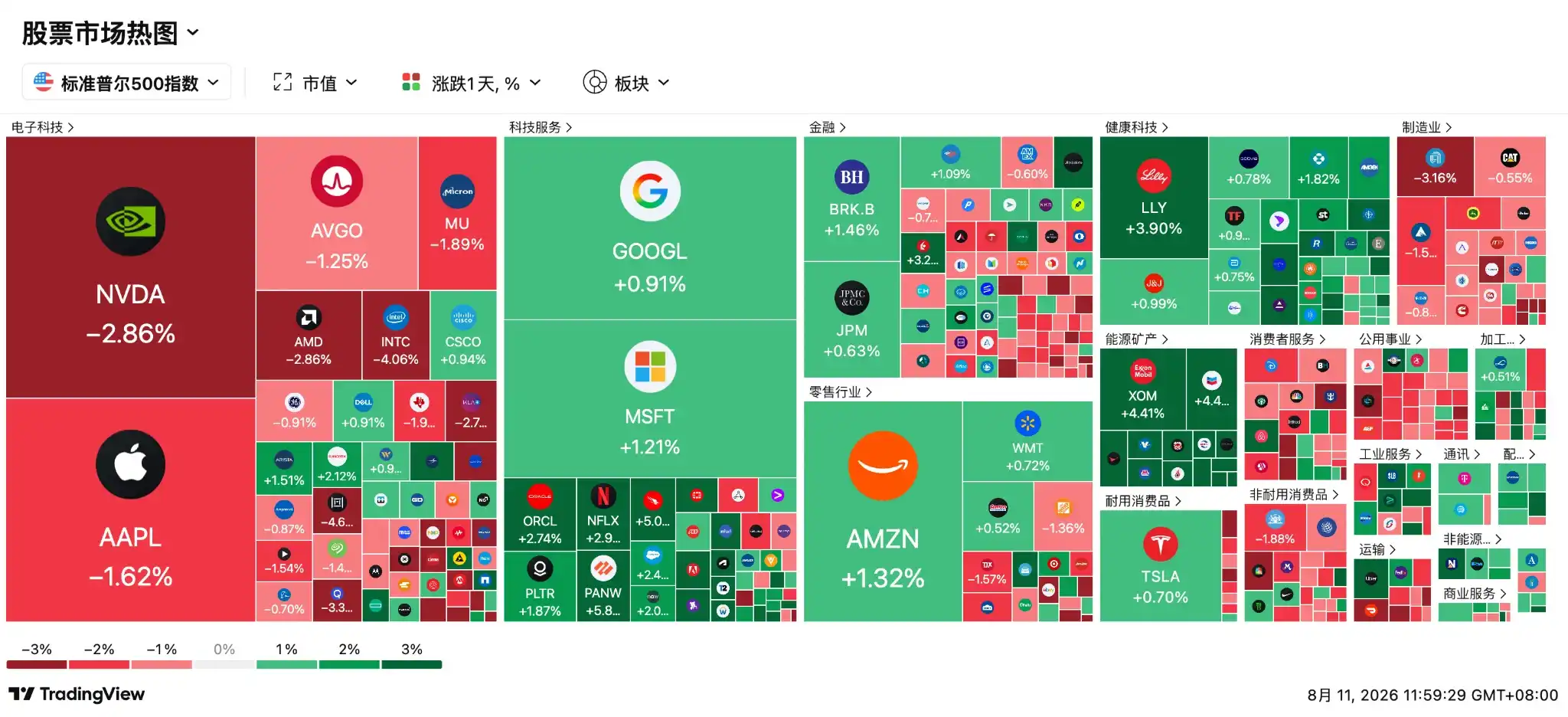
Defense and oil stocks drew inflows as geopolitical risk intensified, and the energy ETF rose nearly 4.7%. SpaceX gained 4.23%, extending its rally to a third straight session and closing at $138, enough to reclaim its issue price. The company’s self-built power narrative and Starlink theme continued to support the stock.
Rocket Lab fell 3.37% and dropped more than 7% in after-hours trading. Its second-quarter revenue rose 62% year over year and came in slightly above expectations. Backlog increased 137% from a year earlier to a record $2.36 billion, and non-GAAP gross margin of 41.5% also beat expectations. Still, the company posted a loss of 8 cents a share versus market expectations for a 6-cent loss, gave third-quarter profit guidance below estimates, and suggested the Neutron rocket program may face fresh delay risk.
What markets are watching next
Next on the calendar is the Reserve Bank of Australia’s rate decision at 12:30 on Aug. 11, followed by Governor Michele Bullock’s press conference at 13:30. Markets broadly expect the cash rate to stay unchanged at 4.35%, with attention on whether softer inflation, weaker employment, and housing risks prompt any signal toward future rate cuts.
On Aug. 12, Lumentum, CoreWeave, and Super Micro Computer are set to report after the U.S. market closes. For investors focused on AI infrastructure, the results and capital expenditure guidance from Lumentum and CoreWeave will serve as a direct test of real end-demand. Super Micro’s gross margin, expected at 15% to 17%, and the pace of order conversion will also shape sentiment around AI server names.