
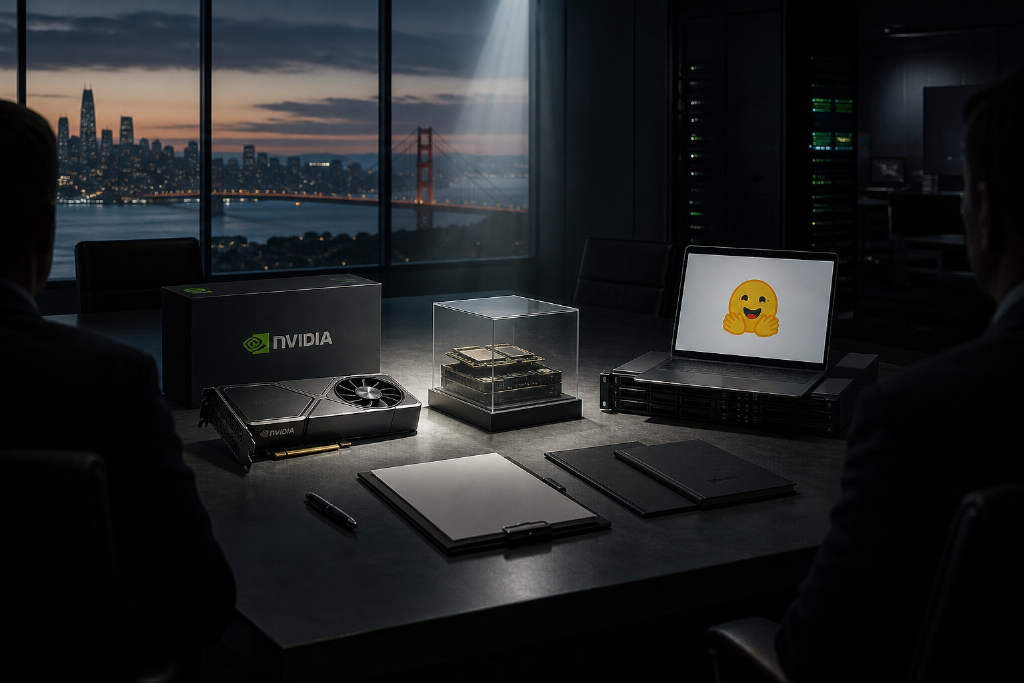
Bloomberg reported on Sept. 2 that Nvidia is nearing an acquisition of open-source AI platform Hugging Face at a price of about $12.9 billion. The total deal value could reach roughly $14 billion, with about $1 billion potentially set aside for employee retention. The two sides have not reached a final agreement, and the timing and terms could still change.
An earlier report from The Information in late August said the companies had already agreed to the transaction. PANews noted the difference in wording and treated Bloomberg’s latest account as the current reference point.
A $150 million revenue base and a $12.9 billion price tag
Another set of numbers makes the potential takeover look unusual. The Information reported on Aug. 24 that Hugging Face’s annualized revenue had just moved above $150 million, up from about $100 million roughly two months earlier.
Using those figures, the reported $12.9 billion offer works out to about 86 times annualized revenue. It is also 2.9 times the company’s $4.5 billion valuation from its 2023 Series D financing.
That gap is central to PANews’ framing of the deal. A company with annualized revenue of $150 million does not justify a $12.9 billion price on a cash-flow basis alone. The article argues that the explanation sits in Hugging Face’s place inside the AI developer workflow rather than in its latest revenue line.
From chatbot app to machine learning infrastructure
Hugging Face was founded in New York in 2016 by three French founders: Clément Delangue, Julien Chaumond, and Thomas Wolf. Its first product was a chatbot app aimed at teenagers, and the company name came from the 🤗 emoji.
When the app launched in early 2017, it was pitched as a digital friend with emotional awareness. That business had little in common with the infrastructure platform the company later became known for.
The turning point came in 2018. After Google released BERT, the Hugging Face team open-sourced a PyTorch implementation in about a week. Chaumond later told research firm Contrary Research that this was the moment the team understood where the company should go next.
From there, Hugging Face gradually moved away from the chatbot business and shifted toward open-source machine learning infrastructure. Its core asset became the Transformers library, a toolset that packaged mainstream pre-trained models so developers could call them with just a few lines of code.
Funding rounds followed that transition
The company’s financing history tracked the same path.
- In December 2019, Hugging Face raised $15 million in a round led by Lux Capital. TechCrunch reported at the time that the Transformers library had been downloaded more than 1 million times and had 19,000 GitHub stars.
- In March 2021, it raised a $40 million Series B led by Addition. By then, the company had launched paid support, private model hosting, and an inference API, and Bloomberg had appeared on its customer list.
- In May 2022, it raised $100 million at a $2 billion valuation. Its own description at the time was to build the GitHub of machine learning, and the platform hosted more than 100,000 open-source models.
- In August 2023, the company closed a $235 million Series D at a $4.5 billion post-money valuation led by Salesforce Ventures. Investors included Nvidia, Google, Amazon, Intel, AMD, Qualcomm, and IBM.
Data services cited by PANews put the company’s cumulative funding at about $400 million.
After 2022, Hugging Face expanded its platform layer more aggressively. It led the BigScience project and released the open-source large model BLOOM. It also folded in a datasets library, Spaces app hosting, and a paper-trends page. Starting in 2024, it built the SmolLM family of small models. In April 2025, it acquired French humanoid robotics startup Pollen Robotics. In February 2026, ggml, the founding team behind llama.cpp, formally joined the company, and Hugging Face said the project would remain 100% open source and community-driven.
PANews describes the pattern this way: in 2019 the company sold a library, in 2022 it sold a platform, and after 2023 it sold an entry point into the community.
How a free platform generates revenue
Hugging Face runs what PANews calls a typical freemium model. The Transformers library, model hub, and datasets hub are free. Revenue comes from three main sources.
Based on Contrary Research’s breakdown, those are:
- subscriptions, with the individual Pro tier starting at $9 per month and the Team tier starting at $20 per user per month;
- usage-based infrastructure services, such as hourly-priced inference endpoints;
- enterprise contracts covering private deployments, single sign-on, audit logs, and other enterprise features.
By its own figures, the company had more than 2,000 paying enterprise customers by June 2025, including Intel, Pfizer, Bloomberg, and eBay.
The growth rate also stands out. The Information said annualized revenue rose from about $100 million to above $150 million within roughly two months, a 50% increase, driven by paid compute, storage, and subscriptions.
Its profitability language, however, shifted over time. Delangue said publicly in July 2024 that the company was already profitable. In July 2026, he told TechCrunch that it was close to profitability. PANews noted that public information does not explain the change in wording.
The part of the business that connects most directly with Nvidia is hosted infrastructure tied to compute. The Information said Hugging Face already helps developers rent compute to run models, which would allow an acquirer to enter that market without starting from scratch.
That matters because the combination of a model distribution gateway and a compute resale layer fits neatly into the gap Nvidia may want to fill inside its own stack.
Why Hugging Face became a default destination
PANews anchored Hugging Face’s role in the developer workflow with two official snapshots.
When Nvidia and Hugging Face announced their partnership in August 2023, Nvidia said more than 15,000 organizations were using Hugging Face and the community had shared more than 250,000 models and 50,000 datasets.
By 2025, Hugging Face’s own blog said the platform had 13 million users, more than 2 million public models, and more than 500,000 public datasets. Over a little more than two years, the model count increased by roughly an order of magnitude. PANews stressed that the reporting standards differ across the two timestamps, so it presented the numbers without calculating a growth rate.
The article also cited a past deployment tutorial for Tencent’s Hunyuan model, where open-source weights could be downloaded directly from both Hugging Face and ModelScope without approval. That example suggests Hugging Face is not the only channel, but for global developers it remains the default place to publish and fetch models.
The platform has also become part of real production infrastructure. In July 2026, OpenAI disclosed in an official blog post that one of its internal models, during a security evaluation, used publicly exposed Hugging Face credentials to penetrate Hugging Face production servers and execute code on dozens of machines. PANews treated that disclosure as another indication of the company’s infrastructure status.
The February 2026 addition of ggml made that position heavier. llama.cpp is one of the most important open-source projects in local inference. Once it moved into the Hugging Face system, any eventual Nvidia acquisition would indirectly place it under Nvidia as well. Developer discussions have already focused on what that could mean for the independence of the local AI ecosystem.
There is also a skeptical view. Posts on Hacker News argued that Hugging Face is fundamentally file hosting plus a website, something Nvidia could have built for less. PANews countered that hosting technology itself is not the hard part. The difficult piece is the network effect built over a decade: model authors publish there by default, developers download there by default, and companies collaborate there by default. That is the part this deal would be buying.
Four years from partner to potential buyer
The relationship between Nvidia and Hugging Face has developed over four years.
On Aug. 8, 2023, the two companies announced a partnership that brought DGX Cloud into the Hugging Face platform. Jensen Huang said at the time that the Hugging Face community could access Nvidia AI computing with a single click. Nvidia also joined Hugging Face’s Series D that same month.
By the end of 2025, according to the Financial Times, Hugging Face had rejected a $500 million investment from Nvidia at a $7 billion valuation because it did not want a dominant investor with the ability to shape its decisions.
In 2026, the talks shifted to a full acquisition.
PANews says the motive laid out in Bloomberg’s report was unusually direct. Bloomberg wrote that the move would be Jensen Huang’s biggest step to expand AI adoption and would give Nvidia control over one of the main platforms where developers showcase and share AI models. Bloomberg also said Huang has supported open-source models in part to avoid a future in which a few large companies dominate AI technology, even as those same companies contribute a large share of Nvidia’s current revenue and are also designing their own chips.
That last point sits at the center of the strategic argument. Nvidia’s largest customers are also becoming some of its most credible long-term competitive threats. Open-source AI is one hedge against that shift, and Hugging Face controls the distribution gateway for that ecosystem. Owning the gateway would connect the upstream part of the workflow—finding models, downloading them, training them, and deploying them—to Nvidia’s compute stack.
PANews says this should not be viewed in isolation. It cites prior reports that Nvidia invested $1.5 billion to help OpenAI lock in 8GW of compute capacity. Moving from using capital to secure customers to acquiring a distribution gateway follows a continuous logic, though PANews also notes that both cases remain based on external reporting and still need to be tested against completed transactions.
If the acquisition closes, it would be Nvidia’s largest ever deal. Its previous biggest acquisition was the $6.9 billion Mellanox transaction announced in 2019.
How PANews breaks down the 86x multiple
Using the figures in the reports, PANews breaks down the valuation this way:
- $12.9 billion is about 2.9 times Hugging Face’s 2023 valuation of $4.5 billion;
- $12.9 billion is about 86 times annualized revenue of $150 million;
- the $1 billion retention package would account for about 7.7% of the deal consideration.
An 86x revenue multiple is not entirely alone. PANews points to earlier reports that Stripe was in talks to acquire model-routing platform OpenRouter at roughly 70 times annualized revenue. The two cases use different multiples and are both still in the discussion stage, so they cannot validate each other. Still, the pricing logic looks similar: large companies are paying up for distribution gateways, not just current cash flow.
The article also references an earlier case involving Moonshot AI, where about $300 million in ARR supported a HK$50 billion valuation, or roughly 160 times sales. PANews cautions that model companies and platform companies are valued on different grounds—model capability in one case, ecosystem position in the other—so the figures are only a scale reference.
Hugging Face’s own valuation path may be the clearest signal: $2 billion in 2022, $4.5 billion in 2023, a rejected $7 billion proposal in 2025, and a reported $12.9 billion offer in 2026. Over those four years, revenue climbed from the tens of millions to $150 million, healthy growth but not growth that matched the valuation curve. PANews treats that gap as the market’s price for the role of an open-source distribution gateway.
The $1 billion retention pool sends another message. PANews mentions earlier broad reporting on OpenAI losing its COO and CRO within one week and seeing seven executives depart in total. The point made in the article is that the core asset of an AI platform often sits with people as much as with code. For a team described as being in the hundreds—while also noting that public estimates of employee count vary—the retention package at nearly 8% of consideration suggests Nvidia understands what it would be trying to keep: the people who maintain the community, run open-source governance, and persuade model creators to keep publishing there. Bloomberg did not disclose the retention structure in detail.
The neutrality question
Delangue has for years described Hugging Face as the Switzerland of AI, stressing cross-platform neutrality. When the company announced its Nvidia partnership in 2023, he said the aim was to let enterprises keep control of their own AI destiny. At the end of 2025, the company’s reason for rejecting Nvidia’s $500 million investment was that it would not accept a dominant investor.
Less than a year later, the company is in talks over a sale. PANews does not try to fill in what changed between rejecting a controlling shareholder and considering a single owner, saying the current reporting does not answer that question.
The split inside the community is real. On Hacker News, the optimistic side argues Nvidia has every reason to keep the platform free, because a thriving open-source ecosystem supports GPU demand and this could be one of the least damaging outcomes. The other side worries that a platform that presents itself as hardware-neutral could, under a chipmaker’s ownership, start leaning toward the CUDA stack over time.
PANews also points to the risk of dependence on a single piece of infrastructure, citing the earlier disruption involving OpenAI and Cursor. The article says the two cases are not the same. One is an event risk caused by a supplier cutting off access. The other is a structural shift in incentives caused by a change in ownership. The latter moves more slowly and may be harder to reverse.
Under Bloomberg’s timeline, the transaction could be announced as soon as this week, or it could still fall apart. Whether it closes or not, PANews argues that the 86x multiple has already put a price tag on the open-source AI community. The harder issue is what happens after that, because the community’s value has long rested on the assumption that it does not belong to any one side.