
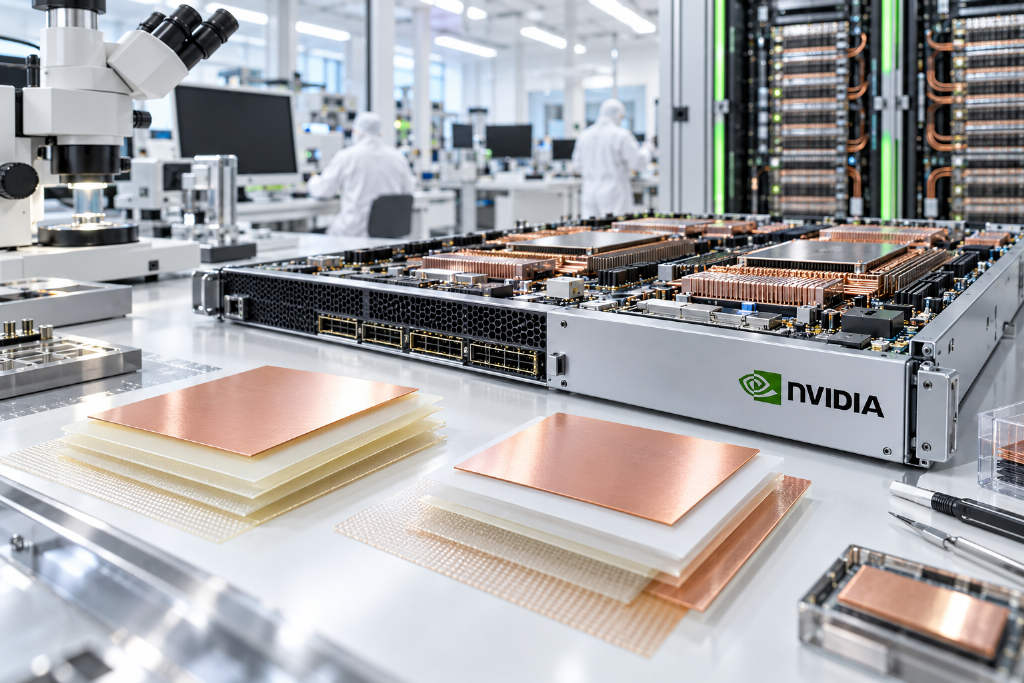
ChainCatcher reported that TF International Securities analyst Ming-Chi Kuo said in a post that his latest supply-chain checks show Nvidia has begun testing a glass-fiber-free copper clad laminate, or CCL, based mainly on hydrocarbon resin. The material is being used in place of the glass-fiber-free PTFE CCL that had been tested earlier, and is paired with a glass-fiber-free hydrocarbon prepreg.
Testing targets Rubin Ultra NVL576 switch tray PCB requirements
Kuo said the purpose of the test is to verify whether that material combination can meet the printed circuit board requirements for the Rubin Ultra NVL576 switch tray. NVL576 is an eight-rack interconnect solution that is expected to enter mass production in the second half of 2027.
Early results focus on manufacturability
According to Kuo, preliminary testing conducted to improve PCB manufacturability shows that the glass-fiber-free hydrocarbon CCL has already met the high-frequency electrical requirements of the switch tray. He said the material’s electrical performance is behind the original PTFE option, but ahead of the M9-grade solution and above published M10 specifications.
He added that the result does not represent a final material choice. What it shows, he said, is that Nvidia is still looking for a way to meet electrical requirements while improving PCB manufacturing yield and production efficiency.
Suppliers and material models under review
Kuo said Shengyi Technology is currently the leading supplier in the material evaluation process for the NVL576 switch tray. The materials involved include the glass-fiber-free PTFE CCL SG5300N, the glass-fiber-free hydrocarbon CCL SG1030N, and the glass-fiber-free hydrocarbon prepreg SIF09.
He also said SG1030N and SIF09 still contain a small amount of PTFE. Once specifications are finalized and mass production begins, Kuo expects Shengyi Technology to accelerate procurement from Chinese hydrocarbon material suppliers including Dongcai, Shengquan, and potential supplier GCH Technology.