
Nvidia will report fiscal 2027 second-quarter earnings after the U.S. market close on Aug. 26. With a market value of about $5.3 trillion as of mid-August, the company remains one of the world’s largest corporations, and its results are being treated as a readout for the broader AI trade. This quarter, though, the debate is less about whether the numbers will look strong and more about whether strong numbers will be enough to lift the stock.

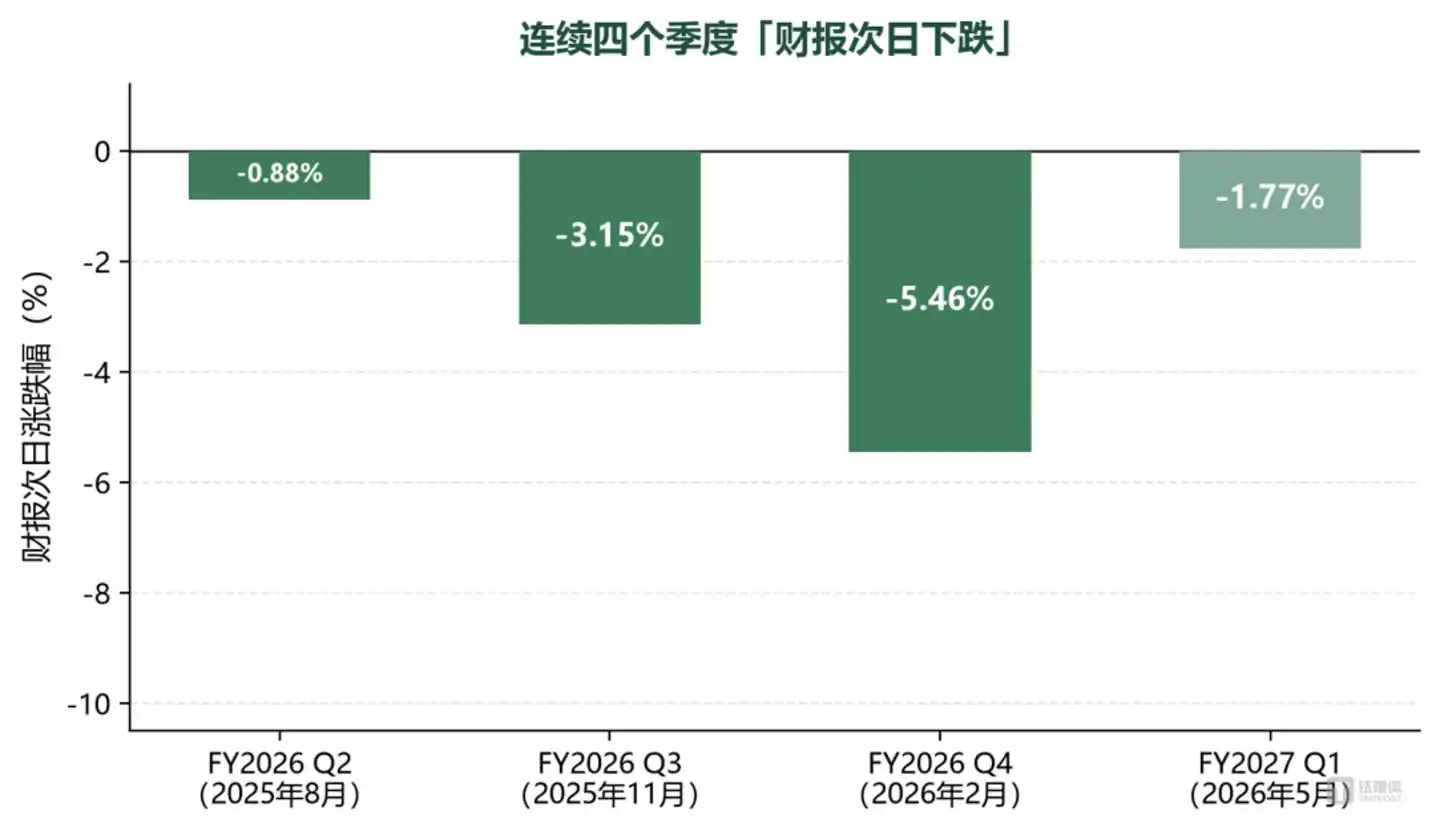
That split has a track record behind it. Morgan Stanley said in its earnings preview that Nvidia shares have dropped the day after earnings for four straight quarters. The pattern has held even when the company beat expectations and raised guidance, leaving investors wary of treating another upside print as an automatic positive for the share price.
Nvidia’s revenue guidance for the quarter is $91 billion, plus or minus 2%. Analyst consensus stands near $91.9 billion, while Jefferies has a more bullish estimate of $95 billion. The bigger question, according to the source article, has shifted to Rubin.
Four straight post-earnings declines have reset the setup
The source article lists Nvidia’s post-earnings share performance over the last four quarters as follows:
- FY2026 Q2, released in August 2025: down 0.88% the next day;
- FY2026 Q3, released in November 2025: down 3.15% the next day;
- FY2026 Q4, released in February 2026: down 5.46% the next day and 9.39% over two days;
- FY2027 Q1, released in May 2026: down 1.77% the next day and 3.64% over two days.
The article argues that these declines did not reflect disappointing earnings. Nvidia met or exceeded expectations in each case. The issue was that the market had already revised expectations higher before the releases, shrinking the room for upside surprise by the time the company reported.
Once beating estimates becomes the default assumption, the benefit of a beat gets harder to convert into a higher stock price. Under that setup, any less favorable comment about Rubin ramp, gross margin, or China exposure can become the point investors focus on.
The article also says the pullbacks looked more like sentiment being realized than a rejection of Nvidia’s fundamentals, noting that institutional earnings expectations rose rather than fell during those four periods.

That tension remains in place this quarter. Nvidia guided to $91 billion, consensus sits near $91.9 billion, and Jefferies is at $95 billion. The roughly $900 million gap between company guidance and consensus leaves little room for a modest beat to change sentiment on its own.
There is, however, one sign of moderation. The latest post-earnings decline narrowed to 1.77% from the prior quarter’s 5.46%, which the article says may suggest the market’s pricing of the “beat and drop” pattern is easing at the margin, even if one quarter is not enough to establish a durable trend.
Rubin is the variable investors think can reopen the expectation gap
The article presents Rubin as the platform most likely to reset expectations because of its larger technological step and faster production profile compared with the early Blackwell phase.
In July, Nvidia said on its official blog that the Vera Rubin platform is designed around performance per watt and the lowest token cost, with more than 300 partners supporting global deployment. CoreWeave, Google Cloud, Microsoft Azure and Mistral were listed among those already connected to the platform. By Nvidia’s own measure, Vera Rubin can cut inference token cost by as much as 10x versus Blackwell.
This is framed as more than a standard product refresh. Vera Rubin NVL72 integrates 72 Rubin GPUs and 36 Vera CPUs into a single rack, tied together with a new generation of interconnect and optical modules. Nvidia describes that rack as an AI supercomputer. The company’s stated figure of a 10x token throughput gain per megawatt implies a major reset in compute efficiency at the data center level.
The article cites another efficiency comparison tied to running DeepSeek R1. Against GB200 NVL72, Vera Rubin NVL72 delivers about 5.4x better performance per watt and about 5x better performance per dollar.

Looking across three generations makes the shift more visible. On a relative estimate of inference cost per million tokens, with Hopper set at 100, Blackwell comes in near 2.9 and Rubin falls further to around 0.3. The article describes that as an order-of-magnitude jump rather than an incremental percentage improvement.
In that framing, the move from Hopper to Blackwell was largely quantitative, while the move from Blackwell to Rubin is a qualitative architectural shift built around inference workloads. That point matters because it speaks directly to the argument that ASICs are cheaper. Nvidia’s answer, as presented in the article, is the speed of iteration on a general-purpose platform.
From mass production to volume shipments, execution now matters most
Product capability may already be established, but the market is more focused on whether Rubin can ramp on schedule and convert performance claims into revenue.
According to official information cited in the article, the Vera Rubin platform entered mass production in July 2026 and has started global deliveries. Foxconn and other ODM manufacturers have said shipments will begin ramping in the fourth quarter of this year.
Institutional forecasts diverge in emphasis but point to a meaningful contribution if the rollout stays on track. Morgan Stanley expects Rubin to contribute about $9 billion in revenue in FY2027 Q3. Jefferies expects more than 13,000 Rubin racks to ship before year-end and more than 120,000 during 2027. On a revenue basis, Rubin’s share of Nvidia GPU revenue could rise from 12% in FY2027 Q3 to above 40% in Q4.
Jefferies’ bullish case rests in part on reuse. Rubin keeps the 72-GPU rack format, allowing customers to reuse liquid-cooled data center infrastructure built during the GB200 and GB300 cycle. That, the article says, should allow a faster ramp than Blackwell’s early phase.

Supply-chain signals have also been read as constructive. Foxconn’s confirmation of a fourth-quarter shipment ramp is presented as a key marker for Rubin’s move from mass production to broader volume deployment. The article argues that the bottleneck is shifting away from chip capacity and toward the pace at which data center infrastructure can be matched to the new systems.
Still, caution remains. TrendForce said in April that geopolitical factors and supply-chain adjustments could delay Rubin shipments, and that Blackwell would still account for about 70% of high-end GPU shipments in 2026. Semianalysis also warned that Rubin remains in an early bring-up phase, while the market still remembers GB200’s early issues with under-target bring-up performance and longer test cycles.
That split between optimistic and cautious views is itself part of the earnings setup. One side measures the ramp in revenue terms, another in rack shipments, and the difference highlights how little consensus there is on the slope of Rubin’s commercialization. Test cycles and yield are described in the article as the main execution risks for the earnings call.
Demand remains strong, but power and financing are now part of the equation
How far Rubin goes will depend not only on what Nvidia can build, but also on who is willing and able to buy the compute.
The article points first to Nvidia’s deepening relationship with OpenAI. In mid-August, Nvidia announced more than $105 billion in financing support for an OpenAI data center in Ohio covering land, power and infrastructure. The project is planned with 4.25 gigawatts of initial computing capacity and an 8-gigawatt long-term target. The source notes that this is materially smaller than an earlier reported $250 billion guarantee proposal, which makes AI financing structure a topic investors are likely to press on the earnings call.
Cloud spending is also still moving higher. Goldman Sachs expects global AI investment to exceed $1 trillion in 2026, with the U.S. accounting for more than half. The article says the four major cloud providers are already among the first Vera Rubin deployment customers.

China is another moving part. The Financial Times reported that H200 exports to China have been approved, and that ByteDance and Tencent have each received about 10,000 H200 chips in recent weeks. The article adds that this revenue has not been included in Nvidia’s guidance and that the company has explicitly denied plans for a China-specific “special supply” LPU chip.
China revenue has already fallen sharply in the figures cited by the article, from $17.1 billion for full-year FY2025 to $2.8 billion in FY2026 Q2, or about 3% of quarterly total revenue. The article leaves open whether that represents a temporary gap or a more structural change.
Power is a separate constraint. The bottleneck for AI data center construction is shifting from chips to electricity supply and grid-connection timelines. A gigawatt-scale site can take years to move from location selection to energization. Even if chip supply is available, the pace at which operators can secure power and complete facilities can slow the conversion of demand into actual deployments.
That is part of why Nvidia has chosen to use its balance sheet to support the OpenAI project, according to the article. Whether that model is sustainable is likely to remain a focal point for investors.
Competition is getting closer, especially in inference
Demand may still be robust, but competition is not standing still.
In June, OpenAI and Broadcom jointly introduced Jalapeño, their first in-house inference chip. The official claim was that its cost is 50% lower than Nvidia GPUs and that it moved from design to production in nine months. Anthropic then also said it had begun work on its own AI chip.

Some institutions, according to the article, view Broadcom as a rival that is reshaping AI economics through custom XPUs and long-term hyperscale customer commitments. Over the past two quarters, its AI business has reached the $8 billion range in quarterly revenue, growing faster than Nvidia, though from a lower base.
The reason this matters is the mix inside Nvidia’s own data center business. In FY2027 Q1, inference accounted for more than half of data center revenue for the first time, overtaking training for the first time in the company’s history. If in-house chips continue to gain ground in inference, they would be pressing directly into Nvidia’s highest-margin business.
Nvidia’s response, as framed in the article, is to center Rubin on inference efficiency. If a custom ASIC can save around 50% on cost, but Rubin cuts inference cost by an order of magnitude on a generational basis, then the economic argument for replacement looks less straightforward. The competitive contest is presented as a race between iteration speed on a general-purpose platform and point efficiency from specialized chips.
Three things the market is watching on earnings night
The article narrows the earnings watch list to three main items.
Gross margin
Nvidia’s non-GAAP gross margin guidance is 75%, plus or minus 50 basis points. Market consensus is also near 75%, broadly in line with the midpoint of guidance. The pressure comes later. Morgan Stanley expects gross margin to fall to 72.5% in FY2028, with DRAM, wafers, advanced packaging and substrate costs as the main drag.
Whether gross margin can hold in the mid-70% range will shape how investors value the Rubin cycle.
First quantitative Rubin disclosure in Q3 guidance
The market is less interested in the quarter that has already occurred than in management’s first explicit revenue guide for Rubin in Q3. The article says that if the figure comes in above Jefferies’ 12% expectation, it would likely stand out as the biggest positive catalyst.
China outlook
There has been progress on H200 entering China, but the impact is not in current guidance. Management’s comments on when China might begin contributing revenue again could shift expectations quickly.
The focus is shifting from growth alone to the quality of that growth
Based on those points, the article lays out a simple reading framework. If Nvidia’s Q3 guidance shows Rubin ahead of expectations and gross margin stays above 75%, the four-quarter streak of post-earnings declines is likely to be broken. If guidance only barely matches consensus and margin comes under pressure from higher input costs, a fifth straight post-earnings drop remains possible.
The article also cautions that even if the pattern is broken this time, volatility is unlikely to disappear. Investor scrutiny of AI spending is moving from whether growth can continue to what that growth is worth. Gross margin, financing exposure and power constraints can each become new lines of disagreement.
Its final point is broader. The significance of the Rubin cycle may extend beyond this single Nvidia earnings report because it could help define an inflection point in AI compute inflation. If inference costs keep falling by orders of magnitude from one generation to the next, the debate over who is cheaper may have to be rewritten.
The article was first published on TMTPost App and credits Silicon Valley Tech-news as the author and Jiao Yan as editor.