
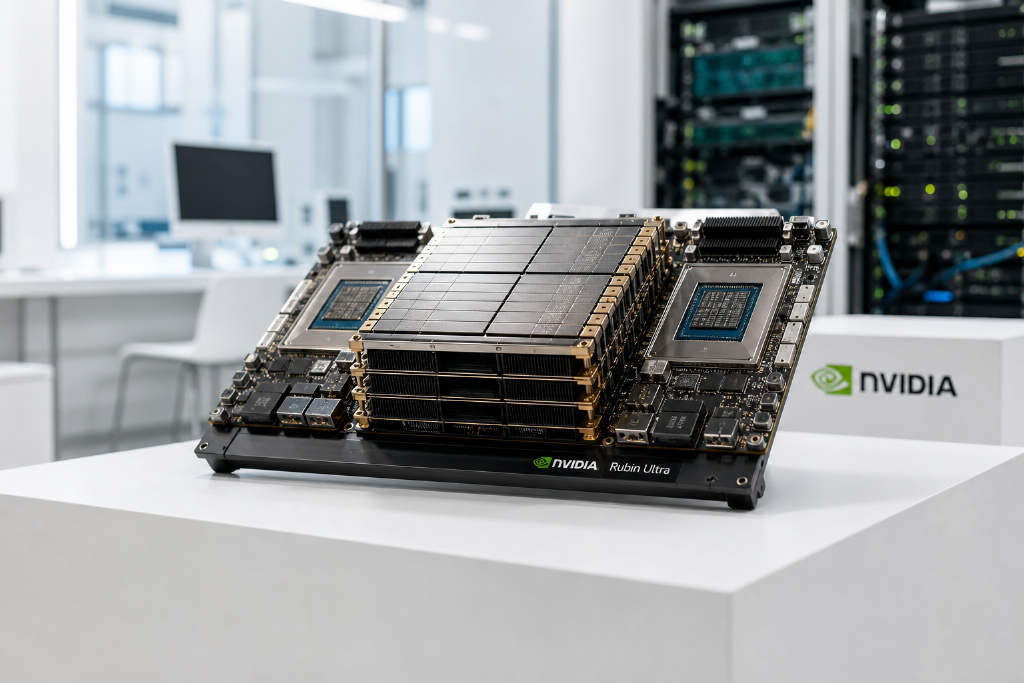
A bill-of-materials report from investment research firm Aletheia Capital suggests Nvidia’s Rubin Ultra AI compute module, expected in the second half of 2027, could carry an average selling price of nearly $170,000 for the dual-GPU version. The four-GPU model could reach $350,000, about 30% higher than the prior Rubin generation.

The report says the cost stack has shifted in a notable way. SoCAAM, an advanced packaged memory module, has replaced the GPU chip itself as the single most expensive part of the module and now makes up more than half of total BOM. Industry analysts also said Rubin Ultra will use HBM4E rather than HBM4, and that a higher-end version with four GPU dies remains on the product roadmap, putting memory suppliers in focus.
Three generations show higher pricing per GPU
With Nvidia maintaining gross margins in the 75% to 80% range throughout the lineup, the allocated selling price per GPU has risen from $40,000 to more than double that level within two years. Aletheia’s numbers also show that both BOM and ASP for the four-GPU model are a little more than twice those of the dual-GPU version. The report ties that gap to the extra integration premium of a four-die packaging structure and to Nvidia’s stronger pricing power on a per-unit-of-compute basis.
SoCAAM now dominates the BOM mix
A closer look at the BOM breakdown shows how much the cost center has moved. SoCAAM, described as a modular low-power memory standard, accounted for 20% in the GB300 generation, rose to 45% in Rubin, and moved past 51% in the dual-GPU Rubin Ultra version. Over two generations, the core cost burden has shifted away from the compute chip and toward advanced packaging infrastructure.
Logic, which includes GPU, CPU, and CoWoS packaging, fell from 36% in GB300 to 17% to 18% in Rubin Ultra. HBM slipped slightly as a share of BOM, from 27% to 20% to 21%, even as its specifications moved from HBM3E to HBM4 and HBM4E. The Others category, including ABF substrate, PMIC, and motherboard, declined from 17% to 11% in percentage terms, but its dollar value increased from about $2,400 to $4,600.

Questions remain over the 30% price increase
The BOM picture may be clear, but whether hyperscaler buyers will accept Rubin Ultra pricing is still an open question in the report. The GB300 generation had visible support for a 35% increase, with FP4 performance improving 50% to 60% from the previous generation.
Rubin Ultra’s 30% increase over Rubin does not yet have the same level of published support. Nvidia has said the full Rubin platform can deliver 50 PF of FP4 compute at a 2,300W power configuration, but that figure refers to the complete system specification rather than the standalone performance of a dual-GPU module.
Without an official FP4 figure for the dual-GPU Rubin Ultra module, buyers have limited ability to calculate how much compute-per-dollar improves. Nvidia’s case is that scale-up multi-rack systems bring higher aggregate compute, more NVLink bandwidth, and a lower cost per token, but those are system-level claims that still need deployment data for validation and measurement.
HBM4E, a four-GPU model, and Kyber remain in play
Citrini analyst Jukan added several points. Rubin Ultra is expected to skip HBM4 and move straight to HBM4E, using both 8-high and 12-high stacks, with bandwidth and capacity above HBM4. The four-GPU Rubin Ultra remains on the roadmap and could scale to as much as 768GB of HBM4E. Jukan also said the Kyber platform, which had previously been rumored to be canceled, is still going forward.
For packaging, Jukan outlined two possible routes for the four-GPU version: a monolithic CoWoS approach from TSMC, or a design in which an OSAT provider combines two dual-die packages on an ABF substrate.
Memory suppliers are the clearest beneficiaries in the report
Jukan said that setup would be a direct positive for the memory supply chain. HBM4E demand could ramp at scale, while the technology carries a higher barrier than HBM4 and supply expansion will take time. In that scenario, major HBM suppliers led by SK hynix could maintain elevated ASP levels.
If the four-GPU Rubin Ultra is deployed at scale, the amount of HBM4E used in a single module would be far above the previous generation. The report says the resulting demand would be difficult to ignore.