
NVIDIA said it has deepened its partnership with Toyota, expanding the use of its AI and hardware technologies across vehicles, robotics and infrastructure. The two companies are starting with in-vehicle systems, then extending the work into smart factories and smart city deployments.
Toyota taps DRIVE platforms for next-generation vehicles
At a press event, Deepu Talla, NVIDIA vice president of robotics and edge AI, said Toyota is using NVIDIA DRIVE HDX and DRIVE AGX, both described as offering safety-certified compute, to build next-generation smart vehicles running the DriveOS operating system.
According to the announcement, the vehicle lineup will support L2+ to L2++ advanced automated driving and contextual awareness functions aimed at improving safety and intelligence in mobility.
Code-assist AI model added for SDV development
As the auto industry shifts toward software-defined vehicles, or SDVs, Toyota is also adopting a code-assist AI model built to meet MISRA safety standards. The model was trained on NVIDIA Megatron-LM technology and the Nemotron dataset.
NVIDIA said the model can help engineers generate, review and verify in-vehicle software more efficiently while meeting strict compliance requirements in the industry, cutting overall development time.
Digital twins for factory simulation
Toyota is also pushing a simulation-first approach for product development and manufacturing. Using NVIDIA Omniverse and NVIDIA Isaac Sim, the company is building digital twins of production lines in virtual environments.
The system is designed to simulate factory layouts, robot motion paths and complex workflows. By testing and refining manufacturing details before mass production begins, Toyota can address potential issues earlier, which the announcement said may reduce downtime, lower maintenance costs and improve plant-wide operating efficiency.
Woven City project targets traffic infrastructure in Shizuoka
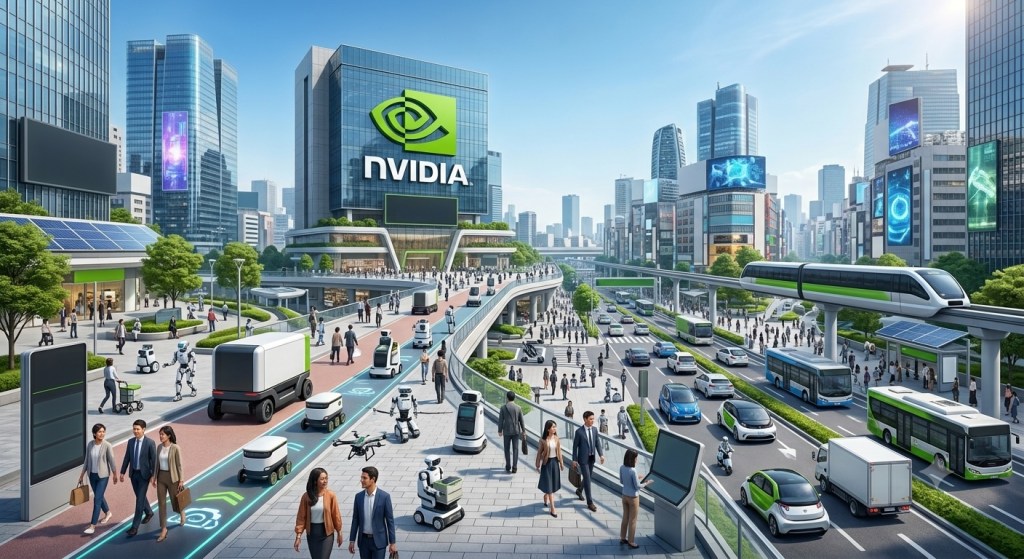
The partnership also reaches into smart city infrastructure. Woven by Toyota, a Toyota subsidiary, is using NVIDIA H100 Tensor Core GPUs and the Megatron-Core framework to develop the Woven City AI Vision Engine, a multimodal vision-language model built for urban traffic scenarios.
The model is intended to interpret real-world environmental changes in real time and predict what comes next. It will first be deployed in Toyota’s Woven City in Shizuoka, Japan, where it is set to serve as infrastructure for urban traffic control systems and mobility service forecasting.
NVIDIA broadens robotics and physical AI stack
Alongside the Toyota collaboration, NVIDIA said it is rolling out more hardware and software tools for robotics and physical AI. On the hardware side, the company has expanded its Jetson AGX Thor processor lineup for robots with new models that are smaller and more energy efficient.
On the software side, the open-source Nemotron model is being introduced to companies including NTT DATA and Hitachi. NVIDIA also said it is widening cooperation in areas such as biomedicine and data center cooling systems, where it provides foundational semiconductor technology support to help companies integrate AI more deeply with hardware.