
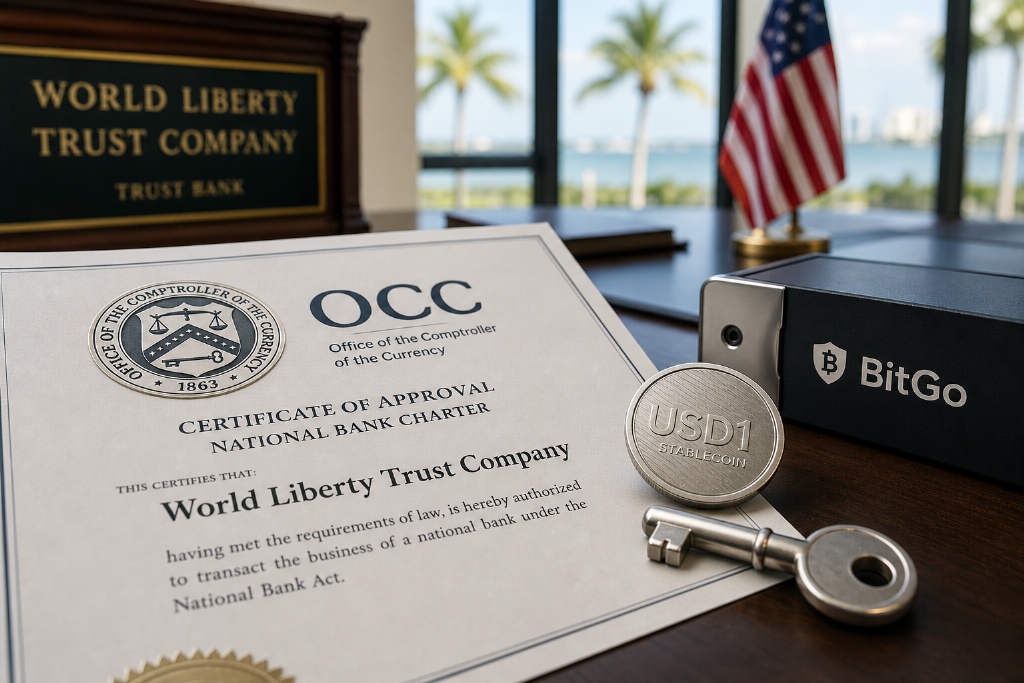
The Office of the Comptroller of the Currency on Aug. 14 issued Corporate Decision #1385, giving World Liberty Trust Company conditional preliminary approval for a national trust bank charter, No. 25407. The entity is tied to the Trump family and is expected to take over the USD1 stablecoin business from BitGo Bank & Trust.
The proposed bank will be located in Bay Harbor Islands, Florida, and will operate as a wholly owned subsidiary of Delaware-based WLTC Holdings LLC. The approval does not allow immediate operation. The company still has to satisfy pre-opening requirements before it can launch.
USD1 issuance and custody are set to shift away from BitGo
According to the OCC materials cited in the report, the bank will handle issuance, redemption and reserve management for a U.S. dollar stablecoin in a non-fiduciary capacity. It will also provide digital asset custody in a fiduciary capacity and conduct stablecoin conversion for custody clients.
That structure would let World Liberty Trust Company take over nationwide issuance of USD1. The business is currently handled by BitGo Bank & Trust as the token’s exclusive issuer and custodian.
USD1 has roughly $4.03 billion in circulation and close to $600 million in 24-hour trading volume. The report compares that with USDT at $183 billion and USDC at $72 billion, putting USD1 at about 2.2% of USDT’s size.
Approval comes with capital, liquidity and compliance conditions
The OCC described the charter as a conditional preliminary approval. Among the requirements, the bank must maintain at least $20 million in tier 1 capital and hold liquid assets sufficient to cover 180 days of operating expenses.
If the capital is not raised within 12 months, or if the bank does not open within 18 months, the approval will lapse.
The approval also requires the bank’s stablecoin operations to comply with the GENIUS Act and any future implementing rules. If the business does not meet those standards, it must be adjusted, halted or divested, with the OCC retaining full authority to determine compliance.
The company also committed that it would not become a “bank” under the Bank Holding Company Act, does not plan to become a federally insured depository institution, and does not currently plan to apply for a Federal Reserve master account.
Appendix includes three passivity commitments
The appendix to the OCC decision includes three signed passivity commitments dated July 13. The signers are DT Marks SC LLC, StringZ Holding RSC (DE) LLC and AMGUS, LLC.
For DT Marks SC LLC, the document was signed by Eric F. Trump in his capacity as president. The StringZ Holding RSC (DE) LLC commitment was signed by Hamad Khlfan Ali Matar Alshamsi, listed as manager. The AMGUS, LLC commitment was signed by Zachary Folkman, listed as managing member.
The three commitments are identical. They are designed to limit control rather than economic benefit. The signers agreed not to make the bank a subsidiary, not to place representatives as officers, agents or employees, not to nominate an opposing slate of directors, not to seek or use material nonpublic information, and not to communicate with directors, executives or employees for the purpose of influencing management decisions. They also agreed not to try to influence dividend policy, investment decisions, service pricing, personnel decisions or operating arrangements.
Two restrictions are more explicit. First, the signers may not seek a board seat, including as a non-voting observer or adviser. Second, they may not pledge their shares to a financial institution as collateral for borrowing.
If ownership rises above 10% of any class of voting shares, the portion above 9.9% must be placed under management proxy voting and cast in proportion to the votes of other shareholders.
The OCC said failure to comply strictly with those terms would lead the signer to be treated as having “control intent,” which could trigger administrative action.
OCC says broader political objections fall outside its review
In the body of the decision, the OCC said World Liberty Financial, Inc. is not a party to the application and that foreign investors have no investment in or control over the bank. It also said comments related to the Emoluments Clause and review by the Committee on Foreign Investment in the United States fall outside the scope of the agency’s review.
The regulator’s position, as described in the report, is that career staff acting under delegated authority reviewed the application and that politics did not factor into the decision.
The report notes, though, that the passivity commitments address control, not profit. In Eric Trump’s case, the signed terms bar involvement in board membership, personnel and pricing, but do not require that he forgo financial benefit from the business.
Board roster names Witkoff family members
The letter also included a management and board list. Zachary Witkoff is named organizer, director and president. Robert Witkoff and Scott Alper are listed as directors. The two independent directors are Jeffrey Weiner and Erin Baskett.
That means, according to the report, Trump family members signed commitments not to join the board, while members of the Witkoff family are seated on it directly.
Democrats respond with proposed legislation
After the approval became public, Senator Elizabeth Warren and several Democratic colleagues said they would introduce the Ending Presidential Corruption in Banking Act, which would bar senior government officials from owning or controlling banking institutions.
The report says Warren had asked the OCC in January to pause the review until Trump separated himself from his crypto business. In May, she questioned Comptroller Jonathan Gould directly, accusing the agency of approving “unqualified” crypto banks and arguing that such institutions were trying to avoid the basic safeguards and obligations tied to bank status.
Gould replied at the time that the OCC would not take political considerations into account and would move forward on its normal timeline.
The report also highlights the names on Warren’s side. Senators Angela Alsobrooks and Ruben Gallego, who joined her, are described as key negotiators on the CLARITY Act. According to the report, that bill is currently stalled over ethics provisions, with Democrats demanding a presidential commitment to step away from crypto business activity first.