
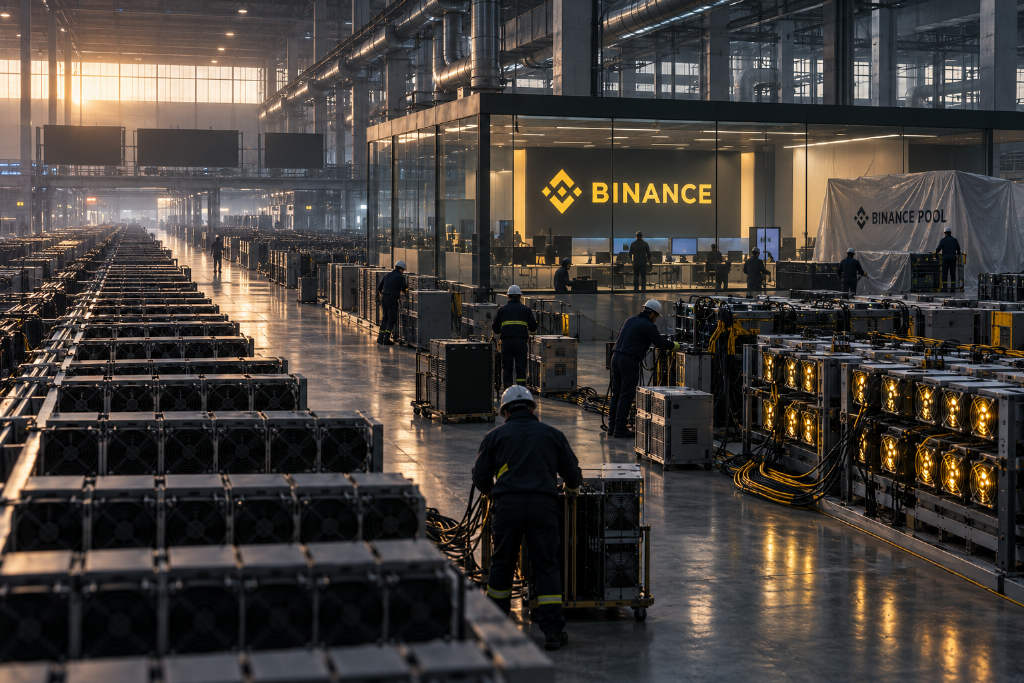
Binance to shut down Binance Pool in November
Binance said it will stop Binance Pool and related services at 15:00 Beijing time on Nov. 10, 2026, according to an official announcement. The shutdown covers Binance Pool, Pool Savings, cloud mining, transaction acceleration, and pool API functions. Mining connections and Stratum addresses will be terminated at that time, and the platform will no longer accept new hashrate contributions or generate mining rewards.
The exchange asked miners to switch machines to other pools in advance and handle any Pool Savings positions. Eligible remaining rewards, refunds, and settlements will be processed after the service ends under the applicable rules. Historical pool data pages will remain available until 15:00 on Nov. 24, after which they will be permanently closed.
Five listed miners produced 47% less BTC year over year
A CryptoQuant report said IREN, Core Scientific, Bitfarms, TeraWulf, and Cipher produced a combined 7,075 BTC this year, compared with 13,263 BTC in the same period last year, a drop of about 47%.
Within that group, output at IREN, Core Scientific, and TeraWulf fell by more than 50%. Bitfarms was down 49%, while Cipher declined 18%. Over the same period, MARA, CleanSpark, Riot, HIVE, and American Bitcoin posted combined production growth of 16% year over year.
Hashprice fell to an August low as fee income stayed weak
CryptoSlate reported that Bitcoin hashprice, or daily revenue per unit of hashrate, fell to about $33/PH/s, the lowest level since August. Its calculation showed that with gross daily revenue of $33.35 per PH/s, a 2% pool fee, and electricity priced at $0.06 per kWh, a machine running at 25 J/TH would generate about $32.68 per PH/s per day after pool fees. That was below electricity costs of roughly $36, without including hosting, maintenance, or other expenses.
WuBlockchain Data Center said Bitcoin on-chain fees as a share of block rewards fell to 0.31% on Oct. 11, the second-lowest reading in its series since July 2016, above only the 0.30% recorded on Feb. 15, 2026. The metric was down about 50.4% from 30 days earlier and had stayed below 1% for 51 straight days. Eight of the 10 lowest trading days in the series occurred in 2026.
CryptoQuant analyst Axel Adler Jr. said fees accounted for an average of just 0.64% of Bitcoin miner revenue over the past 30 days, slightly below 0.65% a week earlier, and had remained under 1% since mid-August 2025. He said miner revenue still depends mainly on block rewards.
At an electricity price of $0.05 per kWh, the power cost to mine 1 BTC with a Bitmain Antminer S19 is about $86,700, above the current BTC market price, while the comparable figure for an S21 is about $44,300. Adler said the rise in BTC price has improved operating conditions for miners, though older machines still face heavier cost pressure. He added that a recovery in fee share above 1% would indicate a larger contribution from on-chain activity to miner revenue.
Miner revenue recovered from July lows as network hashrate climbed
CryptoSlate, citing a CryptoQuant report, said total daily Bitcoin miner revenue rebounded from about $27 million at the July low to as much as $48 million, an increase of about 78%. Over the same period, network hashrate recovered from 899 EH/s on July 31 to about 962 EH/s. The report said the improvement in revenue was driven mainly by the recovery in BTC price, while transaction fee income remained well below levels seen during parts of 2025.
Digital Asset reported that the 7-day moving average of Bitcoin network hashrate reached about 1,031.61 EH/s as of 14:00 on Oct. 17, up about 44.08 EH/s from a week earlier and the highest level since May 29. CryptoQuant data showed Bitcoin miner holdings at 1,192,622 BTC over the same period, up 379 BTC from a week earlier. Bitcoin’s Puell Multiple fell to 0.99, down 0.14 week over week.
Hashrate Index, in its fourth-quarter global hashrate distribution update, estimated U.S. Bitcoin hashrate at about 335 EH/s, down about 10 EH/s from the previous update, with global share slipping from 36.7% to 35.6%. Russia added about 8 EH/s to reach 170 EH/s, lifting its share to 18.1%, while China accounted for about 11.7%. Ethiopia fell from about 23 EH/s to 15 EH/s, a decline of about 35%. The firm said these figures are estimates and differ from installed capacity disclosed by mining companies.
Bitdeer, CleanSpark, BitFuFu, and Phoenix released operating data
Bitdeer said it produced 1,355 BTC in September 2026, up about 200% from 452 BTC a year earlier and above the 1,310 BTC reported in August. By the end of September, self-mining hashrate operating in the company’s own data centers had reached 82.3 EH/s, up from 79.9 EH/s at the end of August. Collaborative mining hashrate using the company’s machines and operated by third-party data centers rose to 28.7 EH/s from 21.6 EH/s.
CleanSpark reported 529 BTC of production in September 2026, with average daily output of 17.64 BTC and average operating hashrate of 36 EH/s. The company held 13,530 BTC at month-end and sold a combined 702 BTC during the month through spot sales and the exercise of call options. It also said it will shift to quarterly reporting and stop publishing monthly operating updates.
BitFuFu reported September 2026 production of 167 BTC, down 4.0% month over month. Of that total, 98 BTC came from self-mining and 69 BTC from cloud mining. Managed hashrate fell from 20.6 EH/s to 19.4 EH/s, managed power capacity declined from 344 MW to 324 MW, and month-end holdings rose by 15 BTC to 1,388 BTC.
BitFuFu also said its proposed acquisition of an 80 MW mining site in Ethiopia faces the risk of not closing because of a contract dispute with the power supplier. The company said it had already paid $4.1 million and deployed about 13,700 mining machines, and is evaluating options including terminating the agreement, starting arbitration, and recovering funds and equipment.
Phoenix Group reported third-quarter operating data showing production of about 322 BTC, including 222 BTC from self-mining. Gross margin in self-mining rose from 43% in the second quarter to 44%, while mining cost per Bitcoin fell 16.6% year over year to $46,154. Fleet efficiency improved to 18.5 J/TH.
The company also said a combined 38 MW at its new Onmine site in Texas was energized during the quarter, using S21 hydro-cooling miners. Third-quarter revenue totaled $17.4 million, including about $13.3 million from self-mining and about $4.1 million from hosting.
NIP Group, Datacentrex, and Fortitude outlined equipment plans
Bitcoin.com reported that NIP Group, the listed parent company of esports club Ninjas in Pyjamas, signed an agreement to issue up to 247.1 million Class A ordinary shares to acquire about 4.47 EH/s of Bitcoin mining equipment in a deal valued at up to about $27.3 million. After closing, total hashrate is expected to rise to about 13.85 EH/s. Once fully deployed, the company’s monthly production target would increase from 160 BTC to about 195 BTC, though actual output will depend on mining difficulty, network hashrate, and operating conditions. The equipment is already running at hosted facilities, and the transaction remains subject to customary closing conditions.
Nasdaq-listed Datacentrex said it has begun installing and energizing more than 500 ElphaPex DG2 Scrypt ASIC miners purchased earlier. The first batch has started producing, and the rest is expected to come online over the following weeks. Once fully energized, the company expects online Scrypt hashrate to rise from about 43.2 TH/s to 52.2 TH/s, an increase of about 21%, while deployed power capacity is expected to increase from about 12.5 MW to 14 MW.
Zcash miner Fortitude Mining said it signed a non-binding letter of intent with Bitmain that gives it priority allocation for Bitmain’s next-generation Zcash miners, with planned purchases of up to $100 million in equipment. The machines have not yet been commercially released and are expected to begin shipping in the second quarter of 2027. Final purchase size will depend on specifications, pricing, and definitive purchase agreements.
At the same time, parent company DCG increased Fortitude’s credit facility from $50 million to $70 million. Fortitude plans to draw $20 million this week in ZEC to pay a refundable deposit.
Zcash saw price gains, mining expansion, and protocol changes
Bloomberg reported that privacy coin Zcash has risen about 3,000% since mid-2025, as Gemini founders Cameron and Tyler Winklevoss and DCG founder Barry Silbert stepped up their push into Zcash mining and investment products.
Cypherpunk Technologies, backed by the Winklevoss brothers, already controls about 20% of network hashrate, while Silbert-backed Fortitude Mining plans to raise its share to about 20%. Grayscale, part of DCG, launched a Zcash ETF in August, and the Winklevoss brothers applied in October to launch a similar product. Bloomberg said renewed attention to Zcash has been tied to privacy concerns around AI, while hashrate concentration, protocol security flaws, and regulatory risk remain challenges.
Zcash developers agreed on activation at block height 3,543,405 for the NU7 upgrade, expected around Nov. 5. The change would shorten block intervals from 75 seconds to 25 seconds. It would also temporarily remove 60% of fees from circulation on each block and return them to miners starting around February 2031, while leaving the existing mining reward halving schedule unchanged. The legacy privacy system Sprout will be fully shut down, and assets not migrated by then will no longer be spendable.
As of 08:00 UTC on Oct. 21, the activation-height proposal had not yet been merged into the deployment specification and still needed to be included in node software before taking effect, according to CoinDesk.
Funding, tokenization, and open-source mining tools
Bitcoin mining services firm Luxor Technology said it completed a $16 million strategic financing led by CMT Digital, with participation from Canaan, MicroBT, Halo, Steelhead, and angel investors. The transaction included both primary financing and transfers of existing equity. The company did not disclose the split or valuation. Proceeds will be used to expand hashrate derivatives trading, market making, AI hardware, and cloud computing platform businesses.
TheEnergyMag reported that Bitmain-backed Bitcoin miner BitFuFu (NASDAQ: FUFU) partnered with Finloop to launch a tokenized note called Hashrate Token, or HASH. The product is designed to give eligible investors exposure to Bitcoin-denominated returns generated by mining activity. HASH is linked to output from hosted mining infrastructure and uses Finloop’s FinRWA platform for token lifecycle and compliance management. Access is limited to qualified investors who meet local regulatory requirements and KYC/AML standards.
Tether said its open-source Bitcoin Mining Development Kit, or MDK, has been jointly supported and integrated by 15 major mining companies, ASIC manufacturers, and mining pools, including Bitmain, Bitdeer, Canaan, MicroBT, Foundry Digital, F2Pool, Luxor, and Block’s Proto. The toolkit uses a unified open interface to reduce barriers between different machines and pools, with the stated goal of speeding up cross-platform automated dispatch and autonomous operation of mining-site physical infrastructure by AI and software. MDK version 0.11 was released at the Plan ₿ Forum in Lugano, and Tether plans to launch a stable 1.0 version by the end of 2026.
Pool products and executive changes
TheEnergyMag reported that Mike Colyer, founding CEO of Bitcoin mining pool operator Foundry, will step down after seven years in the role. He will remain a strategic adviser for the next six months to help with the management transition and the search for a new CEO. No successor has been named. Colyer became Foundry’s founding CEO in October 2019. He said he wants to take a break and spend time with family, and did not link his departure to mining business conditions.
According to f2pool, the pool launched merged mining for Pearl (PRL) and Nockchain (NOCK) on Oct. 21, allowing PRL miners to receive rewards in both assets. Miners need to bind a NOCK wallet address in their accounts, and rewards begin accruing after the address is added successfully. NOCK uses a 1% PPLNS payout model with a minimum payout threshold of 350 NOCK, and returns depend on the pool’s actual output.
f2pool also launched a Quantus (QTC) pool on Oct. 15. It uses a 1% PPLNS payout model with a minimum payout threshold of 0.1 QTC. Quantus is a PoW public chain whose native token uses the Poseidon2-Goldilocks algorithm and supports GPU mining, including Nvidia RTX 30, 40, and 50 series graphics cards.
Luxxfolio said its in-house Scrypt pool, LuxxPool, has entered public beta and is now open to third-party miners. Compatible devices can use a single connection for merged mining across Litecoin, Dogecoin, and other supported coins. The platform includes a miner dashboard and payout settings. The pool had previously been used for the company’s own machines. During the beta period, some payouts are still handled manually, while automatic payouts, automatic coin conversion, and additional wallet integrations remain in development.
Bitcoin.com reported that Bitcoin mining service provider Sazmining launched a purchase program for Block’s Proto immersion hashboards. Customers own the equipment, while Sazmining installs, operates, and maintains it at U.S. mining sites, with mined Bitcoin sent directly to the customer’s personal wallet. Each hashboard is priced at $4,187, with a $1,397 down payment and the balance payable over 18 months at zero interest. Each board offers about 200 TH/s at roughly 15 J/TH. The equipment is expected to begin operating between November and December 2026, with electricity and maintenance charged separately at a standard rate.
Regulatory and enforcement developments across several markets
Fortitude said its 15 MW mining facility in Aurora, Nebraska, has joined the Southwest Power Pool wholesale electricity market through a dispatchable demand response mechanism. The site can adjust power consumption based on grid conditions, dispatch instructions, and market signals, and can quickly reduce load when the grid needs support. Fortitude is a wholly owned DCG subsidiary focused on mining Zcash and other PoW assets.
Bits.media reported that under Russian government Resolution No. 1300 and statements from the Energy Ministry, cryptocurrency mining farms and mining infrastructure operators will only be allowed to apply for grid connection under the fourth category of power supply reliability. That means such facilities may be disconnected first when power supply is tight or system conditions worsen, in order to protect other users. The fourth category was introduced in February this year and allows eligible facilities to connect in power-constrained regions while accepting the risk of interruption at any time. The new rule also applies to connection applications submitted earlier but not yet completed. Russia’s Energy Ministry said the move is intended to prevent electricity shortages caused by crypto mining and improve the use of existing grid infrastructure.
Bloomberg reported that Arkansas and its Oil and Gas Commission on Tuesday urged the U.S. Court of Appeals for the Eighth Circuit to lift a preliminary injunction that had blocked enforcement of the state’s restrictions on foreign ownership stakes in local digital asset mining businesses. The state legislature passed a law in 2024 barring citizens or companies from countries subject to U.S. State Department arms export controls from owning equity in crypto mining equipment in Arkansas. During oral arguments, the Arkansas attorney general’s office challenged the lower court’s view that the state law may be preempted by federal rules, arguing that the restriction falls within the states’ core police powers and only limits investment from countries already identified by the federal government as national security threats.
Kursiv reported that Daniyar Mubarakov, chairman of the Kazakhstan Blockchain and Crypto Mining Association, called for a review of mining electricity charges, including a fee of 2 tenge per kWh for power from the unified grid and 1 tenge per kWh for electricity from independent generation. He proposed reclassifying mining companies as ordinary wholesale power users, adjusting the current quota allocation system, and encouraging oil and gas companies to use associated gas for power generation to supply mining sites. The proposals came from an industry association and have not been approved as policy changes.
The Blockchain Association sent a letter to leaders in both chambers of the U.S. Congress urging progress on bipartisan digital asset tax legislation and launched a public advocacy campaign encouraging people to contact lawmakers. The group said about 67 million Americans hold or use digital assets and that current tax rules create uncertainty, raise compliance burdens, and may push innovation overseas. Its proposed tax principles include a de minimis exemption for small transactions, taxing mining and staking rewards upon disposition, protecting taxpayer privacy, determining tax treatment based on economic substance rather than technical form, and adopting wash-sale rules that prevent abuse without disrupting everyday transactions.
Thailand’s Department of Special Investigation said its “BLACK TRACE” operation is tracing a network suspected of running Bitcoin mining farms with stolen electricity. Authorities seized related real estate in Chonburi and Bangkok worth more than 185 million baht. The case grew out of an earlier illegal mining investigation and involves 25 suspect entities. Six suspects have been charged, and arrest warrants have been issued for another 19. Officials said the network is suspected of using electricity without authorization over a long period to run mining machines and of holding related assets through nominee arrangements.
Interpol said Angolan police dismantled two illegal cryptocurrency mining facilities during phase three of Operation Serengeti, a cybercrime crackdown, arresting nine people and seizing more than 2,000 mining machines and six illegal power substations. The multinational operation ran from June 29 to Aug. 31, and some cases remain under investigation.
Monero pool concentration and Bitcoin pool share shifts
Bitcoin.com reported that Monero network hashrate stands at about 7.12 GH/s, close to the earlier record level of about 7.54 GH/s. SupportXMR, Nanopool, and Kryptex account for about 1.87 GH/s, 1.23 GH/s, and 1.17 GH/s respectively, or about 60% of the network combined. The report noted that this reflects coordinated pool hashrate share and does not mean the three pools own the same proportion of mining machines.
According to on-chain statistics published by Firsthand Bitcoin on Oct. 14, F2Pool contributed about 16.4% of 4,436 Bitcoin blocks over the preceding 30 days, up from 12.2% over the prior 11 months. AntPool’s block share rose from 17.9% to 21.0%, while Foundry USA fell from 28.5% to 25.3%. The three largest pools accounted for about 62.7% of blocks over the recent 30-day period. The data shows changes in pool block share and does not directly prove miner migration paths between pools.
Vitalik Buterin compared Bitcoin mining costs with AI inference
Ethereum co-founder Vitalik Buterin wrote on X that Bitcoin mining costs are split roughly evenly between hashrate-related capital expenditure and electricity costs, while AI inference costs are dominated by hashrate-related capital expenditure.
The chart he shared showed that in Bitcoin mining, capital expenditure including hardware, cooling, power equipment, and financing accounts for about 40% of costs, while electricity-related costs total about 45.9%. In AI inference, related capital expenditure accounts for about 76% and electricity-related costs total about 4.8%.
Two solo miners found Bitcoin blocks on consecutive days
Bitcoin.com reported that two independent miners found Bitcoin blocks 973,262 and 973,413 on consecutive days. The first reportedly used a FutureBit Apollo Solo device, while the second mined through Solo CKPool with about 16.2 TH/s of hashrate. Both blocks were found at a time when large mining pools controlled the vast majority of network hashrate.



