
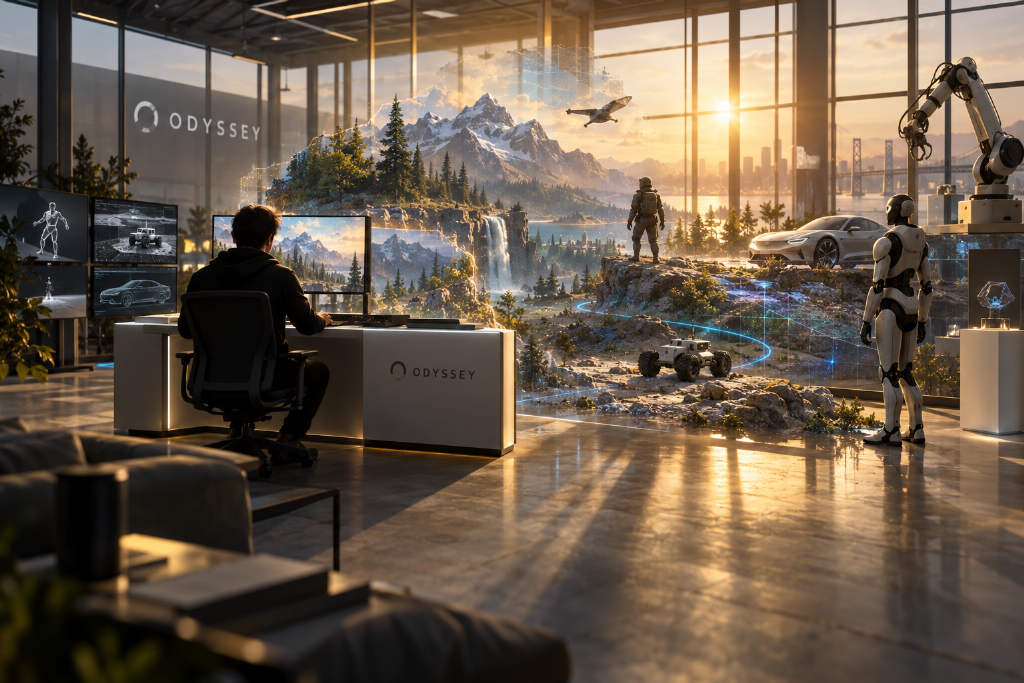
World model company Odyssey has officially released Odyssey-3 and opened a free Flash version for public testing. The model can generate an explorable world from text in real time, with the scene changing as a user moves around or turns the camera.
One model, multiple control use cases
The team also showed experiments applying the same model to robotic arms, humanoid robots, cars, and game characters. Odyssey-3 first learns object motion and the consequences of actions from internet videos, gameplay recordings, and physics simulations.
For robotics and automotive use, the pretrained core model parameters remain unchanged. The team only trains a small control module to turn what the model has learned into action commands. Different machines still need separate adaptation, but the full model does not need to be retrained.
Driving, humanoid robot, and gaming tests
Odyssey said a dedicated control module trained on just 20 hours of simulated driving data enabled a car to drive on real roads in India. In testing, the system trained on simulated data achieved a distance between two safety-driver takeovers equal to about 77% of the result from a system trained on real driving footage.
A humanoid robot developed with Flexion was trained on dozens of hours of teleoperation demonstration data and was able to keep performing tasks under changing lighting conditions.
In a gaming experiment, the control module learned from about two hours of gameplay footage from GTA V. After that, with no additional training, it was able to make a character ride a horse in Red Dead Redemption 2.
Benchmark score tops FLUX 3 [large]
In the Physics-IQ Verified physical video prediction benchmark, Odyssey-3 Pro scored 66.1, ahead of FLUX 3 [large] at 64.35. Both numbers were reported on a best-of-8 basis.
Odyssey also published WorldMark benchmark results, where the model placed first in three of four interactive scenario categories.