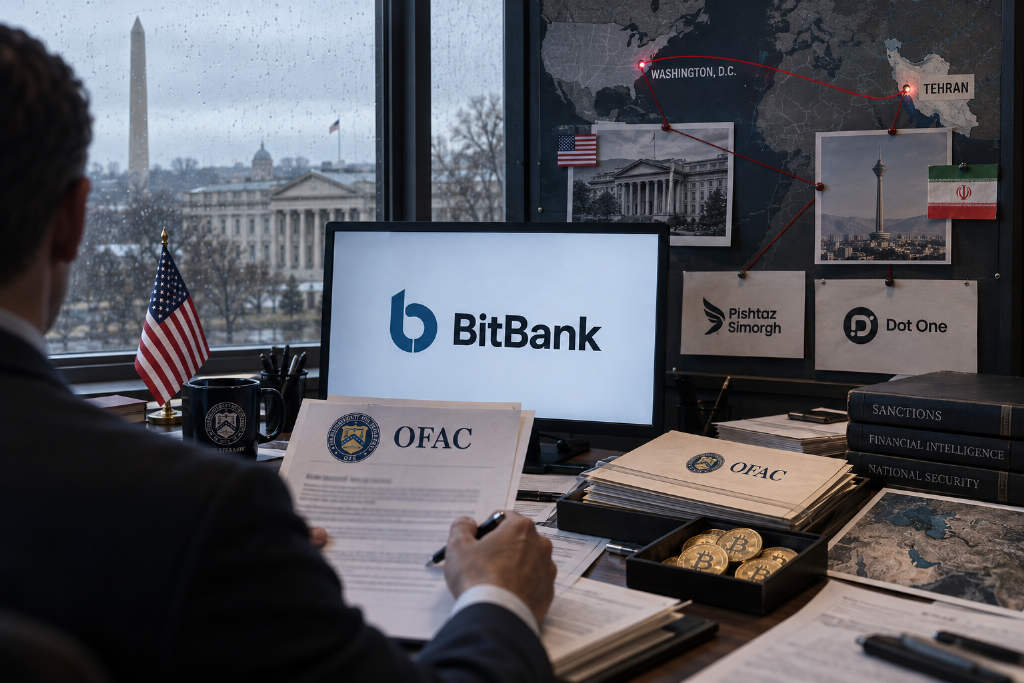
The U.S. Treasury Department’s Office of Foreign Assets Control, or OFAC, has sanctioned Tehran-based crypto exchange BitBank, saying the platform transferred hundreds of millions of dollars in bitcoin to Iran’s Islamic Revolutionary Guard Corps, or IRGC. OFAC said BitBank is controlled by Iranian financier Babak Zanjani, who had already been identified in January, and that he used the platform to carry out transfers between June and July. The designation was made under Executive Order 13902. The sanctions also extend to BitBank software developer Pishtaz Simorgh and three executives at its parent company, Dot One. OFAC separately said Hormuz Safe, a Tehran entity described as selling safe passage through the Strait of Hormuz, routed proceeds through BitBank starting in June; that entity had already been sanctioned in July. U.S. Treasury Secretary Bessent said the use of cryptocurrency to finance the Iranian regime does not fall outside OFAC’s jurisdiction. OFAC did not disclose the wallet addresses tied to the case.
The U.S. Treasury Department’s Office of Foreign Assets Control (OFAC) has sanctioned Tehran-based crypto exchange BitBank, saying the platform transferred hundreds of millions of dollars in bitcoin to Iran’s Islamic Revolutionary Guard Corps (IRGC).
OFAC ties BitBank to Babak Zanjani
According to OFAC, BitBank is controlled by Iranian financier Babak Zanjani, who had already been identified in January this year. OFAC said Zanjani used the platform to carry out transfers between June and July. The designation was made under Executive Order 13902.
Sanctions also cover developer and executives
The sanctions also apply to Pishtaz Simorgh, the software developer behind BitBank, as well as three executives at its parent company, Dot One.
Hormuz Safe payments were routed through BitBank
OFAC also said Hormuz Safe, a Tehran entity described as selling safe passage through the Strait of Hormuz, had its proceeds routed through BitBank starting in June. That entity was sanctioned in July.
U.S. Treasury Secretary Bessent said the use of cryptocurrency to finance the Iranian regime does not fall outside OFAC’s jurisdiction. OFAC did not disclose the wallet addresses related to the case.
This article was originally published by Bit.Fan. For more cryptocurrency news and market insights, visit www.bit.fan. Disclaimer:
The market information, project data, and third-party content displayed on this platform are for industry information sharing only and do not constitute any form of investment advice or return commitment.
Cryptocurrency trading carries high risks. Users should fully assess their risk tolerance and make independent decisions. All profits, losses, and legal responsibilities are borne by the users themselves.