
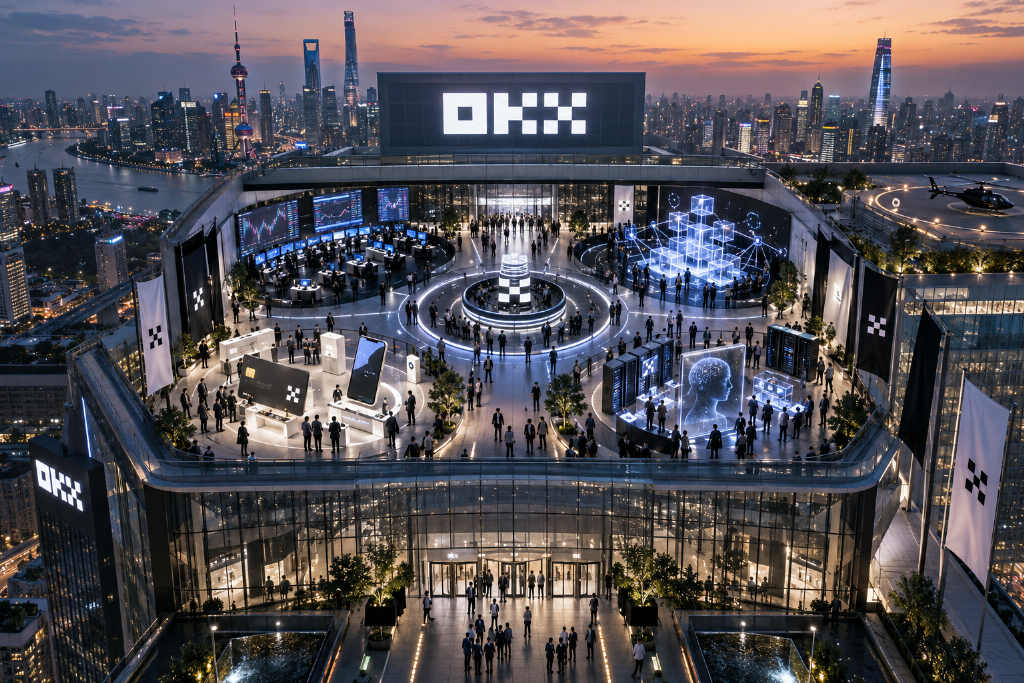
OKX extends its pitch beyond the exchange model
OKX used its global product and ecosystem conference to describe itself as something larger than an exchange, presenting the company as a broader global financial technology platform spanning money storage, payments, investing and wealth management.

At the event on Oct. 6, 2026, OKX founder and CEO Star laid out his view of where finance is heading. In the company’s framing, finance is moving away from a system split across institutions, markets, accounts and infrastructure, and toward one that is more unified, real-time, programmable and intelligent.
The conference carried the title “OKX NOW.” On stage, that theme was given two meanings: a snapshot of the company’s current products and ecosystem, and a statement that the future of finance is no longer theoretical and is now being put into practice.
Another phrase ran through the event: “Always On.” OKX used it both to describe a financial system where assets can be traded at any time, money can move anywhere, payments can be made globally, and investing and wealth management can be handled on demand, and to define the role it wants to occupy in that system.
For OKX, breadth only matters if the rails are connected
“The exchange is our starting point, but not our destination,” Star said during the presentation.
That idea sits at the center of OKX’s new positioning. The company argued that user demand has expanded far beyond the old one-task exchange model. A user may want exposure to DeFi opportunities in crypto, access to U.S. equities for global asset allocation, the ability to complete a payment overseas, or, in an AI-driven setting, a way to tell a system an investment objective and let that system gather information, analyze strategies and execute trades within approved limits.
OKX said that does not mean simply stacking more products on a shelf. In the company’s telling, that approach creates fragmented entry points, preserves the time and cost frictions of traditional markets, and leaves users with more complexity rather than less.
Instead, the company tied real breadth to the ability to remove friction at the infrastructure level. The model presented at the conference rests on three connected layers:
- a unified account system that lets different assets and services share the same user identity and funding relationships;
- a common infrastructure layer so trading, onchain interaction, payments and other financial services do not run as isolated systems;
- a shared view of assets and funds that can be understood and used by both users and AI systems.
In that setup, the outcome users are supposed to notice is less switching, lower friction, lower cost and a more continuous financial experience.
Four product lines: Trading, Onchain, Payments and AI
After outlining the broader platform thesis, OKX moved into a product demonstration built around four lines: Trading, Onchain, AI and Payments.

Star grouped user demand into four areas — holding and managing assets, investing, payments, and AI-driven wealth management and growth. Those are the same four categories used to organize the company’s product strategy.
Trading: expanding the asset menu inside one system
Trading remains one of OKX’s core capabilities, but the company used the event to show how far it wants to stretch that category.
Beyond crypto spot, futures and options, OKX said it has rolled out TradFi perpetuals, Pre-IPO perpetuals and unified tokenized stock trading, bringing tokenized equities, precious metals, commodities and Pre-IPO assets into the same trading framework.
OKX described this as its hardest product line because it addresses not just what users can buy, but also the structural splits that have long defined traditional finance. The company tied that claim to round-the-clock infrastructure, programmable money, global settlement and self-custody features built on crypto rails.
The company broke that integration into three parts:
- asset continuity, meaning one entry point for global assets;
- time continuity, meaning no market-close constraint;
- account continuity, with a unified account sharing margin and position management.
Time continuity was one of the clearest messages on stage. OKX said its unified tokenized stock products and TradFi X-Perps already trade 24/7. It also said OKXICE, its joint venture with ICE, plans to launch a tokenized securities venue, or TSV, under the U.S. Securities and Exchange Commission’s innovation exemption framework. According to the presentation, the venue is intended to cover more than 60 U.S. stocks, including NVIDIA, Apple and Microsoft, with each stock token backed 1:1 by real shares and available for 24/7 trading.
Andrew Cuomo, former governor of New York and a member of the OKX board, called the move “a milestone toward a truly global, 24-hour Wall Street,” according to the event presentation.
OKX also cited official data saying tokenized stocks and TradFi perpetual markets are averaging about $3 billion in daily volume, with peaks reaching $9 billion. The company said it plans to add underlying options and its own tokenized stock product, xRWA, in the coming months so users can directly trade stocks sourced from securities exchanges and share liquidity.
Onchain: taking assets from accounts into open networks
If Trading is the asset entry point, Onchain is where OKX wants those assets to move next.
The company presented OKX Wallet as the core gateway into this part of the ecosystem. The self-custody multi-chain wallet supports more than 100 public chains, and users can generate or activate an onchain wallet from an OKX exchange account with one click, according to the conference.

Outside the wallet itself, OKX said it is linking discovery, research, trading and use of onchain assets more closely together. One of the product demos focused on a new DEX trading terminal that combines hot-token screening, onchain fund-flow tracking, social sentiment monitoring and one-click instant trading, with customizable workspaces for users.
The infrastructure behind this line is X Layer, OKX’s in-house EVM-compatible Layer 2. At the conference, the company described X Layer as a high-throughput, low-fee base layer for its onchain products. It said 530,000 users participated during the World Cup period, covering 104 matches and more than 520 outcome options. At peak, matching and auto-settlement took less than 100 milliseconds, with 100% availability during testing.
X Layer also natively supports stablecoins, DeFi protocols and RWAs, which the company said allows assets on the network to move into lending, yield and liquidity use cases.
OKX paired that with several data points it cited as evidence of onchain market activity:
- combined decentralized perpetual and spot trading volume exceeded $1 trillion over the past 30 days;
- the size of tokenized onchain RWAs has grown from about $2 billion to nearly $40 billion;
- X Layer’s DeFi TVL has risen about 11-fold this year and hit a record high in September.
Payments: moving stablecoins into everyday use
Payments was presented as the last mile that connects financial assets to real-world spending, with OKX Money at the center.
At the conference, OKX announced the formal launch of OKX Money as a standalone app. The app is built around four scenarios — transfers, spending, savings and asset custody — and is meant to serve a broader user base that includes people who are not native crypto users. It is built on X Layer, uses self-custody smart accounts, supports round-the-clock digital asset transfers, and is already available in more than 30 countries, according to the company.
In the on-stage demo, a transfer from Singapore to Venezuela was completed in seconds.
OKX said that, together with products such as OKX Pay and OKX Card, the app is meant to move stablecoins beyond their role as settlement assets inside trading accounts and closer to functioning as a usable digital dollar in daily life.
For the European market, the company also highlighted Pay Boost. The feature lets balances continue earning yield, while spending is deducted directly from those yield-bearing balances and the remaining funds keep generating returns.

AI: from advice layer to execution layer
Among the four product lines, AI was presented as the most distinct. OKX described it as an intelligent layer that can run across the full ecosystem and alter how users interact with finance.
The company linked that idea to a long-standing cost problem in traditional finance. Private banking has historically served high-net-worth clients because those clients can afford professionals who understand the system and handle execution. AI, in OKX’s account, changes that by making it easier to understand a user’s assets, cash flow, risk tolerance and financial goals, while also handling the final execution step.
To build that layer, OKX said it has already released several products:
- Agent Trade Kit, which lets AI agents access OKX data and execute trades;
- OnchainOS, which allows agents to operate onchain assets through natural language;
- Agentic Wallet, which lets users allocate funds to agents within preset permissions and boundaries;
- an AI Agent marketplace that turns professional strategies, signals and agents into callable services.
The event used a simple but specific demo to show that flow. A user asked AI to check a wallet. The system found a forgotten DeFi position, analyzed its yield and risk, and generated plans across different risk levels. The user picked a more conservative option with a 4.95% return, confirmed it, and the execution followed. OKX said a process that previously required hours of information gathering and comparison was compressed into minutes.
The company also said it is testing an AI Bot that would let users create trading strategies in natural language, backtest them and deploy them. On the payments side, OKX said user-authorized AI agents are expected to be able to create investment strategies and carry out small transactions inside OKX Money.
From shipping products to exposing capabilities
Beyond the user-facing product slate, the conference also highlighted a more structural shift: OKX wants to break out its internal capabilities and turn them into infrastructure others can call.
ExchangeOS was presented as the clearest example. OKX described it as a permissionless modular trading infrastructure for developers, built so anyone can use the same institutional-grade technology stack as the OKX centralized exchange to launch a market more quickly.
Historically, building an onchain market required developers to create matching, margining, clearing and risk controls from scratch. ExchangeOS is meant to push those functions down to the protocol layer as shared public services, leaving developers to focus on asset selection, user experience, compliance rules and operating models.
OKX also said it plans to use an X Layer improvement proposal called XIP-Exchange OS to help developers connect gradually to shared trading infrastructure and liquidity and create onchain markets faster.
If ExchangeOS is aimed at developers and institutions, OnchainOS was framed as infrastructure for AI agents. The company said agents have historically had to solve wallet setup, data access, trading, RPC connections, protocol interfaces and permission management on their own before they could operate onchain. OnchainOS is intended to bundle that stack, letting agents enter the onchain world through natural language, retrieve live data, inspect wallets, analyze addresses, find trading opportunities and execute actions within user-approved limits.

In that sense, OKX said its role is shifting from a closed platform to a public layer that others can build on. The first model serves only the platform’s own users and is limited by how many products it can create itself. The second extends its reach by giving tools to developers who want to build markets without assembling the full stack alone.
That is also where the company attached a deeper meaning to the phrase “Always On”: not only OKX itself, but also OKX’s financial capabilities being available externally on a continuous basis.
$25 billion valuation round adds strategic investors
On the same day as the conference, OKX said it completed a new financing round at a $25 billion valuation. Participants included Standard Chartered’s SC Ventures, Ripple, Circle and QRT. The amount was not disclosed.
According to the conference disclosure, the round extends a March 2026 financing, when ICE, the parent of the New York Stock Exchange, invested about $200 million in OKX at the same valuation.
TechFlow said Star later confirmed the financing on X and stressed that OKX did not bring in the investors because it needed capital.
The article linked each investor to a different part of the system OKX is trying to build: Circle for stablecoin issuance and compliance networks, Ripple for cross-border payment rails and experience, SC Ventures for Standard Chartered’s settlement capacity, institutional client base and regulatory ties, QRT for market making and liquidity, and ICE for exchange operations expertise and possible securities market channels.
TechFlow argued that the list looked less like a standard financing syndicate and more like an alliance map. The article also noted the presence of institutions such as DBS, JPMorgan and Mastercard in the broader conference context, and said discussions around compliance, next-generation financial infrastructure, round-the-clock market liquidity and the future of digital asset banking may shape OKX’s future product direction.
The pitch is in place; market proof still comes later
TechFlow ended on a cautious note. A conference can show products, and a financing round can show who wants exposure, but the final test still comes from market adoption.
By that measure, OKX’s proposed tokenized securities venue and its ongoing AI Bot testing point to a platform still under construction rather than one that has fully arrived. The open question, as framed by the article, is how much of what OKX showed across trading, onchain products, payments and AI will become infrastructure that finance uses every day.
