
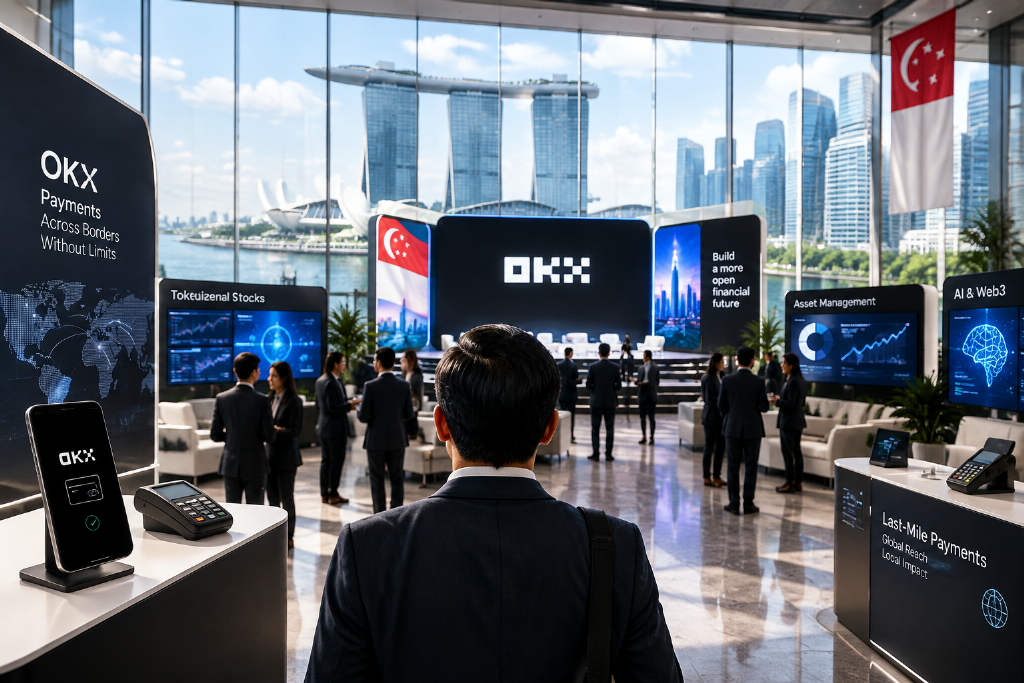
As TOKEN2049 approaches, attention across global finance and crypto has turned back to Singapore. On Oct. 6, OKX held its OKX NOW global product and ecosystem conference there, bringing together speakers from crypto, payments, banking and trading firms to discuss how digital finance is moving from concept to day-to-day use.

Opening the event, OKX CEO and founder Star Xu set out the company’s next step: starting from crypto trading, then building a global fintech platform that covers capital, payments, trading and asset management for a new generation of users. In his view, the overlap of internet infrastructure, crypto rails and AI creates room for financial services that are always connected, easier to use and more responsive to individual needs.
Star also said the buildout cannot rest on technology alone. He pointed to trust, regulation, governance and local responsibility as core requirements for global financial services. The convergence of crypto and traditional finance, he said, brings together technical capability, liquidity, institutional experience and service networks from both sides, creating a base for broader financial use cases.
Why OKX called the conference “NOW”
The event’s title was meant to draw a line between long-discussed industry themes and products that are already live. For years, global markets, onchain assets, round-the-clock capital movement and AI-assisted finance have often been framed as future developments. OKX used “NOW” to focus on what has already moved into real usage: what users can do today, which capabilities are starting to connect and what partnerships are keeping those systems running.
On the product side, OKX presented a slate of existing and upcoming offerings. TradFi perpetuals, Pre-IPO perpetuals and unified tokenized stock trading were described as part of one trading experience intended to bring crypto and traditional financial assets into a shared access point and expand 24/7 trading options.
In Web3, OKX Wallet, its DEX trading terminal and DeFi products cover onchain asset discovery, trading and management. ExchangeOS is set to open shared trading infrastructure and liquidity to developers through XIP, supporting the creation of onchain markets. Spot and perpetual markets tied to that framework are due to enter public beta soon.
For AI, the company highlighted Agent Trade Kit, OnchainOS and OKX AI as products linking market analysis, trade execution and agent-based services. An upcoming AI Bot will support the creation of personalized trading strategies through natural language. OKX Money extends digital asset use into transfers, spending and savings.
Payments and the last mile of daily finance
One of the conference’s recurring questions was simple: what kind of financial experience do ordinary users actually want?
OKX Global Managing Partner and CMO Haider Rafique said people are used to internet services being available at all hours, and they now expect the same from finance. Yet for users outside crypto, wallet addresses, seed phrases, gas fees and different blockchain networks still feel like an unfamiliar language. What they want more directly is a way to use their money easily, send it to friends or pay for something without friction.
He said OKX Money, a standalone app, was designed around those needs. Built on X Layer, it uses self-custodial smart accounts to connect transfers, spending, savings and asset management. The product is already available in more than 30 countries. Expanding beyond trading into everyday money use has also become a major topic in OKX’s discussions with payment partners.
Raj Dhamodharan, executive vice president of Blockchain and Digital Assets at Mastercard, added the payments network view. When consumers tap a card for the subway or shop online, he said, they do not need to understand the banking networks, foreign exchange conversion or fund settlement working behind the scenes. Even if payment rails change in the future, a simple experience and dependable trust will still matter.
Cross-border remittance came up as a concrete example. Sending money from Dubai to the Philippines is not solved by onchain transfer speed alone. If the recipient needs pesos, the system also requires local 24/7 liquidity, competitive exchange rates and compliance support on both the sending and receiving ends. Only when those pieces are connected has the money truly reached the user’s daily life.

Haider said OKX’s current work with Mastercard is centered on card products. Raj said the two sides are also studying openings in pay-ins, pay-outs and agentic commerce as OKX expands from a trading account toward a general-purpose money account, including how agents could pay for services and receive income.
24/7 markets need more than longer trading hours
Another panel turned to what happens once money can move all day: how assets can trade all day as well.
Speakers said extended trading creates operational demands that are easy to overlook. For market makers and trading firms, a continuous market means cross-region risk handoffs, weekend margin management, and keeping systems upgraded and maintained while they remain live.
Tom of QRT said trading teams still have to react to new macroeconomic or geopolitical information after traditional markets close. Without the familiar benchmark of real-time cash-market pricing, institutions have to rethink risk models and quoting methods. The ability to move capital efficiently among wallets, sub-accounts and venues also becomes an operational edge, one that feeds into capital efficiency and quote quality.
These issues are especially visible in products tied to traditional assets such as equities. Information keeps arriving even when the underlying market is closed, and user demand does not stop on the same schedule. In that setting, always-on venues begin to take on more of the price discovery function.
Jeremy of Ludisia said that shift is already visible. Some stock-linked products remain active on digital asset venues while traditional markets are shut. As more traders participate, information can enter prices faster and liquidity can develop more fully.
To support that demand, he said, exchanges need to keep improving the basics. That includes not only order book depth and stable trading latency, but also more standardized and programmatic handling of corporate actions such as stock splits, reverse splits and dividends. For institutions carrying larger positions, those details directly affect risk management and trading quality.
Jeremy said during the panel that OKX’s technical infrastructure had performed well. OKX responded that it would keep investing in engineering and infrastructure to support growth in these markets, while making corporate action processing a priority in product optimization.
That discussion gave broader context to the TradFi trading tools, onchain trading products and open infrastructure OKX had presented earlier. Products provide access points, but professional participation and durable market mechanisms are what keep a venue functioning over time. In that sense, “Always On” describes both the user experience across time zones and the daily coordination required from platforms and liquidity partners.
Banks and exchanges move closer around shared user demand
The conference also spent significant time on capital services and how cooperation between banks and exchanges is evolving.
Evy Theunis, managing director and head of digital assets at DBS Bank, said early tokenization efforts often started from the supply side, placing individual buildings or bonds onchain one by one without necessarily reaching scale. Today, she said, large trading platforms such as OKX already have user bases and distribution channels that can aggregate demand across asset types, giving more tokenized assets a path to market.

Amy Tan, head of Technology and Innovation Economy for Asia Pacific at JPMorgan, said trust, liquidity and settlement efficiency remain central to broader adoption. Banks are moving blockchain initiatives forward, but they also need to understand real client demand. Some businesses already need 24/7 capital services, while others are still adjusting gradually.
Luke Boland, global head of FinTech Client Coverage at Standard Chartered, focused on settlement rails. How tokenized deposits, stablecoins and other digital currencies interoperate will shape the pace at which more real-world assets move onchain, he said. Banks bring long experience in treasury, liquidity and trust, which can connect with the technology and service capabilities of digital asset platforms.
He added that working with exchanges like OKX gives banks a closer view of digital asset demand across markets, while opening room to explore custody, collateral and institutional services. Because exchanges connect users, institutions, liquidity providers and stablecoin issuers, they also create a wider field for ecosystem cooperation.
David Fragale, senior managing director and head of Blockchain and Digital Assets at Western Alliance Bank, described the value of cooperation from the technology side. Digital asset platforms, he said, have already built specialist capabilities in key management, trading systems and 24/7 operations. By partnering with them, banks can respond faster to rising enterprise demand for digital asset services.
When the discussion returned to retail users, the expectations became more concrete: whether funding can be available in time on a weekend, whether different asset types can be viewed and used in a familiar interface, and whether AI agents could eventually help handle payments and banking tasks.
Speakers also discussed digital-asset-backed financing, starting with assets such as bitcoin and covering arrangements including custody, collateral haircuts and loan-to-value ratios. Those areas still need to be developed step by step, but the conversation showed that bank-exchange cooperation is moving toward more specific service needs.
From product rollout to everyday use
Across the conference, OKX framed product rollout and ecosystem cooperation as part of the same process. Trading products are being used to connect a broader set of assets. Web3 tools are aimed at lowering the barrier to onchain use. AI products link analysis with execution. OKX Money is designed to bring digital assets into transfers, spending and savings. The participation of payment partners, liquidity firms and banks gives those products a route into more scenarios and a better chance of operating on a sustained basis.
The message behind “NOW” was not that the work is finished. It was that capabilities already in the market now have to be expanded, trusted across jurisdictions and tested through everyday use.
For users, the change may show up in small moments rather than grand claims: a transfer that arrives smoothly over the weekend, a payment completed without having to decode technical jargon, or market access at a time that suits the user instead of the exchange schedule.
The panels have ended, but the product and partnership work described in Singapore is still moving. For OKX, the shift from a financial future that is beginning to happen to one that is already happening starts with products and experiences it says it can deliver now, then extends through cooperation with more partners to bring those tools into daily life.
