
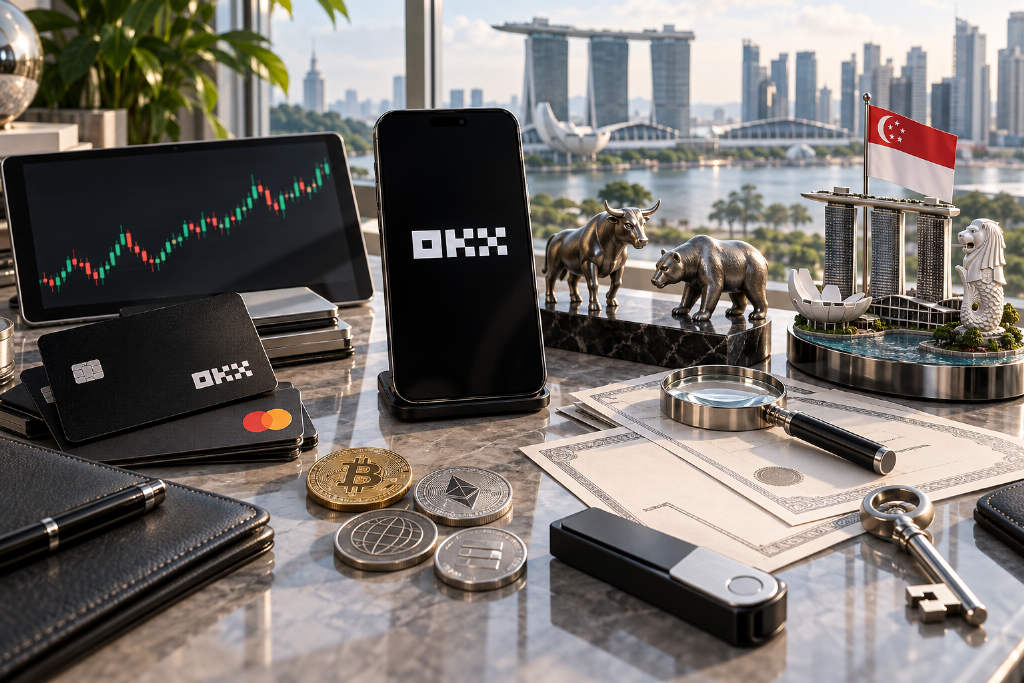
OKX used its OKX NOW Global Product and Ecosystem Conference in Singapore on Oct. 6 to present its next phase of growth: moving from a crypto exchange business toward a global fintech platform that spans money movement, payments, trading and asset management. The event took place as attention across the crypto and broader financial industries turned back to Singapore ahead of TOKEN2049.

In opening remarks, OKX CEO and founder Star Xu said the company is building for the next generation of users. He framed the shift around the intersection of internet infrastructure, crypto and AI, arguing that financial services now have a chance to match the kind of digital experience people already expect in daily life: always connected, easy to use and better able to understand individual needs.
Star Xu also stressed that technology alone is not enough. Building global financial services, he said, also requires trust, regulation, governance and local responsibility. In that view, the convergence of crypto and traditional finance brings together technical capabilities, liquidity, institutional experience and service networks from both sides, creating a base for broader financial use cases.
Products already in market were the center of the discussion
The conference name, NOW, was meant to point to what users can already do today rather than what the industry has long discussed in future tense. Over the years, themes such as global markets, onchain assets, round-the-clock money movement and AI in financial services have often been treated as ideas still taking shape. At this event, the focus shifted to the point where those ideas become products and move into real use.
OKX presented a set of products and capabilities that it said are already live or under active rollout. In trading, TradFi perpetual contracts, Pre-IPO perpetual contracts and unified tokenized stock trading were positioned as a way to bring crypto assets and traditional financial assets into one trading experience and widen the set of choices available in a 24/7 market.
On the Web3 side, OKX pointed to OKX Wallet, a DEX trading terminal and DeFi products that connect onchain asset discovery, trading and management. The company said ExchangeOS will open shared trading infrastructure and liquidity to developers through XIP, allowing them to build onchain markets. Related spot and perpetual markets are set to enter public beta.
On the AI side, the company highlighted Agent Trade Kit, OnchainOS and OKX AI, which tie together market analysis, trade execution and agent-based services. An upcoming AI Bot will let users create personalized trading strategies using natural language.
OKX Money was presented as the product that extends digital asset usage into day-to-day activities such as transfers, spending and savings.
Payments discussion centered on the last mile
One of the clearest themes in the conference panels was that adoption depends less on abstract infrastructure debates and more on whether ordinary users can move and use money without friction. Haider Rafique, OKX global managing partner and CMO, said people are already used to internet services being available at all times, and they naturally expect the same from financial services.
For users outside the crypto industry, though, wallet addresses, seed phrases, gas fees and multiple blockchain networks still form a language that is hard to navigate. The more direct demand, he said, is much simpler: people want to use their own money easily, send it to friends or pay for something.
That is the setting for OKX Money, which Haider Rafique described as a standalone app built around those needs. The app is based on X Layer and uses self-custodial smart accounts to connect transfers, spending, savings and asset management. It is currently available in more than 30 countries. Serving broader daily financial needs beyond trading has also become a major topic in OKX's conversations with payment partners.

Raj Dhamodharan, executive vice president for blockchain and digital assets at Mastercard, added the payments-network view. When consumers tap a card for transit or shop online, he said, they do not need to understand the banking networks, foreign-exchange conversion or settlement processes running in the background. Even if the rails behind those experiences change over time, simplicity and trust still matter.
A cross-border remittance example made the point more concrete. Sending money from Dubai to the Philippines is not solved by blockchain transfer speed alone. If the recipient needs pesos, the process also depends on local 24/7 liquidity, competitive foreign-exchange rates and compliant support on both the sending and receiving ends. Only when those pieces are connected does the money actually reach the user's daily life.
Haider Rafique said the current focus of OKX's work with Mastercard is on card products. Raj Dhamodharan said the two sides are also studying opportunities around sending and receiving payments, as well as agentic commerce, as OKX expands from trading accounts toward more general-purpose money accounts. That includes questions such as how agents pay for services and how they receive income.
24/7 trading raises operational and liquidity demands
A separate panel looked at what happens after money can move at all hours: how assets can trade at all hours as well. Extending trading sessions brings a list of practical issues for market makers and trading firms, including cross-regional risk handoffs, weekend margin management and maintaining trading systems that must stay online continuously while still being upgraded.
Tom of QRT said trading teams still need to respond to new macroeconomic or geopolitical developments after traditional markets close. Without the familiar anchor of real-time reference prices, institutions need to rethink both risk models and quoting methods. The ability to move capital efficiently among wallets, sub-accounts and trading venues can also become an operational edge, one that eventually shows up in capital efficiency and quote quality.
Those issues are especially visible in products tied to traditional assets such as equities. When the underlying market is closed, new information does not stop arriving, and user demand to trade does not stop either. That leaves 24/7 venues carrying more of the price-discovery function.
Jeremy of Ludisia said that shift is already visible. Some stock-linked products remain active on digital-asset venues while traditional markets are shut. As more traders participate, information can flow into prices more quickly, and the market has a better chance of developing deeper liquidity.
To support that demand, exchanges need to keep improving their core systems. Beyond order-book depth and stable trading latency, corporate actions such as stock splits, reverse splits and dividends need to be handled in a more standardized and programmatic way. For institutions carrying large positions, those details can directly affect risk management and the trading experience.
Jeremy said during the panel that OKX's technical infrastructure has performed well. OKX said it will keep investing in engineering and infrastructure to support market growth and will treat corporate-action handling as a key area of product improvement.
That gave broader context to the TradFi trading products, onchain trading tools and open infrastructure that OKX had already highlighted. Products create access points to markets. Long-term market operation depends on professional participants and trading systems that can keep up.

Banks and exchanges are moving closer around user demand
The discussion then moved into cooperation between banks and exchanges on money services and tokenized assets. Evy Theunis, managing director and head of digital assets at DBS Bank, said early tokenization efforts often started from the supply side, putting individual buildings or bonds onchain one by one without necessarily creating scale. Large trading platforms such as OKX now bring user bases and distribution channels that can aggregate more diverse asset demand, which opens the way for more asset classes to enter tokenized markets.
Amy Tan, JPMorgan's head of technology and innovation economy for Asia Pacific, said trust, liquidity and settlement efficiency remain central to broader adoption. Banks are pushing forward with blockchain applications, but they also need to understand what different clients actually need. Some businesses already require round-the-clock money services; others are still adapting step by step.
Luke Boland, global head of fintech client coverage at Standard Chartered, focused on settlement foundations. How tokenized deposits, stablecoins and other forms of digital money interoperate will influence how quickly more real-world assets can move into onchain markets, he said. Banks bring experience in treasury, liquidity and trust, while digital-asset platforms contribute technical systems and service capabilities.
He added that working with exchanges such as OKX gives banks a closer view of digital-asset demand across different markets and creates room to explore custody, collateral and institutional services. Because exchanges sit at the center of relationships among users, institutions, liquidity providers and stablecoin issuers, they also open up a wider field for ecosystem-level cooperation.
David Fragale, senior managing director and head of blockchain and digital assets at Western Alliance Bank, described the value of cooperation from the technology side. Digital-asset platforms, he said, have built deep expertise in key management, trading systems and 24/7 operations. Banks can use those partnerships to respond more quickly as corporate demand for digital-asset services increases.
When the discussion returned to individual users, the practical questions became more basic again: whether usable funds can be made available in time when someone wants to enter the market on a weekend, whether different kinds of assets can be viewed and used through a familiar interface, and whether AI agents may eventually help handle payments and banking services.
Panelists also discussed the possibility of starting digital-asset-backed financing with assets such as bitcoin, including arrangements around custody, collateral haircuts and loan-to-value ratios. They described that work as something that still needs to advance step by step, but it showed how cooperation between banks and exchanges is moving into more specific client needs.
From delivered products to everyday use
Across product presentations and ecosystem panels, the event drew a consistent line between shipped products and the partnerships needed to make them useful at scale. Trading products connect a broader range of assets. Web3 tools aim to lower the barrier to onchain use. AI products tie analysis more closely to execution. OKX Money is meant to push digital assets into everyday money usage. Participation from payment partners, liquidity firms and banks is what gives those products a path into more real-world scenarios.
The message behind NOW was less a slogan than a description of ongoing work: keep building on capabilities that are already live, build trust across different markets and make sure products and services can hold up under daily use. For OKX, the shift from a future that is "starting to happen" to one that "is happening now" rests on products and experiences it says it can deliver today, together with partners that can help extend those services into more parts of financial life.
Disclaimer: Markets involve risk and investors should exercise caution. This article does not constitute investment advice. Users should consider whether any opinions, views or conclusions in this article fit their own circumstances and bear responsibility for any investment decisions made on that basis.
