
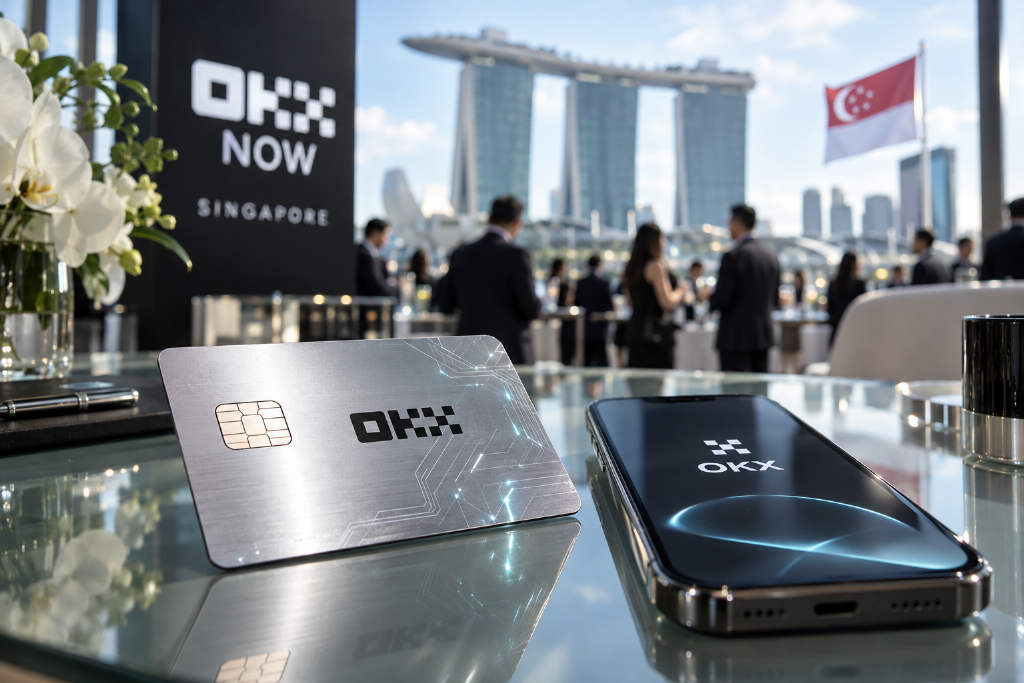
OKX founder and CEO Star used his opening speech at the OKX NOW global product and ecosystem conference in Singapore on Oct. 6 to describe a company that no longer wants to be seen only as a crypto exchange. His message was broader: the internet, crypto technology and AI are converging, and OKX wants to build financial services for the next generation around that shift.
Star said OKX began 13 years ago as a cryptocurrency exchange, but its ambition now extends to helping users hold money, make payments, invest and grow wealth in smarter ways.
Financial systems are still catching up to a real-time world
Star opened with a comparison between modern digital life and legacy finance. People can send messages across the world in a second, book a ride in minutes and watch live video from another country in real time, he said, yet much of finance still runs on infrastructure and assumptions built decades ago.
That gap carries real costs for ordinary users. Domestic payments can still cost 0.5% or 1%, while cross-border payments often cost several percentage points, he said. For migrant workers sending a few hundred dollars home each month to support parents, spouses or children, the total cost of a small remittance can approach 10%.
He also pointed to operating-hour limits in traditional finance. Many transfers are not processed overnight or on weekends, and conventional stocks trade only during set hours. Most people leave money in ordinary bank accounts and earn very little, while more tailored private banking services remain focused on wealthy clients.
Crypto has moved from experiment to mainstream integration
Star described crypto as one of the most important social experiments of this generation. From roughly 2008 to 2013, he said, the field was led largely by geeks, cryptographers and engineers trying to answer a fundamental question: could money exist natively on the internet?
From 2013 to 2017, financial institutions began taking digital assets seriously as exchanges developed and liquidity improved, forming what became a real financial market. From about 2018 to 2022, the sector entered the ICO and DeFi phase, producing extensive experimentation around smart contracts, stablecoins and decentralized finance, alongside bubbles, failures and bad actors.
Then, from around 2022 to 2024, the focus turned to compliance capacity: licensing, governance, consumer protection, risk management and institutional-grade infrastructure. Since 2025, he said, the industry has been entering a mainstream phase as crypto technology becomes increasingly integrated into the global financial system.
Why Star says OKX is no longer just an exchange
Looking back, Star said OKX started with a straightforward product: a spot crypto exchange. He noted that many people still remember the company’s first version and first product launched in 2013.
Since then, OKX has expanded into derivatives, built what he described as one of the industry’s largest Web3 wallets, entered payments and helped connect users to a wider set of markets. Where regulation permits, those markets include crypto assets, tokenized stocks, stock perpetuals, commodity perpetuals and other financial products.
For that reason, he said, calling OKX simply a cryptocurrency exchange no longer captures the scope of what it is doing. The exchange was the starting point, not the endpoint. OKX is developing into a broader global fintech platform.
The four-part framework for next-generation financial services
Star organized his long-term vision around four questions.
The first is how users hold money. He said people should be able to choose how their funds are kept, whether in regulated exchange accounts or in their own self-custody wallets. Some future services, he added, may take the form of next-generation digital banks.
The second is payments. Sending money to a friend or paying a merchant should be as easy as sending a message, he said: cross-border, instant and low-cost.
The third is investing. Star asked why exposure to different asset classes should require many separate apps. Crypto, equities, commodities and other markets, he said, are likely to be brought into a more unified digital experience.
The fourth is wealth management, which he sees as one of AI’s most important use cases. Private banking has historically been expensive because banks could justify dedicated relationship managers and investment professionals only for high-net-worth clients. AI is changing that cost structure, he said, opening the possibility that ordinary people could have an AI agent acting as a personal private banking adviser, one that understands assets, cash flow, risk preferences and financial goals.
He summarized the goal in simple terms: let users hold money, pay easily, invest and grow wealth.
Trust, regulation and governance remain central
Star said technology alone is not enough to build global financial services. Trust, regulation, governance and the ability to take responsibility locally all matter.
Over the past few years, he said, OKX has continued to invest in regulated infrastructure worldwide. The company has obtained licenses or operates under regulation in major markets including the U.S., Europe, the UAE, Singapore, Australia, Brazil and Turkey, as well as in other countries and regions.
He also said OKX was among the earlier major global crypto exchanges to make proof of reserves a routine transparency mechanism, adding that he believes it has now become an industry standard.
Star further said OKX may be one of the few international exchanges to appoint a Big Four accounting firm as its global auditor. Deloitte has become OKX’s global auditing firm, he said.
The objective, in his words, is to combine crypto-native technology with the standards people expect from global financial institutions.
Crypto finance and traditional finance are moving together
Another major change, Star said, is the fading divide between crypto finance and traditional finance. For years, the two were discussed as opposing worlds. That is changing quickly.
He said large global financial institutions are making equity investments in OKX. Those institutions span exchanges, banks, stablecoins, payments and quantitative finance, including ICE and the New York Stock Exchange, Standard Chartered, Ripple, Circle and others.
To Star, the significance goes well beyond capital. It shows that the boundary between crypto finance and traditional finance is disappearing.
His view is that the two will continue to merge. Every crypto company will expand toward traditional finance, and every traditional financial company will invest in crypto. Crypto brings always-on infrastructure, programmable money, global settlement and self-custody; traditional finance brings deep liquidity, regulatory experience, financial infrastructure and institutional trust. The two systems are converging into one.
AI has become core infrastructure inside OKX
Star also described a separate transformation underway inside the company: AI. He said it may even be closer to what he called SI, or super intelligence, though he added jokingly that OKX does not need to follow U.S. government language.
His broader argument was clear. Crypto changed money, and AI will change how financial institutions operate.
At OKX, he said, AI is already core infrastructure and is deeply embedded in day-to-day operations. The company has built its own internal AI platform, and roughly 95% of engineering pull requests now have their primary development work completed through AI workflows. Engineers still review, test and approve the final output, but the development process itself has changed at a basic level.
He expects an even bigger shift in customer service. Today, many people still associate AI support with clumsy chatbots that fail to understand questions. In the future, he said, AI support systems will be able to understand a user’s account, transactions, issues and relevant policies in real time, respond around the clock and, for many categories of issues, eventually outperform human agents.
He also pointed to fraud prevention and user protection. Instead of waiting for staff to identify suspicious activity, AI can continuously analyze millions of signals, spot issues faster and intervene earlier.
Compliance is another area he highlighted. Global financial institutions operate across multiple jurisdictions and must deal with different regulatory requirements, often relying on large teams. In that process, different people can interpret the same policy differently. AI, he said, can structure that information and help compliance teams execute more consistently while maintaining a global baseline and adapting to local requirements.
Star said OKX’s AI usage is already substantial. He recalled encouraging the team to use AI widely, then discovering that the company’s bill to large-model providers reached $10 million last month. That prompted a push for more disciplined use. To him, the size of that bill shows AI is not a slide-deck concept inside OKX. It is already operating at scale.
A global, real-time and AI-driven financial system
Looking out over the next decade, Star said he sees the internet, crypto and AI merging. The internet allows information to move instantly around the world. Crypto allows value to move across borders and become programmable. AI allows intelligence to scale and personalization to reach far more people.
Put together, he said, those three technologies could change financial services at a foundational level. Money could move globally around the clock, more people could access markets more easily, payment costs could fall and financial products could become more tailored to individual needs. Services that were once largely reserved for the wealthy could become available to ordinary users.
OKX started 13 years ago as a crypto exchange, Star said. Now the company wants to build a global, real-time, AI-driven fintech platform for the next generation, one that enables users to hold money, make payments, invest and grow wealth in smarter ways.
