


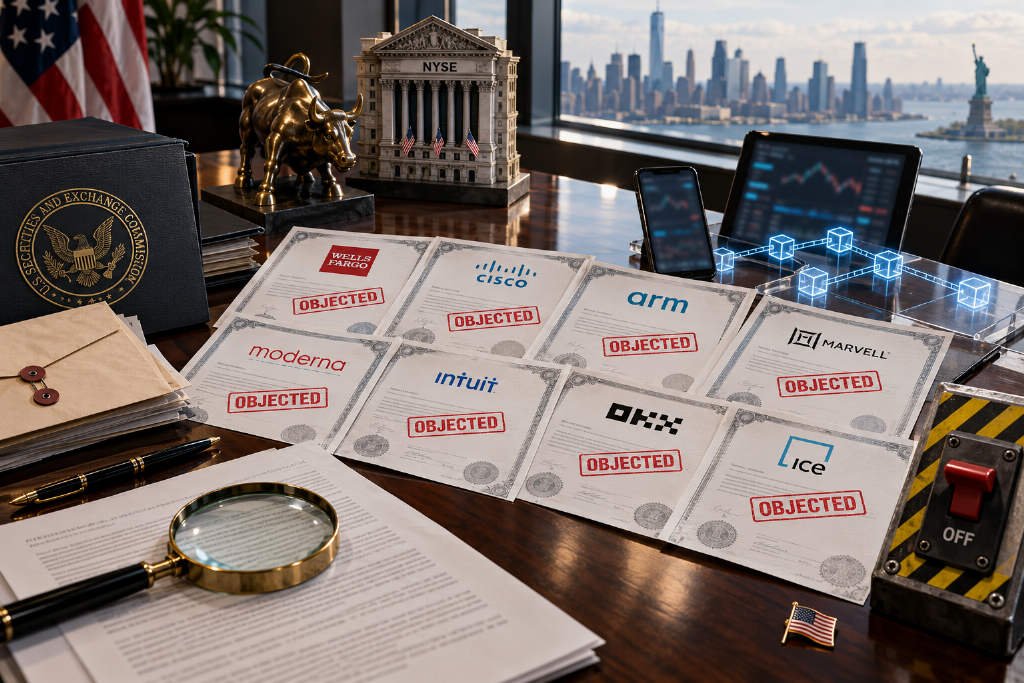
More public companies are pushing back against tokenized U.S. stock trading on OKXICE. In a public notice updated on Oct. 23, the platform said the number of issuers objecting to tokenized trading of their shares had climbed to 22, up from the initial 9 in just eight days. The growing list adds pressure to the 24-hour onchain U.S. equities plan backed by OKX and Intercontinental Exchange, the parent company of the New York Stock Exchange.
Six more companies joined the latest round of objections
The newest additions were Wells Fargo, Cisco, Arm, Marvell Technology, Moderna and Intuit, taking the total from 16 to 22.
Earlier reports had already tracked the expansion. On Oct. 15, nine companies including Broadcom and CoreWeave filed objections. On Oct. 19, another seven companies joined, including Microsoft, Alphabet, the parent company of Google, and Goldman Sachs, bringing the total to 16.
With the latest update, Wells Fargo became the second major U.S. bank after Goldman Sachs to object to tokenized trading on OKXICE. The inclusion of Arm, Cisco and Marvell also widened the opposition across semiconductor, networking equipment and AI infrastructure-related sectors.
SEC framework allows tokenization, but issuers can opt out
OKXICE is a joint venture formed by OKX’s U.S. holding company and Intercontinental Exchange. The venture plans to use OKX’s X Layer blockchain and Uniswap v4’s automated market maker, or AMM, mechanism to let eligible investors trade tokenized U.S. stocks around the clock.
The U.S. Securities and Exchange Commission introduced an innovation exemption in September that opened a regulatory path for this type of business. The same framework also gives stock issuers the right to object.
Under the arrangement, a platform must notify the issuing company in advance. If the issuer submits a valid written objection within the required period, the platform cannot rely on that exemption to offer third-party tokenized trading of that stock. The setup leaves room for innovation, but it does not require every listed company to accept tokenization on every platform.
The report also noted that the restriction applies to a specific platform and regulatory framework. It does not mean the 22 companies have imposed a blanket ban on tokenization of their shares under every lawful structure.
Trading design disclosures raised separate risk concerns
The latest notice drew attention not only because of issuer objections, but also because of the risks disclosed in OKXICE’s trading design.
According to the notice, the platform will suspend trading when an underlying stock is halted, but it does not have additional price circuit breakers. It also has not established a clear policy for maximum extractable value, or MEV, risks that may arise from onchain transaction ordering.
Separately, administrators can upgrade some smart contracts without giving users prior notice. The contract that controls user trading eligibility has so far completed only an internal security audit.
Those details show that the challenge for tokenized equities goes beyond keeping markets open 24/7. Price fairness, investor protection and liquidity during traditional market closures remain unresolved issues.
The broader tokenized stock market is still expanding
Even as OKXICE faces continued objections, the wider tokenized stock market is still growing. Data from RWA.xyz as of Oct. 26 showed distributed value in tokenized stocks worldwide at $3.53 billion, up 11.68% over the past 30 days. The number of holders stood at about 4.42 million, a monthly increase of 12.02%.
That growth has not translated into stronger activity across the board. Over the same period, RWA.xyz showed monthly onchain transfer volume in tokenized stocks at about $10 billion, down 75.6% from the previous 30 days. The figures suggest that asset value growth and onchain capital flows have not been moving in step.