

On-chain options have long been considered one of the hardest categories in DeFi to make work at scale. Over multiple market cycles, protocols including Opyn, Hegic, Ribbon, Lyra, Premia and Dopex launched with strong expectations, only to run into the same structural problems: shallow liquidity, difficult pricing, poor capital efficiency, and user experiences that sat awkwardly between retail simplicity and institutional-grade sophistication. The current market, however, is beginning to look materially different. Lower transaction costs on rollups, better Ethereum scaling, and the migration from AMM-based liquidity to CLOB and RFQ models are giving the category a second chance.
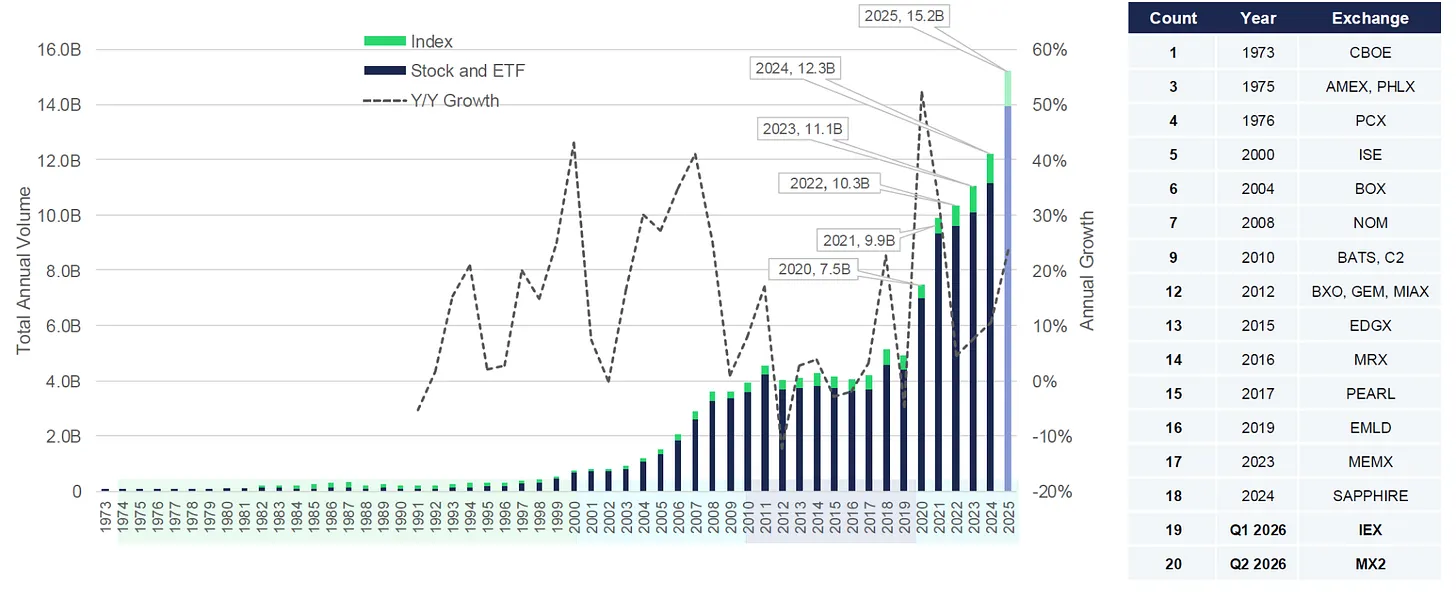
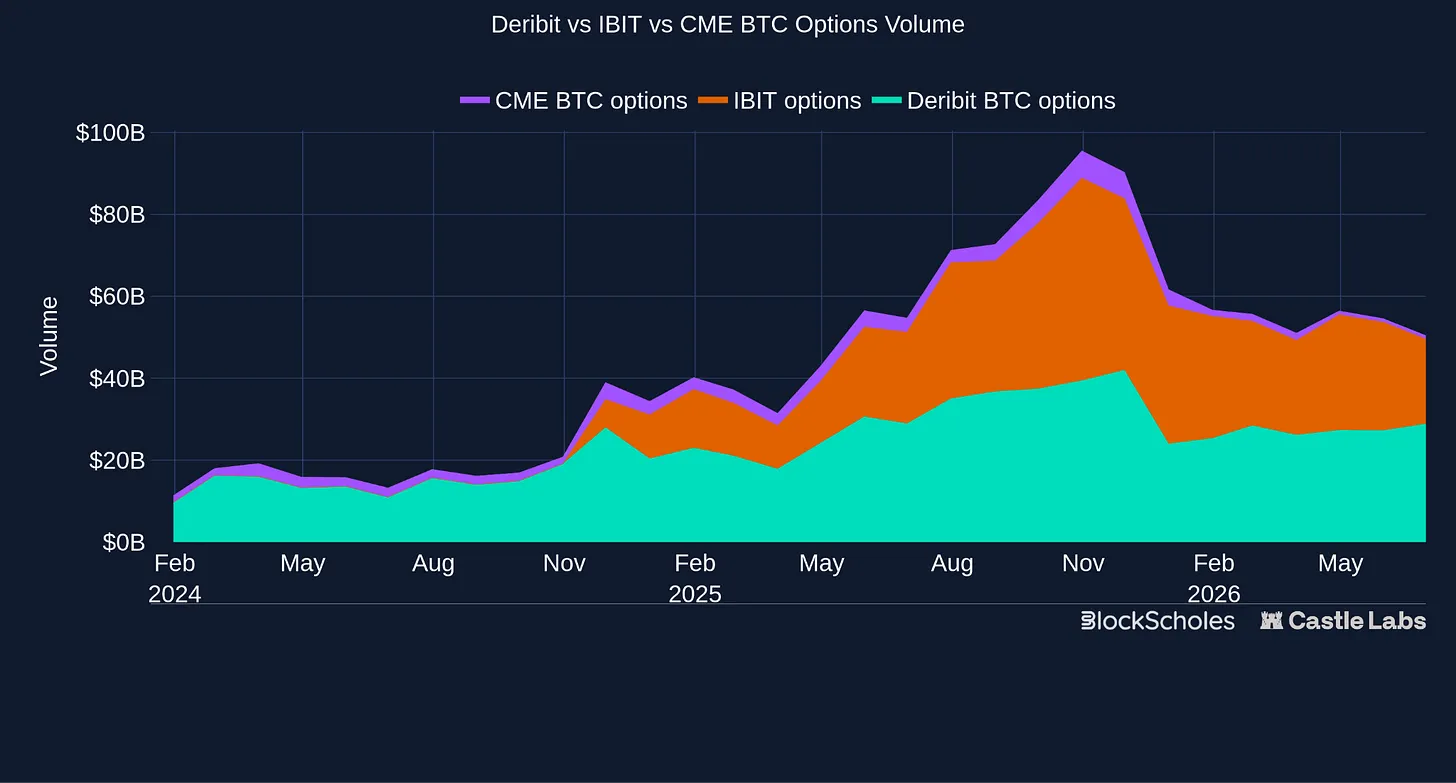
The source article frames this recovery against the backdrop of a much larger global options market. In traditional finance, options have become the dominant listed derivatives instrument by contract count. In 2024, options contract volume was roughly four times that of futures, while U.S. listed options traded about 15.2 billion contracts in 2025, equivalent to roughly $36 billion in daily premium notional. The piece also highlights the rise of 0DTE products and the continued importance of institutional demand. In crypto, that institutional demand has historically concentrated on Deribit, but it is now expanding through CME and BlackRock’s IBIT options as well, suggesting that options are becoming increasingly central to the broader crypto market structure.
Why early on-chain options repeatedly failed
The article argues that early on-chain options did not fail because the product category lacked relevance. If anything, options should have been a natural fit for crypto’s highly volatile markets. The problem was that the surrounding infrastructure was not ready. Opyn’s 2019 tokenized vanilla options on Ethereum suffered from high mainnet fees, weak liquidity and heavy collateral requirements. Hegic’s 2020 pool-based approach improved the buying experience but concentrated difficult-to-hedge risk on liquidity providers. Ribbon, Friktion and Dopex launched vault-based strategies in 2021 that made options easier to consume as deposit products, but those products effectively sold volatility into thin and cyclical demand, compressing yields until premiums no longer compensated for the embedded risk.
Other teams pursued AMM-driven options liquidity. Lyra, Premia, Pods and Siren tried to provide continuous markets across strikes and expiries, but options are harder to market-make than spot or perpetuals because pricing depends on a full volatility surface, not just a single price. That left LPs with inventory risk and volatility risk, while organic flow remained too weak to support healthy markets. In 2022, Opyn introduced Squeeth, a product designed to provide ETH-squared convex exposure without rolling dated options. But Squeeth proved hard to explain, costly to hold when funding was high, and still burdened by Ethereum execution costs.
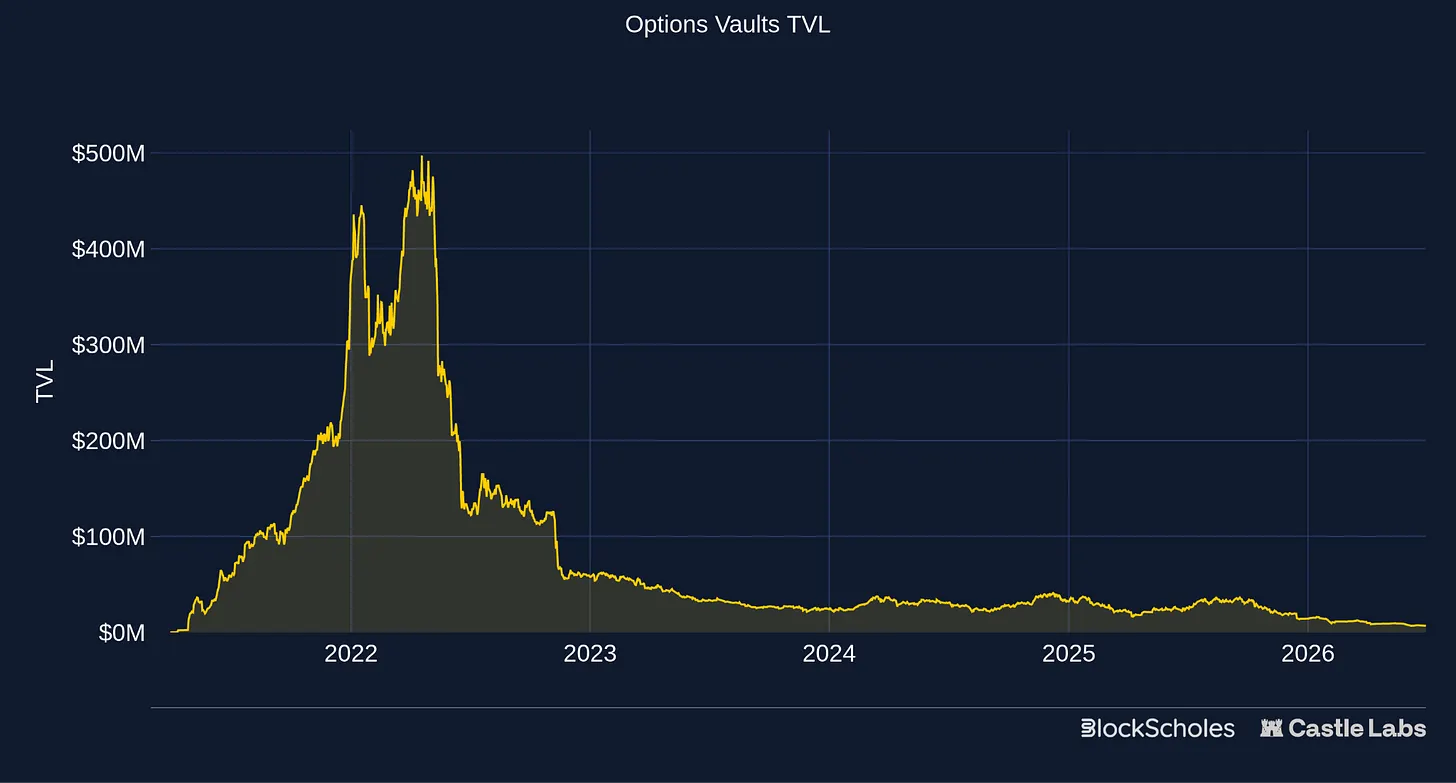
Across these experiments, the same bottlenecks kept appearing. Market makers were not deeply involved, so two-sided liquidity remained weak. Capital efficiency was poor, which made it hard to build reliable implied volatility curves. And product design landed in a no-man’s-land: too complex for most retail traders, yet not built in a way that institutions and professional vol traders would naturally adopt. For years, that combination made on-chain options one of DeFi’s most technically interesting yet commercially disappointing sectors.
Infrastructure and demand are finally improving
The source article suggests that this cycle differs because several enabling conditions have improved at once. Rollups and Ethereum scaling have reduced the cost of complex on-chain execution, making settlement and lifecycle management more practical. At the market structure level, CLOB and RFQ systems are increasingly replacing AMM-heavy options designs. That change matters because professional traders and market makers are far more comfortable quoting specific strikes and expiries through order-book and request-for-quote workflows than passively warehousing volatility risk in pools.
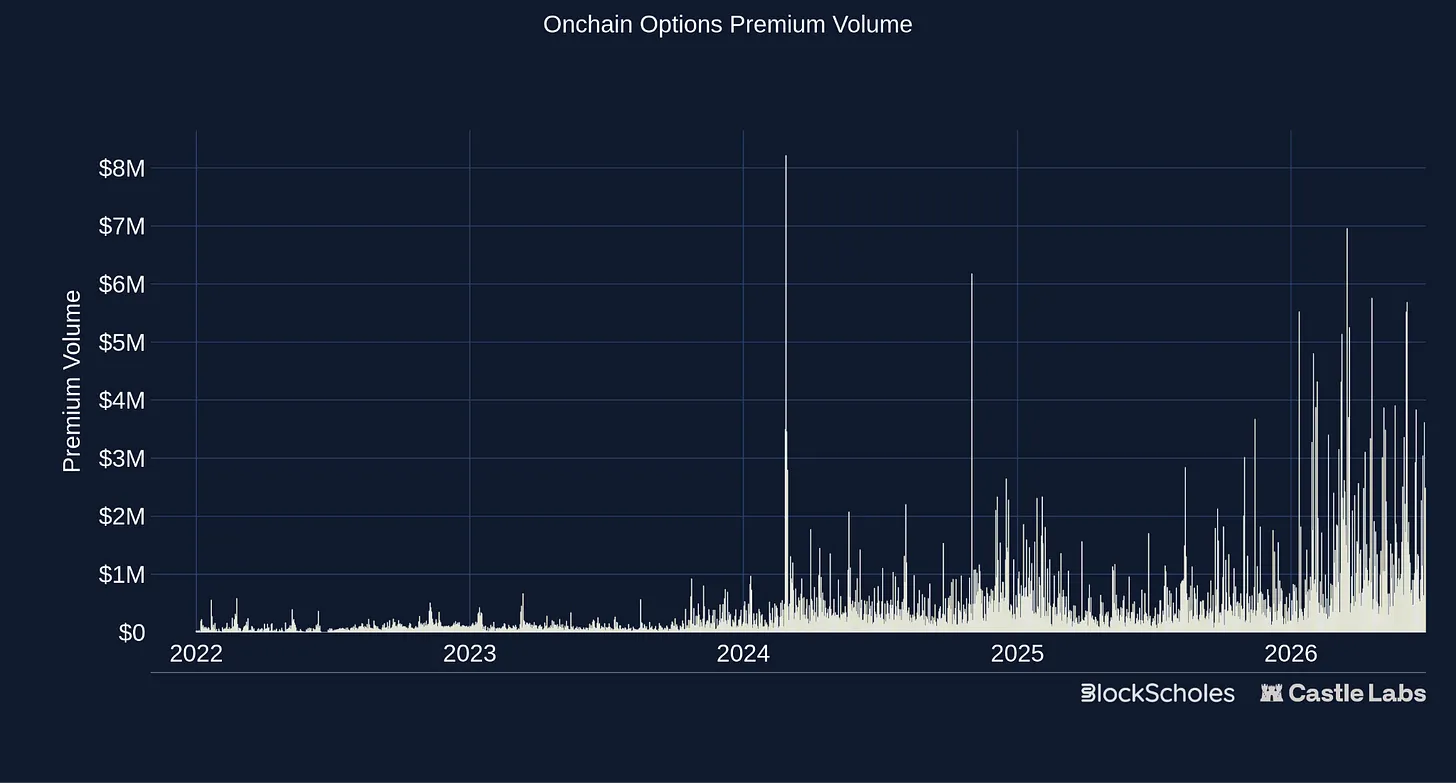
Demand-side conditions are also changing. Institutional appetite for crypto options continues to rise, first through Deribit and now increasingly through CME and IBIT. The article also points to prediction markets as an underappreciated force in user education. By making conditional payoff products easier to understand and trade, prediction markets have normalized non-linear returns for a broader on-chain audience. In that context, the current on-chain options market has reached about $1.44 billion in 30-day notional volume, while premium volume has hit fresh highs this year, according to the figures cited.
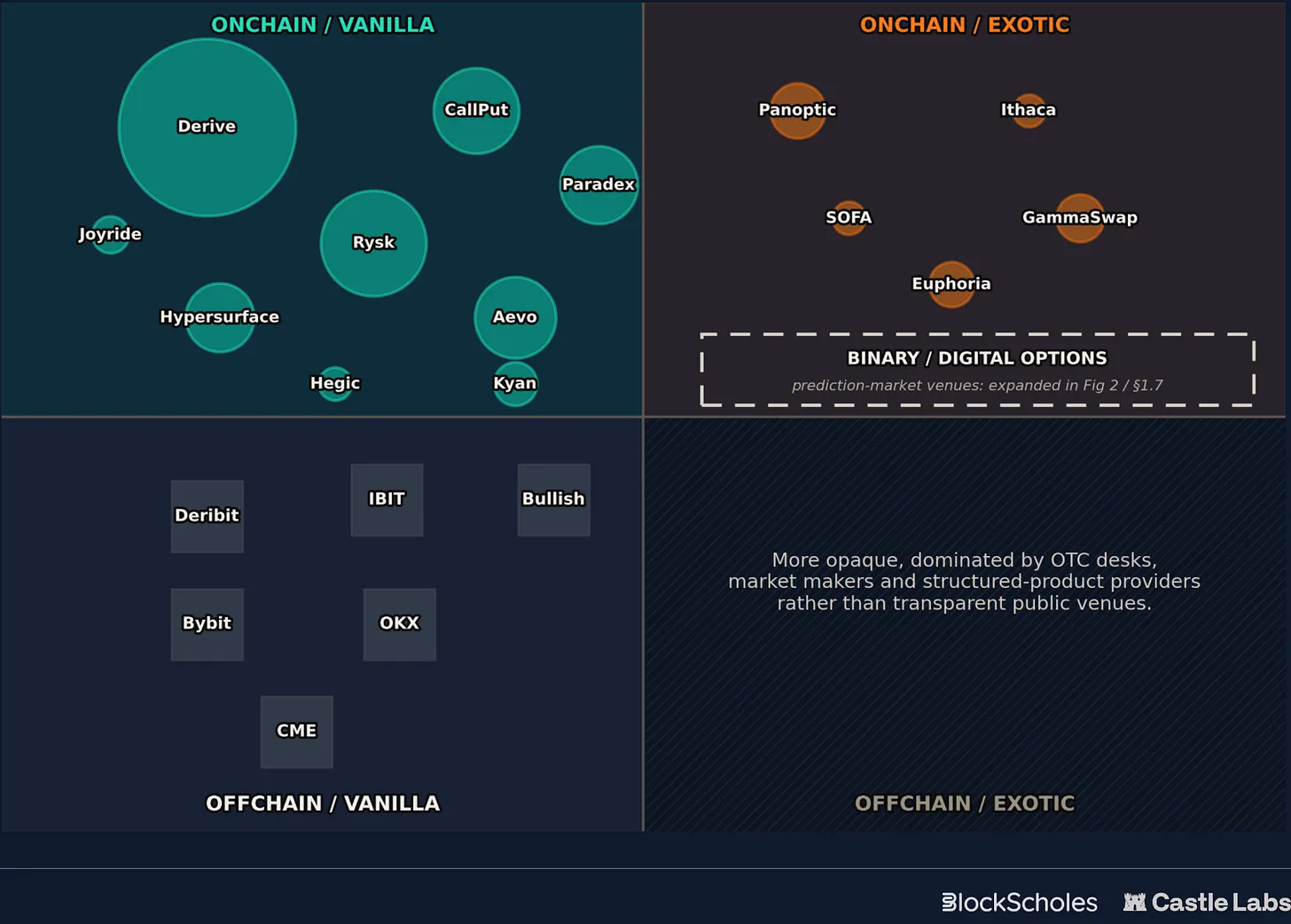
The category itself now looks much broader than in the first DeFi options cycle. Rather than simply trying to build an on-chain version of Deribit, today’s market includes institution-facing vanilla venues, yield-wrapped options products, perpetual options concepts, AMM-native options, short-duration touch structures, and binary-like markets that operate through prediction frameworks. The article organizes the space around two dimensions: settlement, from on-chain to off-chain, and payoff design, from vanilla to exotic. That framing underscores how much the design space has widened.
Derive now dominates on-chain vanilla options
Among on-chain vanilla venues, Derive is presented as the clearest example of how the sector has evolved. The platform emerged from Lyra’s earlier AMM-based options architecture and has since shifted to a CLOB-driven model operating on its own OP Stack Layer 2. Derive offers cross-margined options and futures-like products, using off-chain matching for speed and on-chain settlement for custody. It is not trying to hide the complexity of options from end users; instead, it is explicitly targeting professional traders, market makers, institutions and more sophisticated volatility participants.
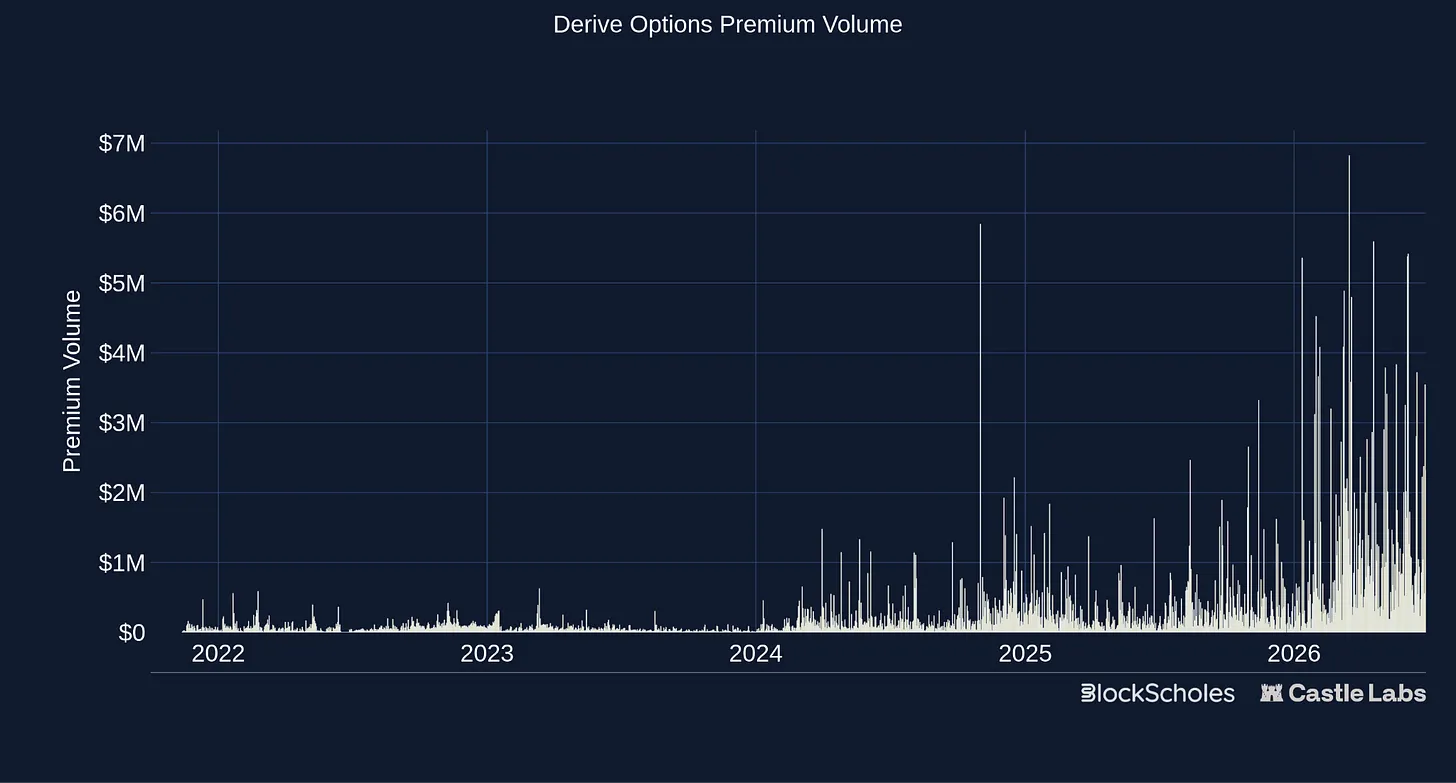
That positioning makes Derive feel much closer to a traditional options exchange. Users can trade across multiple assets, strikes and expiries, and build customized payoff structures from standard instruments. The platform also offers vault products, but unlike earlier DeFi vault experiments, those are built on top of an exchange architecture that can execute predefined options strategies more efficiently. According to the article, Derive generated $1.142 billion in 30-day notional volume and $44.3 million in premium volume, accounting for 79.2% and 87.2% of the on-chain options category respectively.
The article also notes that Derive’s liquidity is supported by incentives, including market maker rewards, OP incentives, DRV rewards and rebate programs. Even so, its market share illustrates a larger point: the most viable modern on-chain options venues increasingly resemble high-performance exchanges deployed on application-specific chains, where institutions can trade at near-CEX speeds without giving up non-custodial asset ownership. In other words, the question is no longer whether options can exist on-chain, but whether they can operate in a form sophisticated users actually want to use.
Rysk turns options into a yield product
Rysk has taken a very different approach from Derive. Instead of focusing on professional discretionary options trading, it is built around covered calls and cash-secured puts, effectively reframing options as a pre-packaged yield product. Users choose the price levels at which they would be comfortable selling or buying an asset, and collect premium while waiting for those outcomes to materialize. Rysk routes demand through an RFQ system, where market makers quote specific requests and manage their own hedging elsewhere.
That design meaningfully reduces user complexity. Rather than learning the full language of volatility trading, users interact with a simpler proposition: earn yield on an existing position, or get paid while waiting to buy lower. The article says this has made the product relevant to a broad range of participants. Treasuries, DAOs and funds can monetize long-held assets without immediately exiting them. Institutional users can also deploy curated strategies on top of the infrastructure. One example cited is Hyperion, a Nasdaq-listed HYPE treasury company, which uses cash-secured puts on Rysk as a natural way to accumulate HYPE while generating premium income.
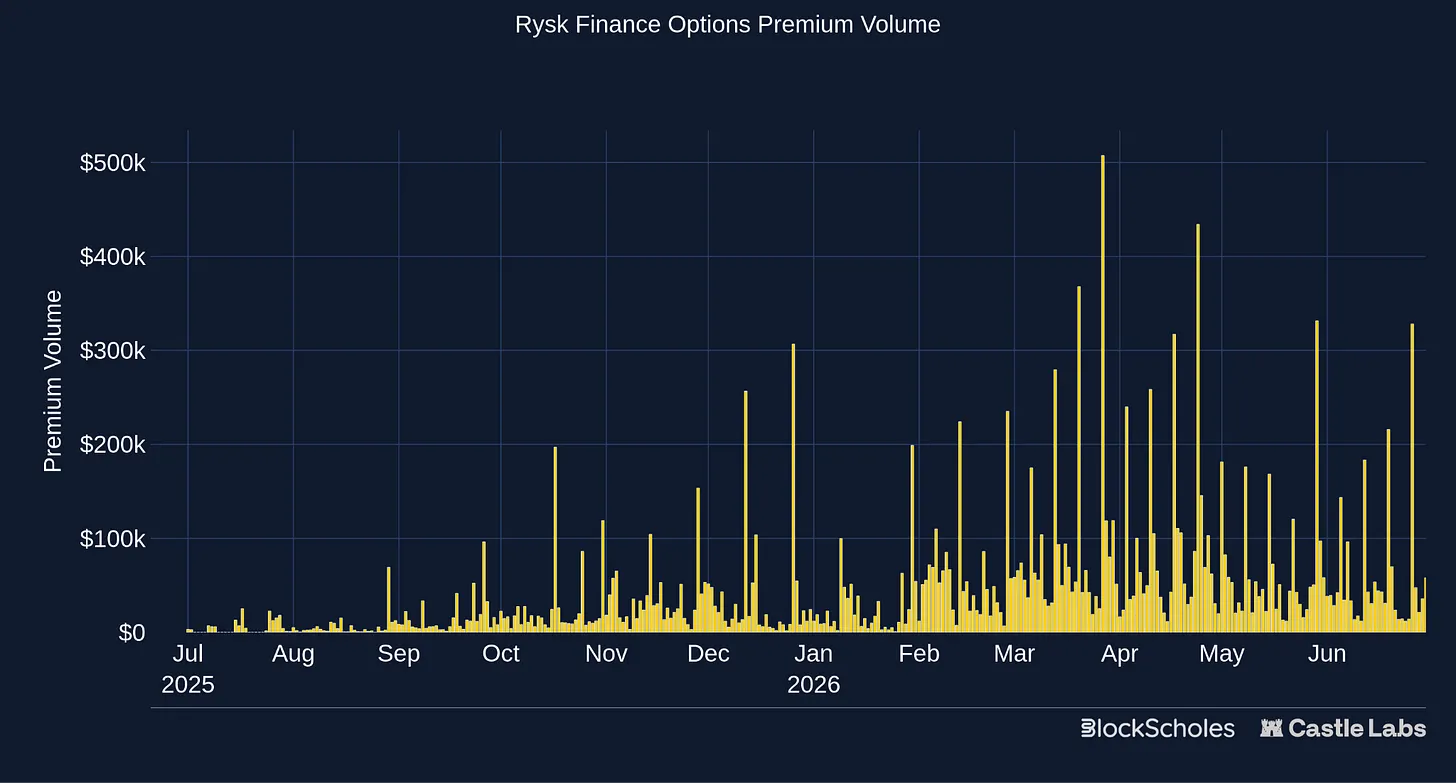
In the past 30 days, Rysk recorded $136.3 million in notional volume and $1.94 million in premium volume, representing about 9.5% of category notional. Its monthly notional volume rose from $50 million in January to $182 million in May, while March and April both stayed above $175 million. The article stresses that TVL matters more for Rysk than for Derive because Rysk’s product is built around collateralized option-selling strategies. Unlike a venue where users can buy cheap optionality with limited premium outlay, Rysk depends more directly on deposited collateral and inventory available for structured yield strategies.
The author sees Rysk as one of the few protocols in the sector that has found a clear product-market fit by tying options directly to a real user problem. In an environment where yields across DeFi have compressed, selling volatility through simple covered and cash-secured structures has become more competitive relative to lending, staking or basis products. That growth, in the article’s reading, suggests that options become far more compelling when they are integrated into asset-holder workflow rather than presented purely as abstract trading instruments.
Aevo and the fragmented second tier
Aevo represents another major branch of the sector’s evolution. Originally related to Ribbon Finance, one of DeFi’s earliest notable options vault teams, Aevo has since expanded into a broader derivatives exchange. It now offers options, perpetuals, pre-launch markets, OTC functionality and automated strategies on a custom Layer 2, using off-chain CLOB matching with on-chain settlement. One of its key differentiators is a unified margin account that lets users access multiple products within a single framework, especially highly speculative pre-launch token markets that can attract attention during hot issuance cycles.
Still, the article suggests that options no longer appear to be Aevo’s main business focus. Over the last 30 days, its options business produced $45.1 million in notional volume and $2.52 million in premium volume, or roughly 3.1% of on-chain options notional. Monthly notional increased from $20 million in January to $50 million in May, but live options open interest was only around $3.6 million, far below Derive and also weaker than Rysk’s implied open positioning. The article notes that Aevo distributes 1 million AEVO in weekly trading rewards, with 30% earmarked for options, which may help explain the recent improvement in visible activity.
Below the top three, the market is smaller and increasingly diverse. Paradex, built by the team behind Paradigm.co, offers futures, options and VTFs and has reintroduced zero fees to gain share. Hypersurface resembles Rysk more closely by packaging covered call and cash-secured put strategies on HyperEVM. CallPut extends beyond crypto by listing equities such as SPCX, TSLA, NVDA and COIN alongside standard calls and puts. Kyan has evolved from Premia into a broader order-book and RFQ-driven derivatives venue with portfolio margin and multi-leg support. Ithaca is integrating AI agents into options strategy management, while SOFA.org continues to wrap options-like outcomes into structured products such as Earn and Surge.
The article’s broader point is that better infrastructure alone does not create demand. Order books, RFQ rails, cross margin and portfolio margin can improve execution, but they do not answer why a user should choose options over perpetual futures for directional exposure, or over prediction markets for event trading. Demand appears strongest when the product is tied to the concrete needs of a specific holder base. In that sense, Rysk’s alignment with HYPE holders is offered as one of the most convincing examples in the market today.
Exotic, perpetual and ultra-short options remain experimental
Outside vanilla markets, the article surveys a set of more experimental on-chain options primitives. One category is perpetual options, which remove fixed expiry and replace it with continuously funded convex exposure. Squeeth remains the best-known historical example, and Paradex has also tested perpetual options despite currently focusing on expiring contracts. The conceptual appeal is clear: users gain convexity without manually rolling dated positions. But the article argues that removing expiry does not remove complexity. Users still need to understand convexity, while also managing continuing funding or premium costs and deciding when those costs no longer justify the exposure.
A second category is AMM-native options. Panoptic uses Uniswap V3-style liquidity ranges to create perpetual options-like exposure. Buyers pay streamed premium over time rather than a fixed upfront premium, while liquidity ranges serve as the basis for strike-like positioning. Its newly launched V2 supports ETH and SPCX perpetual options trading, while depositors can choose products such as the Unicorn vault or PLP Vault to pursue combinations of delta-neutral positioning, gamma scalping, Uniswap fees, Panoptic premiums and borrowing fees. GammaSwap approached the problem differently in V1 by allowing users to borrow AMM liquidity and form perpetual options exposure, enabling impermanent loss hedging or volatility speculation without oracles.
Yet these products also demonstrate a recurring tension in DeFi-native design. While they expand the design space, they can be even harder to understand than listed options. Panoptic reduces expiry fragmentation but introduces streamed premiums, liquidity-width parameters and range mechanics that assume familiarity with concentrated liquidity. GammaSwap has now pivoted toward order-book-based binary markets, seeking to solve capital efficiency and complexity issues with a simpler win-or-lose product structure and no liquidation risk. The article treats these innovations as important experiments, but remains cautious on whether they have proven durable commercial demand.
A third category is ultra-short-duration touch-style products. Euphoria’s Tap Trading is cited as a recent on-chain example. Instead of buying upside or downside exposure at a fixed strike and expiry, the user selects a simple condition within a very short time window. In the example described, each grid square represents a price range for a five-second interval. If the market touches the selected zone before expiration, the trade wins; otherwise, it expires worthless. Professional market makers quote the payout in advance based on distance from spot, time to expiry and volatility.
These products compete less directly with traditional options exchanges and more with perpetuals, binary markets, prediction platforms and even mobile-native speculation products. Their appeal is simplicity. Traders can quickly understand the setup and gain convex exposure without managing liquidation risk, funding rates, Greeks or conventional time decay. That shift matters because it suggests that the future competitive set for on-chain options is broader than listed options venues alone.
Why prediction markets belong in the same conversation
The article concludes by arguing that prediction markets should be considered part of the same broader toolkit because many financial prediction contracts are structurally equivalent to binary options. Whether the contract asks if BTC will be up or down, or whether a specific event will occur, the payoff logic is the same: a fixed payout if the condition is met at expiry, and zero otherwise. Many users participating in prediction markets are therefore already trading options-like products, even if they do not describe them in traditional financial terms.
That observation supports the article’s central thesis. The revival of on-chain options does not necessarily mean the market will converge on a single dominant listed-options venue. Instead, the broader on-chain market is becoming more comfortable with conditional payoff products across multiple interfaces and use cases. From institution-oriented vanilla venues like Derive, to holder-aligned yield products like Rysk, to touch-style and binary structures that overlap with prediction markets, the sector is broadening in ways that were not visible during the first DeFi options cycle.
For a segment that once looked like one of crypto’s clearest repeated failures, this may be the first period in which infrastructure, user education and real demand are improving at the same time. The article stops short of declaring victory, but its implication is clear: on-chain options are no longer just an ambitious idea searching for a market. In some subsegments, they may finally be becoming products designed for the market that actually exists.