

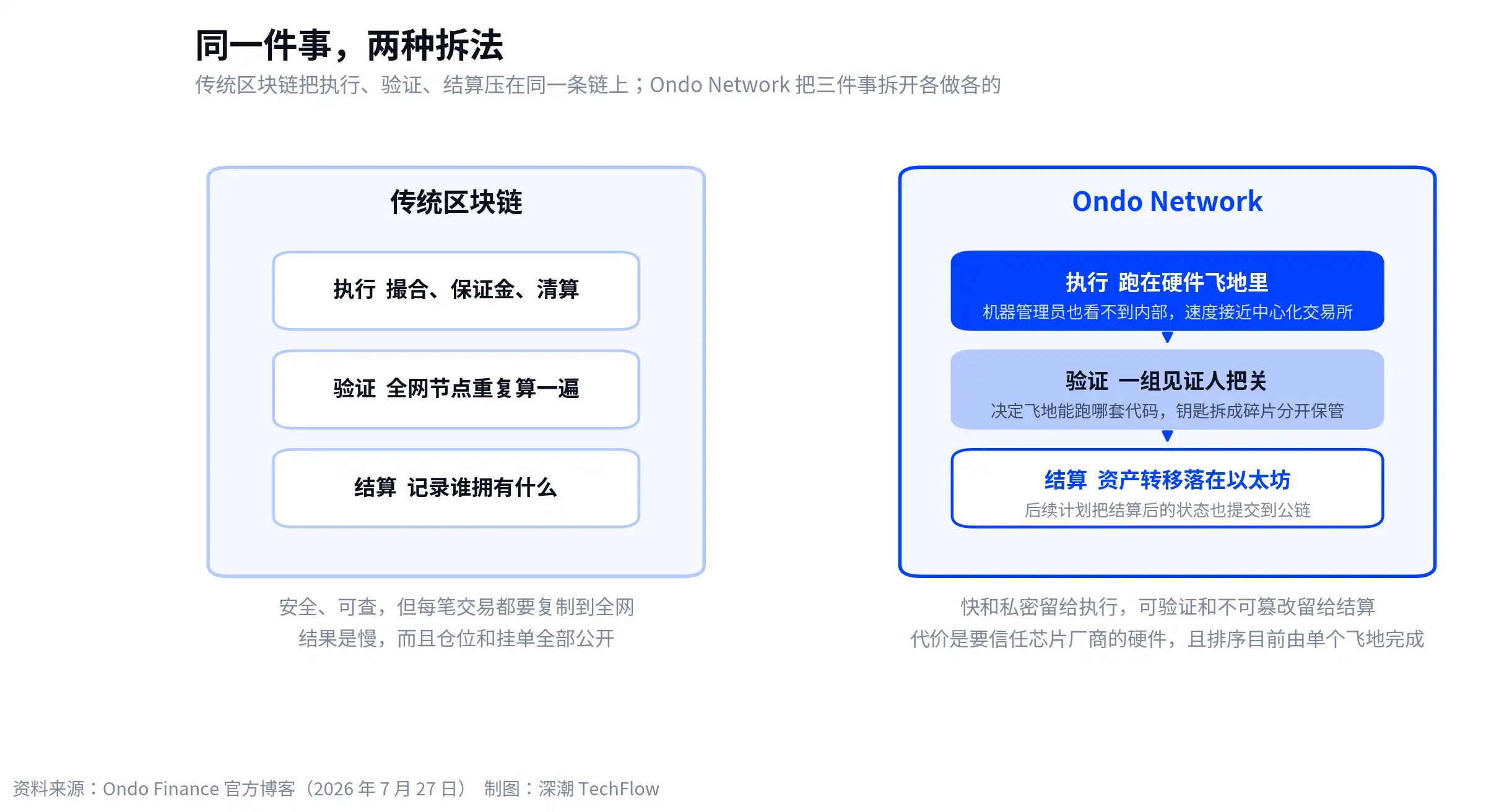
ONDO has risen from roughly $0.31 in early July to around $0.40, a gain of nearly 30% in three weeks, even as Bitcoin has spent close to a month hovering around $63,000 and much of the altcoin market has remained subdued.
The source article argues that the move makes more sense when placed inside a broader market shift. After meme activity cooled, capital and attention started looking for the next active theme. In that reading, RWA has become one of the clearer battlegrounds.
Tokenized U.S. stocks are moving closer to the center of the cycle
According to Startup Fortune, trading volume for tokenized stocks and commodities on Hyperliquid reached $25.1 billion in the third week of July, the first time it exceeded crypto asset volume on the platform. Trade[XYZ] has listed onchain contracts tied to SpaceX and the newly added CXMT, and tokenized stocks now account for 23 of Hyperliquid’s top 30 assets. Binance is also expanding in the segment, taking 56% of the CEX market for RWA perpetuals. The article adds that even the U.S. Securities and Exchange Commission is discussing an "innovation exemption" path for tokenized stock trading.
That combination has pushed onchain trading of U.S. equities into the foreground, and the article frames Ondo as one of the busiest names along that theme.
Ondo’s role is upstream, not just another venue chasing volume
The article says a simple "RWA token rally" label misses what the market may actually be pricing. Hyperliquid and Binance are competing for trading volume. Trade[XYZ], according to the piece, holds 79% of open interest in the RWA perpetual segment, while Binance posted cumulative RWA perpetual volume of $450 billion in the first quarter.
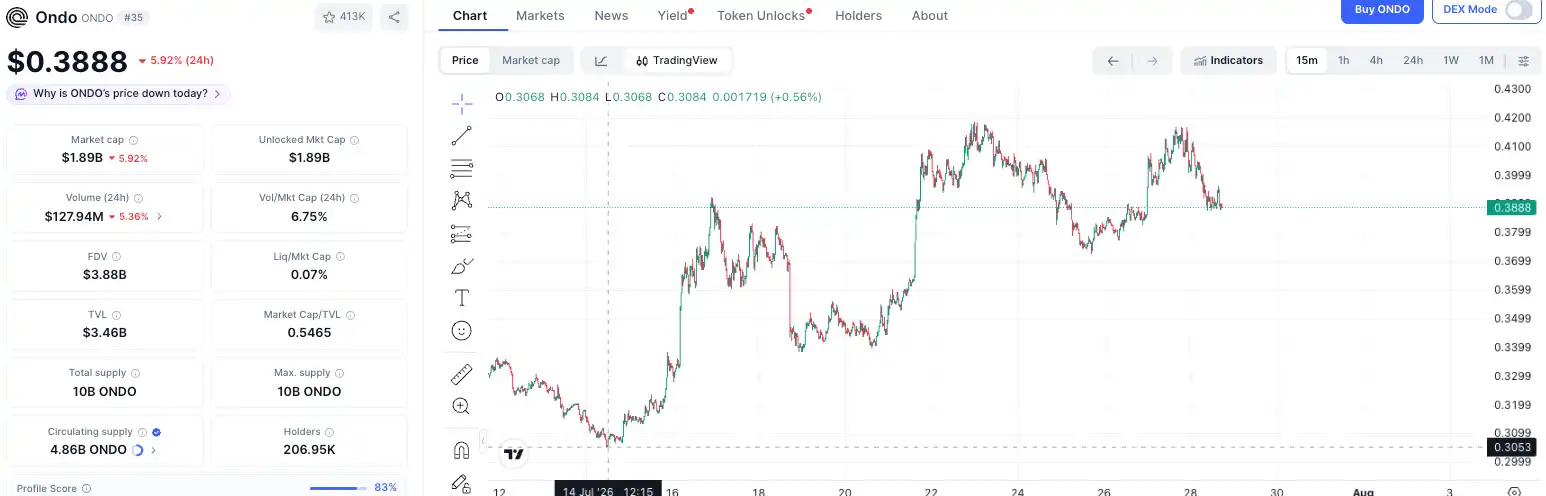
Ondo sits elsewhere in the chain. The article describes it less as the restaurant and more as the supplier. A large share of the underlying assets behind tokenized stock contracts on trade[XYZ] comes from Ondo Global Markets. It also cites AInvest as saying that the onchain tokenized stocks connected to Hyperliquid through Felix Protocol in May were issued by Ondo as well.
RWA.xyz data cited in the report show Ondo Global Markets with more than 70% share on the tokenized stock issuance side, over $5 billion in TVL, and more than $18 billion in cumulative trading volume. The platform lists more than 260 tokenized U.S. stocks and ETFs across Ethereum, Solana, and BNB Chain, distributed through channels including Binance, Bitget, MetaMask, and Blockchain.com.
The piece highlights July 15 as a key date. After DTCC-related news, ONDO rose 18% in a single day. In the article’s framing, that reaction came because DTCC is central to U.S. equity clearing and settlement. Through DTCC’s tokenization service, Ondo’s onchain stock certificates appeared on the same participant list as BlackRock, J.P. Morgan, Goldman Sachs, and Nasdaq. The source article treats that as a distribution-channel upgrade rather than a routine partnership headline.
Ondo is also moving downstream with Ondo Perps
After building scale in issuance, Ondo has started pushing into trading. Ondo Perps, launched on July 7, is its own venue for perpetual contracts tied to U.S. stocks, ETFs, and commodities, with leverage up to 20x.
Its most distinct feature, according to the article, is margin design. Users can post Ondo-issued tokenized stocks directly as collateral. Someone holding onchain Apple or Nvidia tokens can use those assets to open positions. On Hyperliquid and other perpetual platforms, users generally have to convert into USDC or USDT first because the trading venue and the issuer are separate. Ondo combines issuance and trading and removes that extra conversion layer.
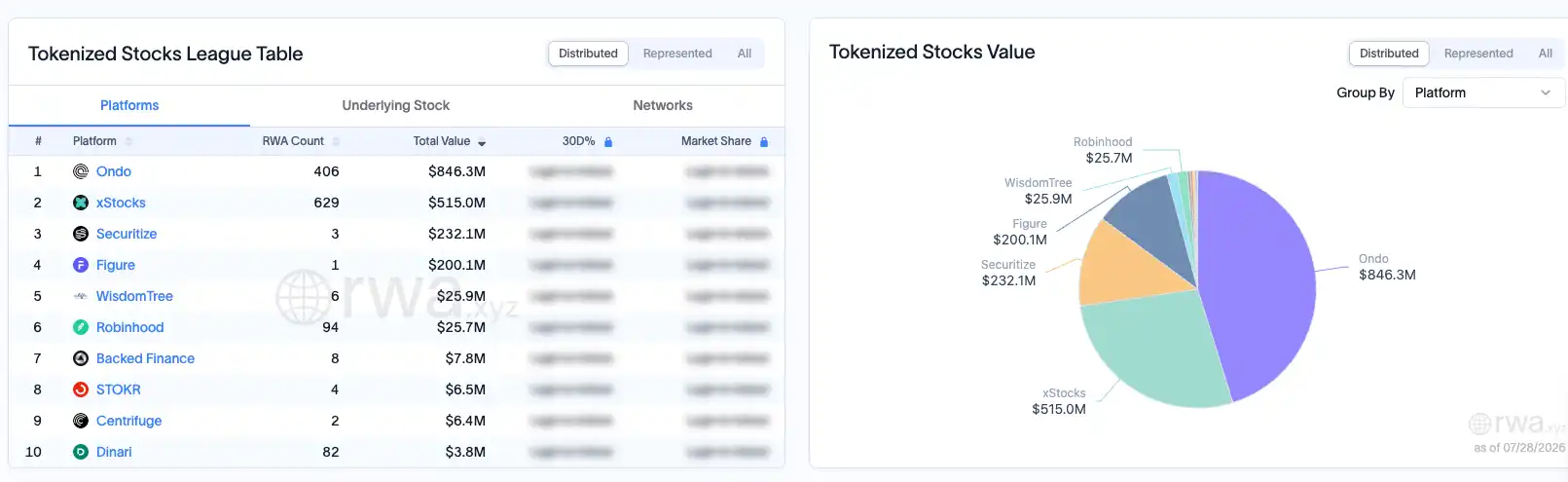
DefiLlama’s RWA Perps ranking, as cited in the piece, showed Ondo Perps at $221 million in 24-hour volume as of July 28, placing fourth. Growth has been quick, but open interest stood at only $49.92 million, or 1.15% of the market. Using those numbers, the article calculates a volume-to-open-interest ratio of about 4.4x, suggesting capital is turning over rapidly rather than staying in overnight positions.
For comparison, the same ratio at trade[XYZ] was 1.6x, which the article reads as deeper capital stickiness. It also notes that $221 million in daily volume is still small next to Hyperliquid’s $25.1 billion weekly figure. Even so, the argument is that Ondo Perps is not chasing exactly the same users. The business logic is to convert holders from Ondo’s $5 billion-plus asset pool into traders and extend revenue from issuance fees to trading fees.
In that framework, open interest may matter more than headline daily volume. Volume can be pushed higher with market making and incentives; overnight positioning is harder to manufacture.
The article also flags a data issue. DefiLlama’s RWA Perps leaderboard and Ondo Perps’ own protocol page show different figures, with a gap of nearly threefold. The protocol page lists $77.53 million in 24-hour volume and $10.3 million in open interest. The source recommends sticking to one dataset for time-series comparison rather than mixing sources.
Ondo Network replaces Ondo Chain
On July 27, Ondo introduced Ondo Network, replacing the Ondo Chain public-chain plan it had been discussing for more than a year.
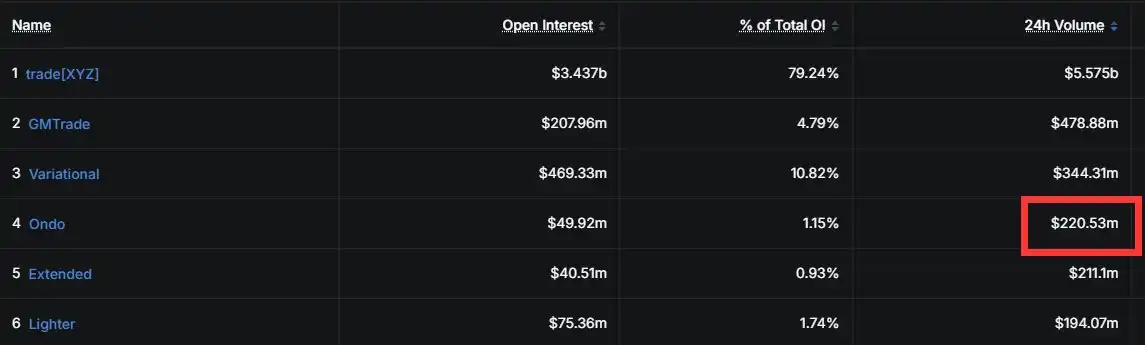
The architecture splits trading into two layers. Execution, including matching, margin, and liquidation, runs inside hardware enclaves. Settlement, meaning final ownership records, remains on Ethereum. The article describes the enclave as an isolated section inside a chip, one that even server administrators cannot inspect, while offering speeds closer to a centralized exchange. Ondo Perps runs on this setup.
The source article argues that dropping the plan to build a standalone Layer 1 may be the more practical choice. Ondo’s assets are already spread across Ethereum, Solana, and other chains, while building a chain from scratch would mean bootstrapping liquidity and ecosystem activity from zero.
Still, the current design comes with trade-offs that the article says Ondo itself has acknowledged. First, execution runs in a single enclave rather than a distributed network. Transaction verification is handled by a group of independent operators called witnesses, but the number of witnesses, their identities, and the list itself have not been disclosed. Second, the security model depends on the chip vendor, yet Ondo has not disclosed which vendor or chip generation it is using.
The article says those details are not direct buy or sell signals, but they do suggest Ondo Network today is closer to a "verifiable centralized execution layer" than the decentralized end state described in its white paper.
What the market appears to be pricing into ONDO
The source breaks the move into separate catalysts. About 18% of the price gain is tied to the DTCC news on July 15, which it interprets as the market pricing in an upgrade to Ondo’s distribution network, especially the signaling effect of appearing on the same participant list as BlackRock and Goldman Sachs.
Another roughly 10% is attributed to the SBI Group partnership, which the article describes as an entry point into the Japanese market, along with beta from a broader rise across the RWA segment. By contrast, the July 27 architecture update — moving away from a dedicated Layer 1 and toward an execution-focused structure — appears to have had limited influence on the token’s price.
That leads to a straightforward conclusion in the article: the nearer-term catalyst is concentrated in Ondo’s more than 70% issuance share and its institutional distribution channels, not in the network design itself.
For valuation context, the piece puts ONDO at $0.38 with a market capitalization of about $2 billion, down about 65% from its 52-week high of $1.13. If onchain trading of U.S. equities develops into a multi-year structural trend, the article argues that Ondo’s position on the issuance side gives it a basic long-term logic. It stops short of calling recent momentum a durable uptrend, though, saying that in a weak crypto market the current move looks more like short-term event pricing and capital rotation than a confirmed structural rerating.