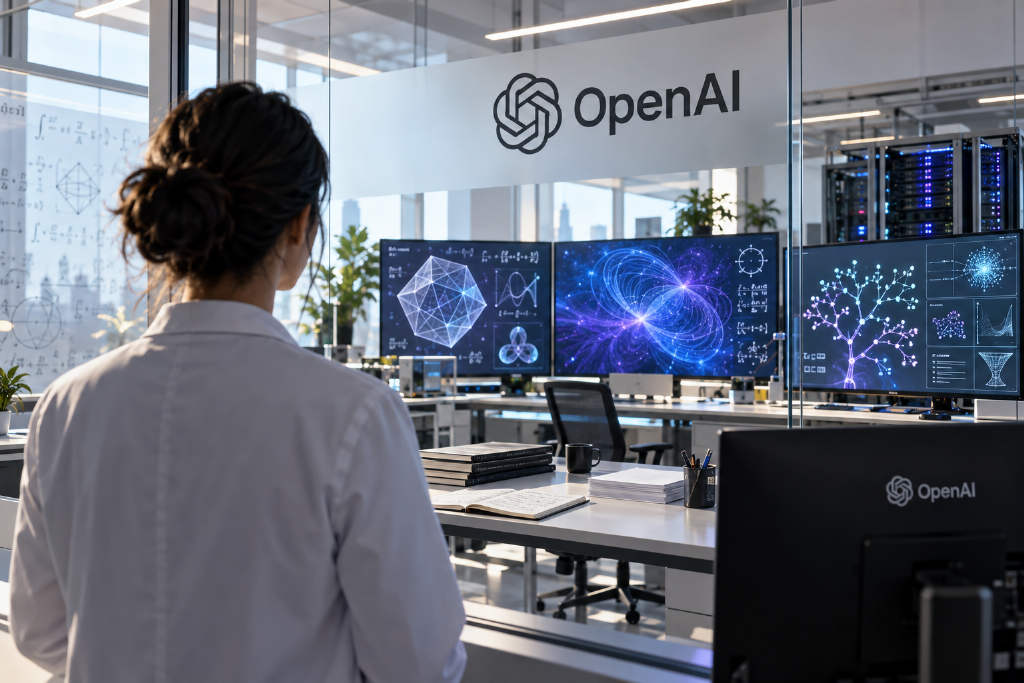
OpenAI said its AI models have achieved three breakthroughs across mathematics, computer science, and physics, according to Jin10 data cited by ChainCatcher. The company said the results show AI can independently discover and prove complex scientific theories rather than only answer questions or assist researchers.
In mathematics, OpenAI said the model proved the local smoothing conjecture in all dimensions, which it said also resolved the Kakeya conjecture and the Stein restriction conjecture. In computer science, the company said the AI overturned the long-accepted Exponential Time Hypothesis, a result it said could imply faster algorithms may be found in the future. In physics, OpenAI said the model produced a rigorous mathematical existence proof related to quantum chromodynamics and Yang-Mills theory, touching one of the seven Millennium Prize Problems.
OpenAI added that the mathematics and computer science results have been formally verified with the Lean proof assistant and that proof materials have been released publicly. The physics result is still under review by experts including Nobel Prize-winning physicists. The findings have not yet been independently confirmed by the broader academic community.
OpenAI said its AI models have made three breakthroughs in mathematics, computer science, and physics, according to Jin10 data cited by ChainCatcher. The company said the results show AI can independently discover and prove complex scientific theories, rather than only answer questions or assist research.
Three claimed advances
In mathematics, OpenAI said the model proved the local smoothing conjecture in all dimensions, and that this in turn resolved the Kakeya conjecture and the Stein restriction conjecture.
In computer science, OpenAI said the AI overturned the long-accepted Exponential Time Hypothesis, which it said could mean faster algorithms may be found in the future.
In physics, the company said the model proposed a rigorous mathematical existence proof for quantum chromodynamics and Yang-Mills theory, involving one of the world’s seven Millennium Prize Problems.
Verification and review
OpenAI said the mathematics and computer science results have been formally verified using the Lean proof assistant, and that the proof materials have been made public.
The physics result is being reviewed by experts, including Nobel Prize-winning physicists. OpenAI also said the work still requires further independent confirmation from the academic community.
This article was originally published by Bit.Fan. For more cryptocurrency news and market insights, visit www.bit.fan. Disclaimer:
The market information, project data, and third-party content displayed on this platform are for industry information sharing only and do not constitute any form of investment advice or return commitment.
Cryptocurrency trading carries high risks. Users should fully assess their risk tolerance and make independent decisions. All profits, losses, and legal responsibilities are borne by the users themselves.