
OpenAI CEO Sam Altman said the company has mathematics findings that have not yet been released, even beyond the work already discussed publicly.
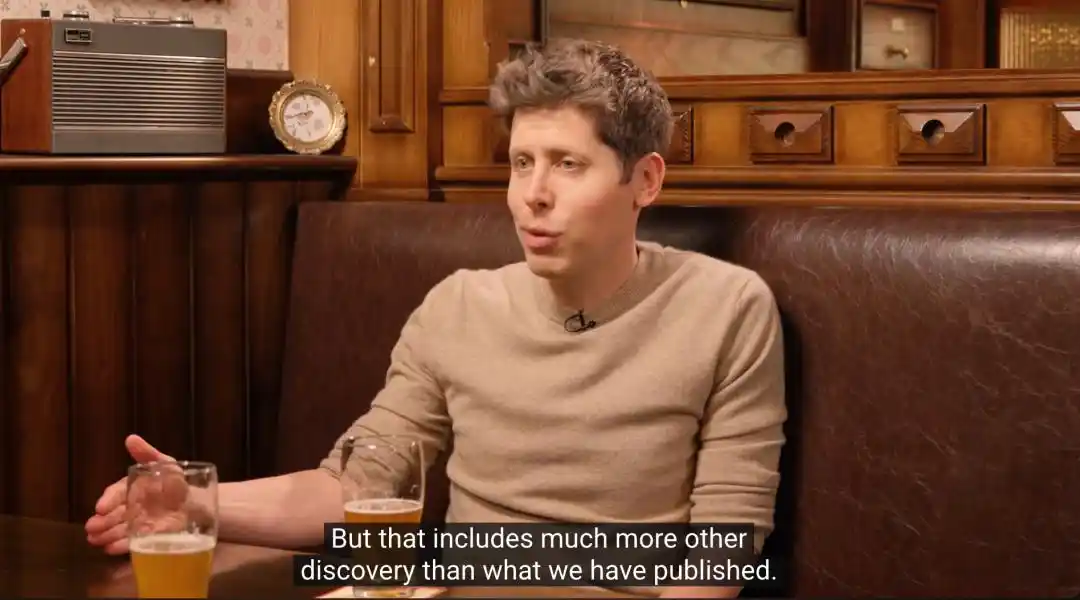
In the Cheeky Pint interview published on Oct. 29, host John Collison asked whether there were results beyond the widely referenced “700 proofs.” Altman replied: “Yes, of course.”
Altman says spending includes undisclosed discoveries
When the conversation turned to OpenAI’s investment in mathematics research, Collison put the scale at hundreds of millions of dollars. Altman agreed with that estimate, then added that the spending also covers other discoveries that have not been made public.
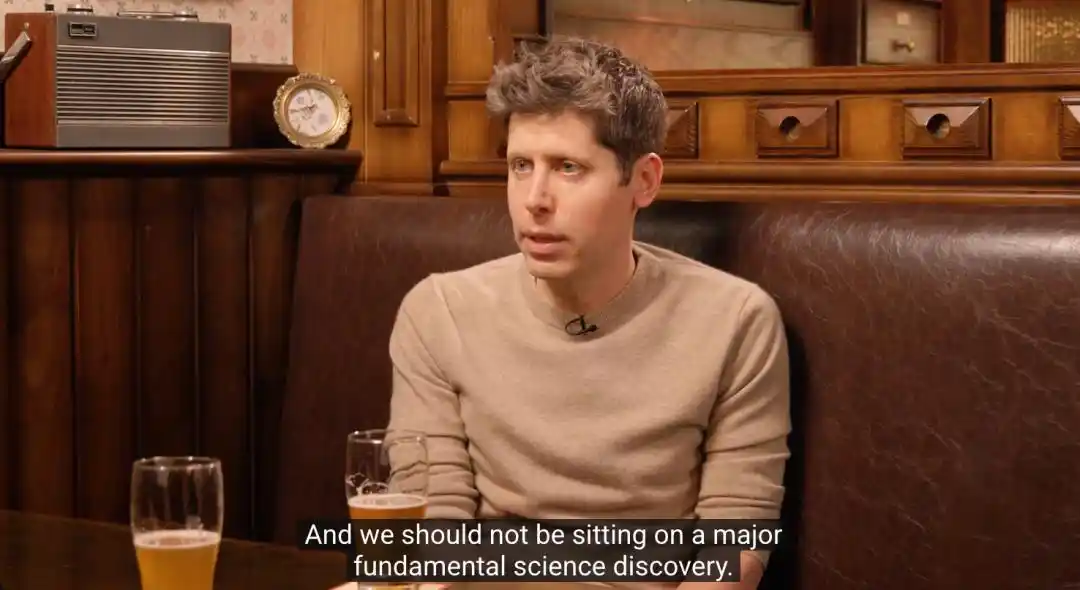
Altman said major discoveries in basic science should be public. In his view, humanity should have access to foundational scientific knowledge, and important scientific findings should be released to the world.
He also said there is a real tension in that approach. Researchers’ careers and sense of achievement are often tied to the act of discovery itself. He said he wants to find a way for the world to benefit from shared knowledge while still giving researchers reasons to stay engaged in future work.
Publication, in that framing, is only the start. Researchers still need help understanding the logic behind a result and checking the key steps in a derivation before the work can serve as a base for later research.
OpenAI math papers are now being revised in public
After OpenAI released recent mathematics results, researchers began working through the public material, trying to understand the methods and verify the crucial steps in the derivations.
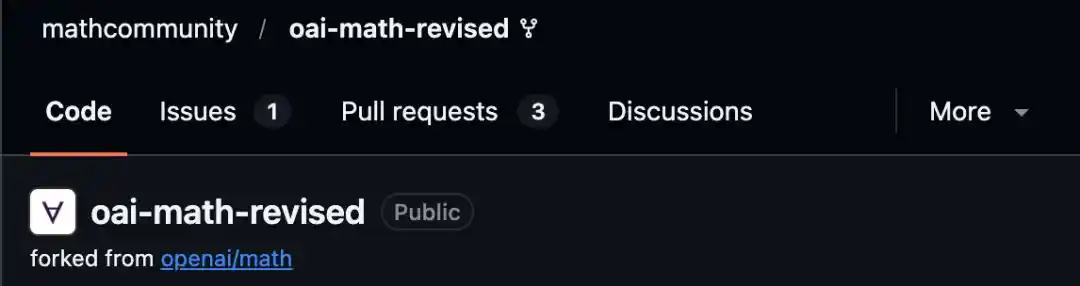
On GitHub, mathematics researchers launched an independent revision project called oai-math-revised to collaboratively edit OpenAI’s public math manuscripts.
The project points to two weaknesses in some of the manuscripts: the exposition is hard to follow, and the citations are incomplete. Its organizers invited students, postdocs, professors, and math enthusiasts to help add references, improve the presentation, and identify and fix errors where possible.
That leaves the broader research community with a second job after an AI system produces a paper: turning it into knowledge that others can read, check, and use. How to support that follow-up work is becoming part of the release question itself.
On Oct. 26, OpenAI described newly released related manuscripts as “raw research data.” The company also said it was trying different release approaches, including asking outside experts to lead efforts and organizing teams to explain the results.
OpenAI said the results are at different stages of verification. Its mathematics repository also states that some results do not yet come with computer-checkable formal proofs.
So even after a manuscript is public, explanation, verification, and revision continue. New work can build on those results only after more researchers understand them and determine which methods hold up.
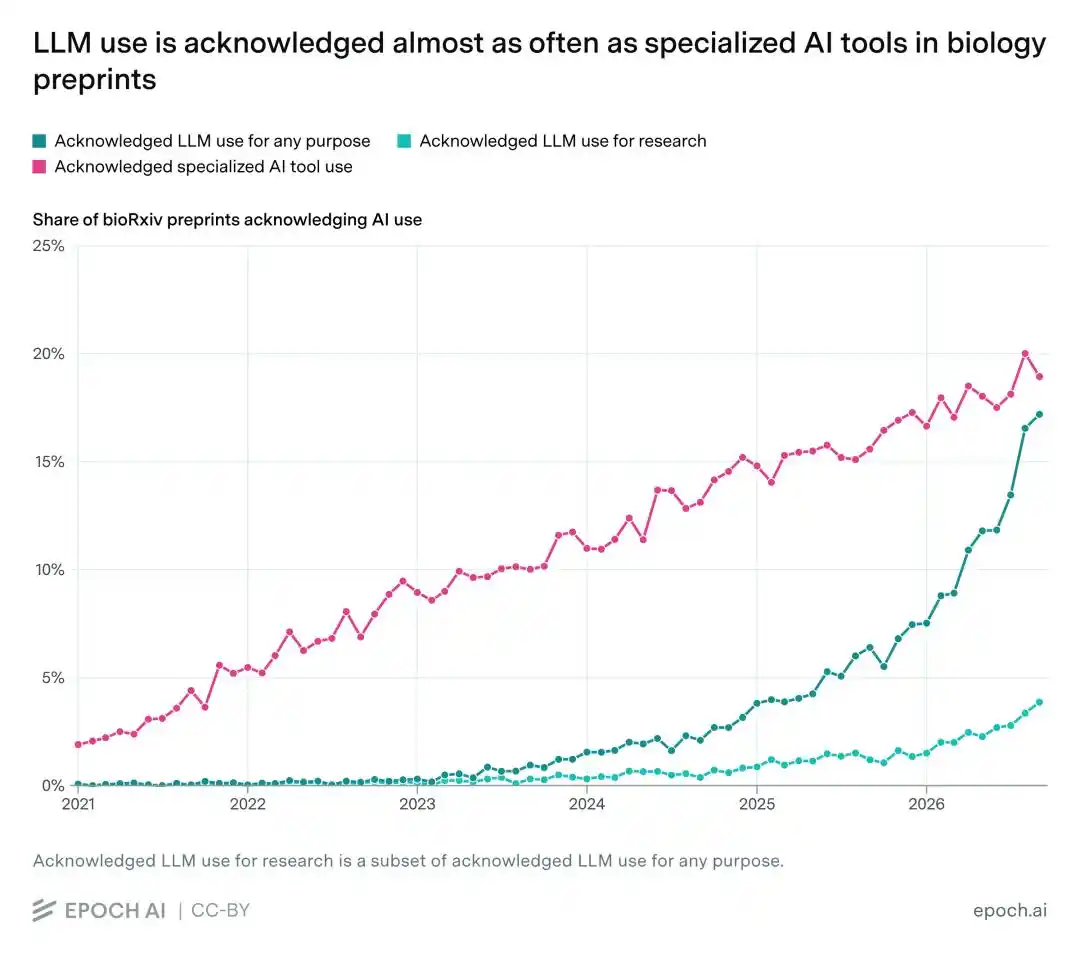
Epoch AI says 17.19% of screened bioRxiv preprints disclosed LLM use
In biology, researchers are already bringing large models directly into their workflows.
On Oct. 30, Epoch AI published a set of statistics on biology preprints. Of 4,922 bioRxiv preprints screened in September 2026, 846 disclosed the use of large language models, equal to 17.19%.
That works out to roughly one in every six papers. In September 2025, the disclosure rate was 6.40%. A year later, it had risen to nearly the same level as specialized AI tools in the same month, which stood at 18.94%.

The disclosures covered literature work, writing, programming, and research analysis.
Within that total, 190 preprints disclosed using large models for research or analysis, or 3.86% of all screened preprints that month. Under Epoch AI’s classification, that category includes experimental design, data labeling, and statistical analysis. Writing, literature review, code, and computation are counted in other use categories.
The figures suggest that large models are already involved in multiple parts of scientific work. At the level of an individual study, the practical questions remain the same: what the model actually did, and how researchers judged, verified, and used its output.
Two biology projects show the handoff between models and experiments
Two recently disclosed collaborations offer a closer look at how humans and AI systems are working in sequence.
On Oct. 21, OpenAI, PerturbAI, and Scripps Research announced a collaboration in which thousands of GPT-Rosalind-powered agents analyzed existing experimental data from millions of mouse brain cells.
According to the team, the round of analysis and interpretation took 32 minutes. Each agent focused on one gene perturbation, analyzed cellular responses, searched the literature, and proposed an explanation. Those outputs were then combined into a reasoning map linking genes, cellular changes, and possible biological mechanisms.
Researchers can use that map to choose which leads to test next and design follow-up experiments.
A separate example came from biotechnology company Generate Biomedicines, which is using AI to design proteins and develop drugs.
On Oct. 27, the team reported progress in redesigning CAR-T receptors with Claude Code. The goal was to shorten the intracellular signaling portion of the receptor while preserving function.
A CAR receptor acts as a recognition-and-activation device for a T cell: the extracellular portion recognizes a target, while the intracellular portion transmits the signal that triggers the T cell response.
Researchers selected 186 model-assisted designs for the first round of experiments. After the results came back, they fed the data into the system again, revised the designs, and ran more experiments.

After three rounds of design and screening, the team arrived at a signaling structure made of just 45 amino acids, about 70% shorter than the second-generation CAR signaling structure used as a control.
The team said that in vitro experiments using the same mRNA dose showed more CAR receptors on the surface of T cells built with the new design, and that the cells maintained their ability to kill target cells for longer.
The design was not produced in one pass. It was refined through repeated experimental feedback.
Can AI-driven science feed back into AI development?
From line-by-line mathematical derivations to repeated biology experiments, AI is moving into more parts of the research process. It is being used to find leads, propose designs, and adjust those designs after validation.
That raises another question in discussions about artificial superintelligence, or ASI: can scientific results produced with AI also speed up AI development itself?
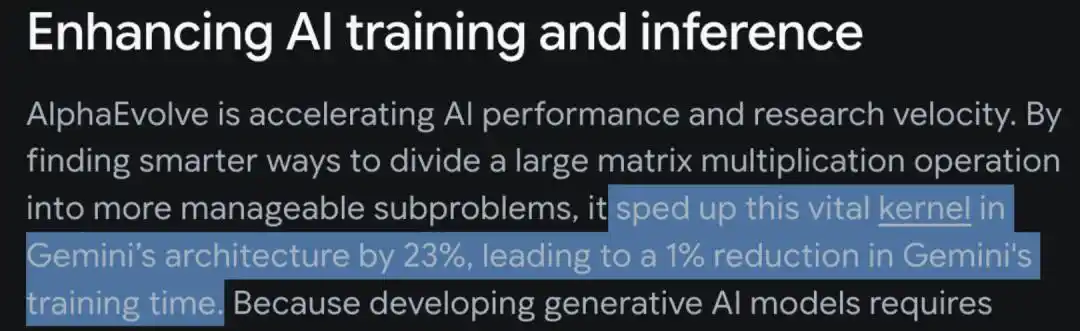
The article points to an earlier disclosure from Google DeepMind in 2025. According to that disclosure, AlphaEvolve sped up one computational kernel used in Gemini training by 23%, cutting overall training time by 1%.
That is one public example of an AI-proposed optimization, after validation, being used to improve model training efficiency.
The next step in that line of thinking would be a system that helps build a stronger successor, which then helps improve AI research again. That is the loop envisioned in RSI, or recursive self-improvement.
The source article says such a loop, if sustained, could become one force pushing toward ASI.
For now, the public examples still depend on a chain of release, explanation, verification, experimental testing, and revision. Whether the subject is a math manuscript or a biological design, the result does not become durable research infrastructure without the work of the broader scientific community.



