
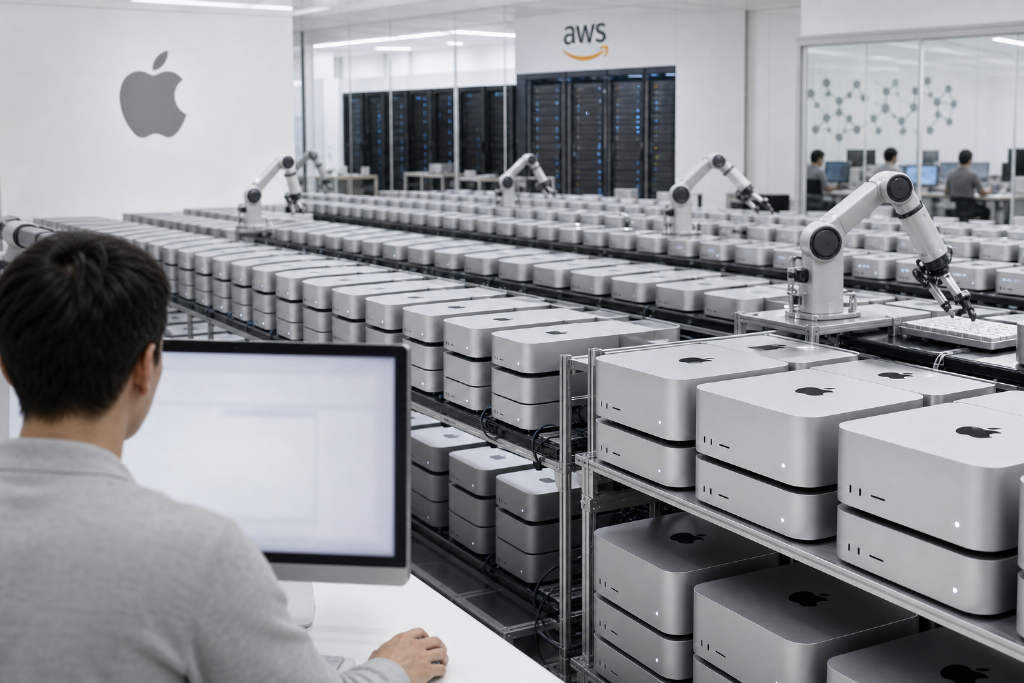
Apple’s Mac mini and Mac Studio lines have been facing tight supply worldwide, with higher-spec models reportedly unavailable for months. According to The Information, OpenAI has purchased tens of thousands of Mac mini and Mac Studio systems to train reinforcement learning models and AI agents designed to operate computers. Anthropic, meanwhile, is renting Mac compute through Amazon Web Services to handle similar work.
The demand shock is now hitting Apple’s supply chain and is also forcing NVIDIA to pay closer attention to a corner of the AI hardware market it has not traditionally defined.
Why AI firms are choosing Macs
The report says the buying spree is rooted in system architecture rather than brand loyalty. Apple’s M-series chips use a unified memory design, and that setup appears to fit a specific class of AI workloads.
Traditional GPU clusters are built for large-scale matrix operations and are best suited to large language model pretraining. Reinforcement learning for computer-use agents looks different. In that workflow, an AI system repeatedly observes a screen, takes an action, and receives feedback inside a real operating system environment. That process is memory-intensive, but it does not rely on parallel compute in the same way pretraining does.
Apple’s M-series chips combine the CPU and GPU on a single chip and let both share the same high-bandwidth memory pool. That reduces data transfer bottlenecks between processors, giving the architecture a practical edge for those workloads. Mac mini and Mac Studio also offer stronger thermal performance than MacBook models, which makes them more suitable for sustained compute over long periods.
In the report’s framing, AI companies are choosing Macs because they are more efficient than GPU servers for this particular kind of task.
Who is buying and how the machines are being used
The Information says OpenAI has been buying Mac mini and Mac Studio machines at scale, with the systems used for reinforcement learning training and for teaching AI agents to operate computer interfaces, draft documents, and organize email. Anthropic is approaching the same need differently by renting Mac mini compute through AWS, giving it a more flexible way to access capacity.
The trend is also attracting startups. Mount Thor, a startup founded by a former OpenAI infrastructure employee, is preparing an AI cloud execution environment built around Apple hardware, with the goal of turning Mac clusters into a product.
Other companies are also working on software tools that would link multiple Macs together in offices or labs so they can run trillion-parameter models locally, lowering the barrier for enterprises that want to build their own AI compute setups.
Supply pressure reaches Apple’s product lines
Large-scale purchases have directly affected Apple’s supply chain. The report says heavy demand for memory chips from AI data centers has kept the large-memory configurations required by higher-end Mac mini and Mac Studio models in short supply. Some premium systems have been unavailable for months, and enterprise procurement teams have even started looking at alternatives such as NVIDIA DGX Spark.
Just days ago, Apple moved early to refresh both product lines. Mac mini added M6 and M5 Pro chip options, while Mac Studio was upgraded to M5 Max and M5 Ultra configurations. The report describes that move as a sign Apple is responding to the supply-demand imbalance.
A new competitive layer in AI hardware
The shift is making NVIDIA reassess Apple’s place in AI infrastructure. A Mac mini starts far below the price of a single enterprise GPU server. For workloads that scale horizontally, buying 10,000 Mac mini units still represents a major capital outlay, but the economics can look very different from renting cloud GPU capacity that is not well matched to the job.
That, the report argues, is one reason some AI companies are willing to route around the NVIDIA stack.
At the same time, the core setup for large-scale AI training has not changed. Data centers and high-end GPU clusters are still the hard-to-replace option for pretraining very large models. What Apple’s Mac lineup appears to be opening is a separate market focused on reinforcement learning, AI agent training, and local enterprise deployment workloads that are more sensitive to memory efficiency and less dependent on parallel processing.
In that segment, Apple has carved out a meaningful position.