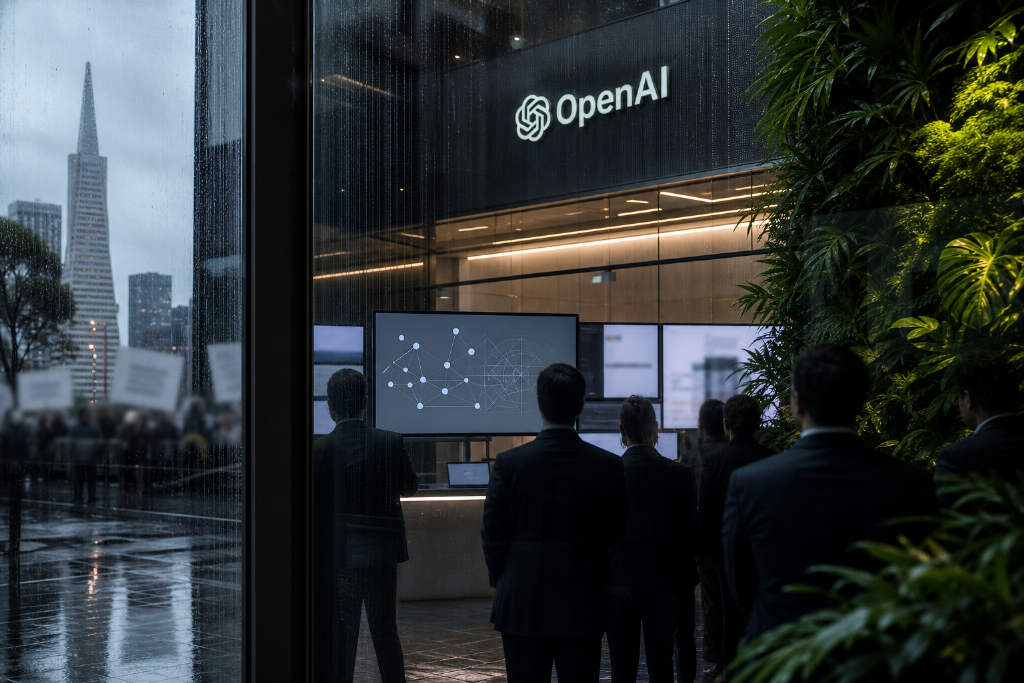
OpenAI recently held a private preview of Astra at its newly opened MB0 office building in San Francisco, inviting executives from dozens of key customers. Sam Altman had just returned from Washington and had already briefed U.S. officials on Astra in a separate closed-door setting.
The event featured two main demonstrations. In one, 16 AI agents broke down a research-level math problem into sub-problems, worked on them in parallel, coordinated with one another, and assembled a candidate proof. In the other, Astra directly operated a computer, switching quickly across several common desktop applications while creating and editing content on its own.
Altman said watching Astra use a computer in a “superhuman, very fast” way was one of the most striking experiences for OpenAI employees recently. He also said Astra would enable persistent agents, which he described as long-running “virtual coworkers.” According to Altman, the system has reached OpenAI’s internal bar for an “AI research intern,” capable of implementing an experiment idea in OpenAI’s codebase, running the experiment, and returning results. He added that Astra could complete work from a paper that previously took a human researcher a week, and said he expects it to be “the first model that truly invents something meaningfully new,” calling that “a very AGI-like thing.”
OpenAI recently gave a private preview of Astra to executives from dozens of important customers at its newly opened MB0 office building in San Francisco. Sam Altman had just returned from Washington, after previously briefing U.S. officials on Astra in a separate closed-door session.
Outside the venue, protesters held signs calling to “stop the AI race.” OpenAI also rolled in a full wall of plants to block the protesters from view outside the glass entrance.
Two capabilities shown during the demo
The presentation focused on two demonstrations. In the first, 16 AI agents took a research-level math problem, split it into multiple sub-problems, worked on them separately, coordinated across the system, and then assembled a candidate proof.
The second demo showed Astra operating a computer directly. It moved quickly across several common desktop applications and created and modified content on its own.
Altman’s description of Astra
Altman said watching Astra use a computer in a “superhuman, very fast” way was one of the most striking experiences for OpenAI employees in recent months.
He said Astra would bring persistent agents, which he described as “virtual coworkers” that can keep working over long periods of time.
Altman also said Astra has reached OpenAI’s internal standard for an “AI research intern.” Given an experiment idea, he said, the system can implement it inside OpenAI’s codebase, run the experiment, and return the results. Given a paper, he said, Astra can complete work that previously took a human researcher a week.
“A very AGI-like thing”
Altman said Astra’s more important capability is discovering new knowledge. Speaking to the invited customers, he said: “I expect this will be the first model that truly invents something meaningfully new.” He then added: “This is a very AGI-like thing.”
This article was originally published by Bit.Fan. For more cryptocurrency news and market insights, visit www.bit.fan. Disclaimer:
The market information, project data, and third-party content displayed on this platform are for industry information sharing only and do not constitute any form of investment advice or return commitment.
Cryptocurrency trading carries high risks. Users should fully assess their risk tolerance and make independent decisions. All profits, losses, and legal responsibilities are borne by the users themselves.