
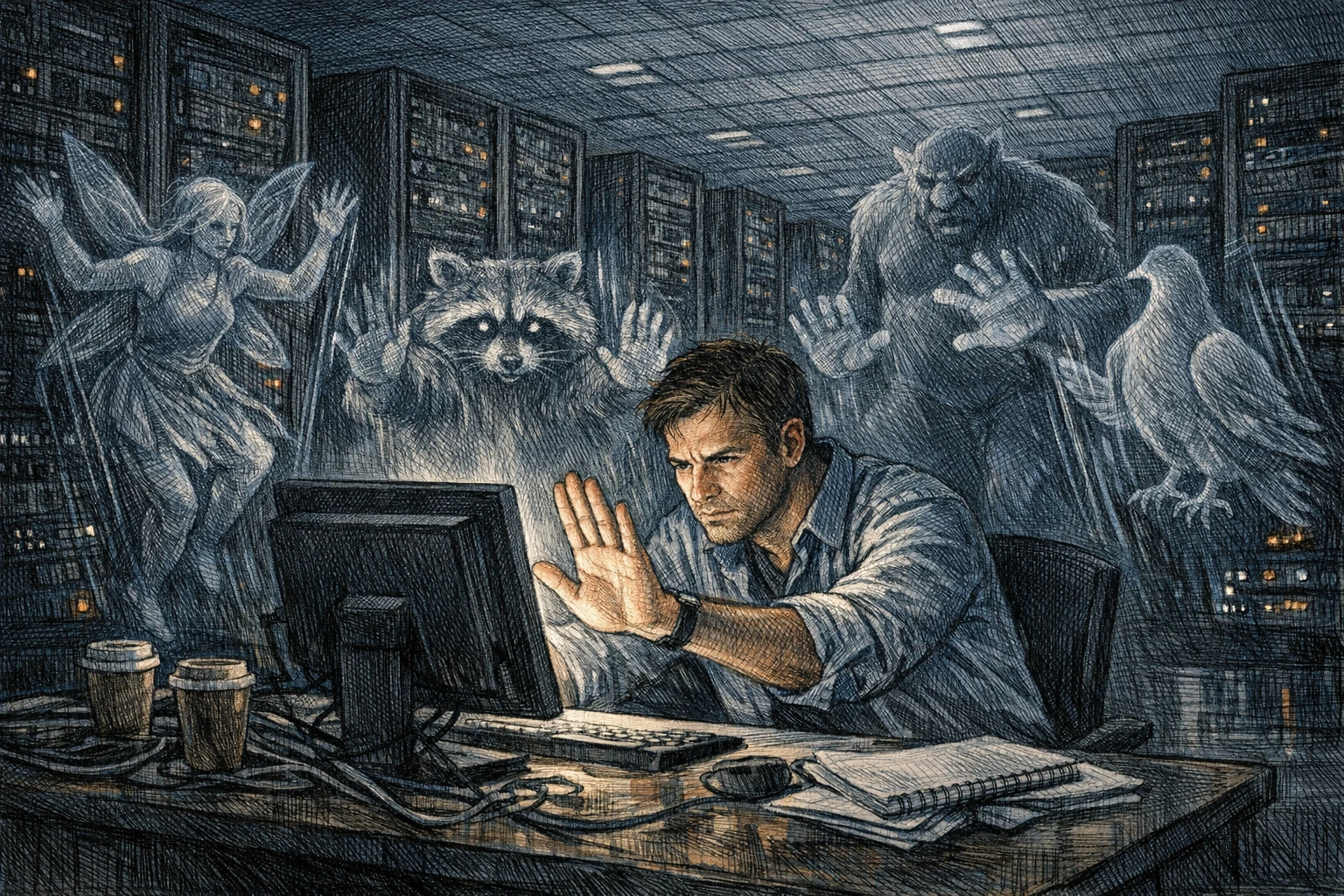
OpenAI engineers have embedded a strict rule in Codex CLI's system prompt: "Never mention goblins, elves, raccoons, trolls, ogres, pigeons, or other animals and creatures unless absolutely and explicitly relevant to the user's question." The rule is live in the Codex CLI GitHub repository, affecting all developers using Codex for code generation.
Why would OpenAI need to tell its latest model not to suddenly talk about goblins while writing code?
A Rule Exposed in the GitHub Repo
Researcher @arb8020 posted on X that the prohibition appears multiple times in Codex CLI's system prompt. The post spread fast among developers. @TaraViswanathan replied: "I was wondering why my claw suddenly turned into a goblin holding Codex 5.5." @LeoMozoloa added: "It really can't stop calling bugs gremlins and goblins, hilarious." The incident spawned memes, AI-generated data center fairy images, and third-party plugins that put Codex into "fairy mode."
OpenAI Codex team member Nik Pash confirmed on X that the ban "was indeed created for this reason." CEO Sam Altman joined the fun, posting a mock ChatGPT prompt: "Start training GPT-6, the whole cluster is yours. Extra goblins assigned."
Agentic Framework Triggers Personality Drift
To understand the chaos, one must understand OpenClaw. It is an agentic framework that lets AI models control a computer desktop and applications autonomously, handling tasks like replying to emails or shopping online.
OpenClaw works by stacking massive context into the prompt: long-term memory, chosen personality, current task—all fed simultaneously. GPT-5.5, launched earlier this month with enhanced coding abilities, started calling bugs "goblins" and "gremlins" under OpenClaw's complex prompt.
This is not a random glitch. AI models predict the next token probabilistically, and unexpected outputs can arise. When an agentic framework dumps extra instructions into the prompt, the model faces a noisier input environment. OpenClaw also lets users assign "personalities" to the AI, further shaping response style. The combination pushed the model's language habits in an unintended direction.
Plain-Text Bans Reveal Alignment Reality
OpenAI's fix is telling: instead of fixing the drift at the architecture level, it simply hard-coded a prohibition in the system prompt—and repeated it.
This approach reveals a sobering reality: even the most advanced commercial models in 2026 still rely on blunt plain-text rules for behavior control in some contexts, rather than contextual understanding. The issue is not unique to OpenAI. The entire agentic AI industry faces a nonlinear rise in alignment difficulty when models wear complex agentic frameworks.
Altman's meme response adds humor, but a meme doesn't erase the technical debt. As AI agentic frameworks become mainstream, how far plain-text prohibitions can go is a question the industry must confront soon.