

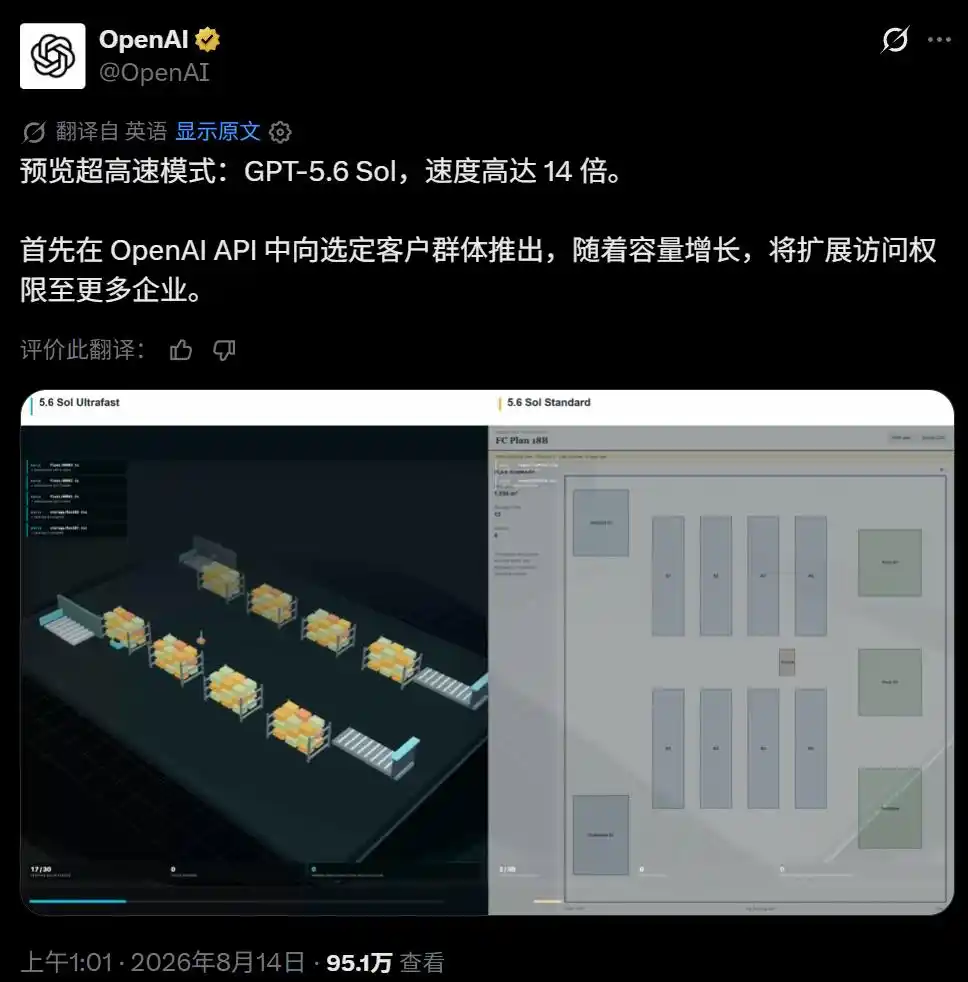
OpenAI and AI chip company Cerebras previewed a new service tier for GPT-5.6 Sol early on Aug. 14, introducing an "Ultrafast Mode" for the flagship model.
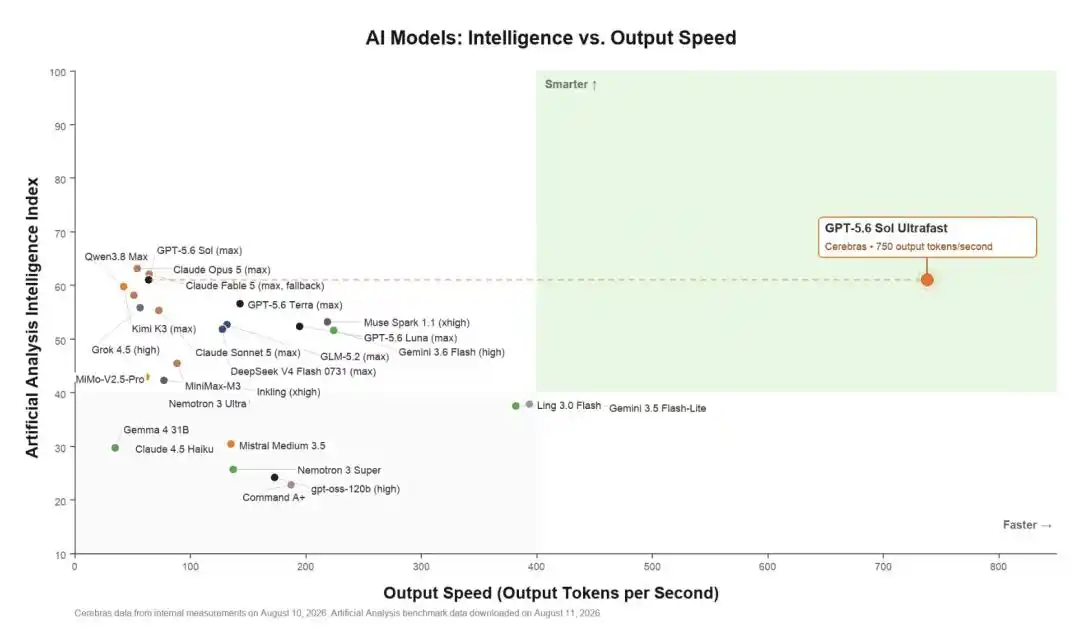
OpenAI said output speed in the new mode can reach as much as 750 tokens per second. That compares with an inference baseline of about 53 tokens per second in Standard mode, marking a speed gain of up to 14x without any drop in quality. In side-by-side comparisons cited in the announcement, accelerated GPT-5.6 Sol was 11x faster than Fable 5 and 5x faster than Opus 4.8 running in Fast mode.
Ultrafast Mode will be introduced first through the OpenAI API. A limited preview is already available to selected customers. OpenAI and Cerebras also published a comparison table covering speed and intelligence across leading frontier models, with GPT-5.6 Sol Ultrafast ranked at the top of that lineup.
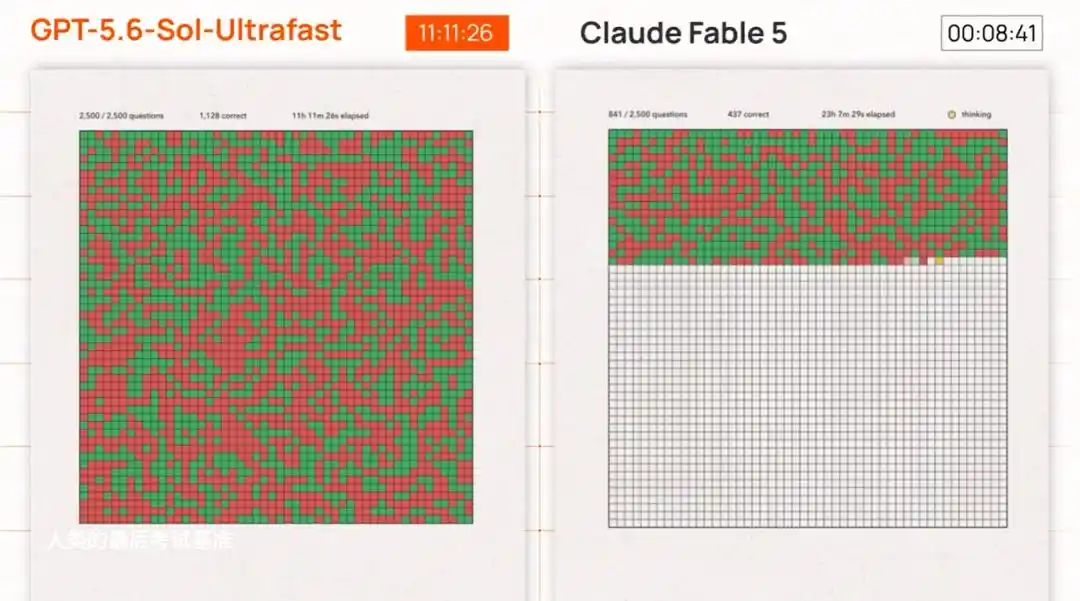
HLE run completed in 11 hours and 11 minutes
In a Cerebras blog post, engineers described tests on Humanity's Last Exam, or HLE. The benchmark contains 2,500 questions and is presented as a difficult model evaluation, with problems that typically require doctoral-level expertise in areas such as chemistry, economics and literature.
According to the published results, GPT-5.6 Sol in Ultrafast mode answered all 2,500 questions in 11 hours and 11 minutes. Claude Fable 5 needed 78 hours and 27 minutes, or more than three days of continuous compute, to finish the same task. With accuracy described as similar, Sol in Ultrafast mode ran at nearly seven times Claude Fable's speed.
OpenAI points to legal, finance and engineering workloads
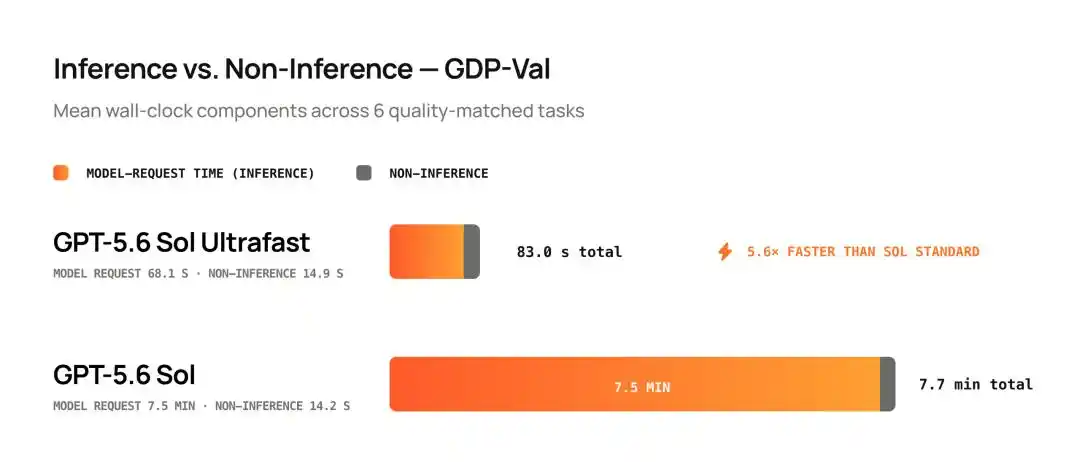
OpenAI said faster inference matters more as model capability improves. The company described GPT-5.6 Sol as its best-performing model so far for legal documents, financial models and engineering reports. On GDP-Val, a benchmark for economically valuable knowledge-work tasks, Ultrafast delivered a 5.6x end-to-end speed increase with quality unchanged.
OpenAI listed several use cases for the mode:
- Incident response and reliability: when a critical system fails, AI can analyze application logs, recent code changes and engineer reports to identify likely causes and help prepare fixes while the outage is still unfolding.
- Financial research and security: analyze market signals, assess trades and identify suspicious activity in fast-moving conditions.
- Customer support and voice: resolve complex customer issues in real time, even when answers require multiple steps or systems, without breaking the conversation.
- Commerce: answer product questions, check inventory, personalize recommendations and solve checkout problems before hesitation turns into cart abandonment.
- Real-time research and experimentation: turn work that once ran overnight into an interactive session in which teams test ideas, inspect results, adjust methods and launch another experiment without stopping the workflow.
OpenAI said internal testing used incident response as one example. Once an alert is triggered, engineers have to build an accurate picture of the event while systems and evidence are still changing. With Sol-level intelligence, teams can quickly read logs, analyze traces, summarize conversations, identify the next checks and assist with preparing or validating a fix. OpenAI said Ultrafast cuts the delay between observing signals, testing hypotheses and choosing the next action, while engineers still make the final judgment and handle deployment.
For research, OpenAI said teams used Ultrafast to search knowledge bases, query data and gather, organize and summarize information from different tools at higher speed. A common workflow had been to start a batch of experiments overnight and review the results the next morning. With Ultrafast, that discovery cycle becomes shorter and can support multiple iterations within a single workday.
Wafer-scale hardware targets inference bandwidth limits
The reported speedup is tied to a break from the memory bandwidth bottleneck that affects large-model inference decoding on traditional GPU clusters. The implementation relies mainly on Cerebras' wafer-scale hardware architecture.
As described in the article, Cerebras takes a different route from most AI chip vendors. Its chips are built on full wafers, combining a large number of compute cores and a high-speed interconnect network on a single piece of silicon.
Conventional GPUs running autoregressive decoding for large language models are constrained by memory bandwidth. Large model weights must move back and forth between off-chip HBM and compute cores, and multi-GPU partitioning adds inter-chip communication delays through links such as PCIe and NVLink.
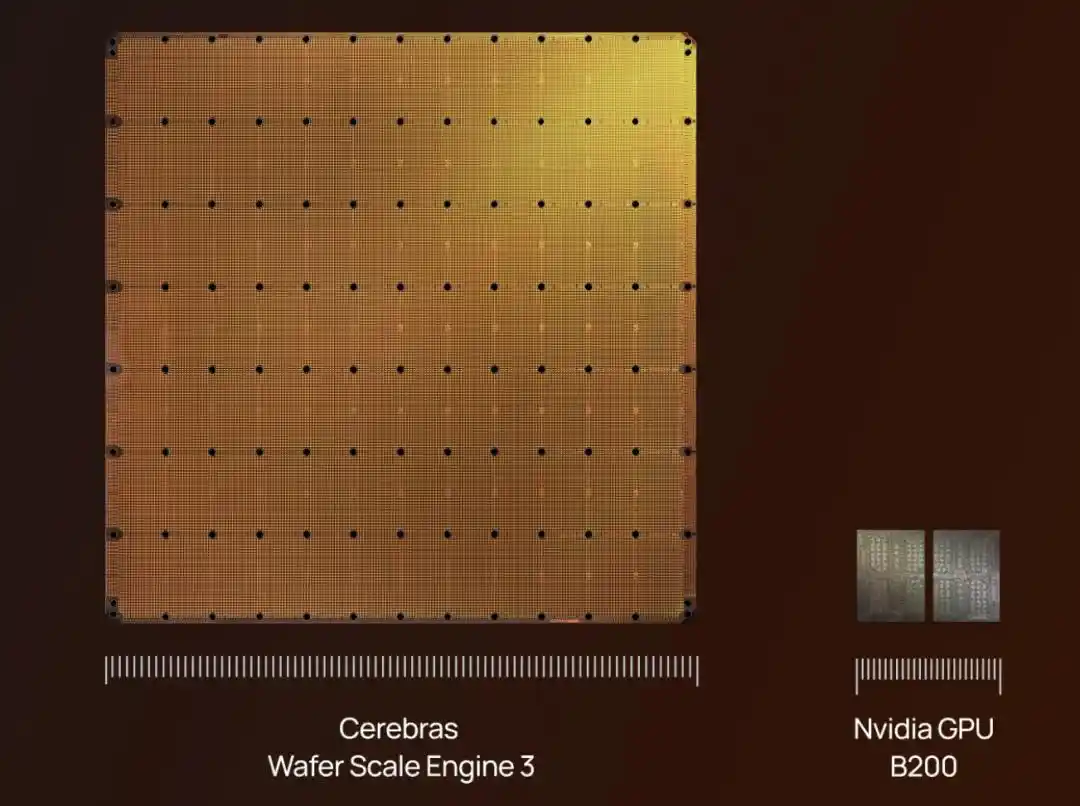
Cerebras said each WSE-3 wafer-scale chip integrates 4 trillion transistors, 125 petaflops of AI compute and up to 44 GB of on-chip high-speed SRAM. Keeping model parameters resident in that on-chip SRAM is intended to avoid the repeated wait associated with loading weights from off-chip memory.
For a frontier flagship model such as GPT-5.6 Sol, the full parameter count is clearly larger than the capacity of a single chip. Cerebras said it uses a "Pipelined across wafers" mechanism that places different network layers across multiple wafers, with each layer's parameters kept in the SRAM of its assigned chip. That setup allows tokens to move through the wafers in a pipeline.

Faster flagship access could reduce fallback to smaller models
The article said a 14x speed gain for a flagship model could change how users allocate workloads. Tasks that previously required switching to secondary models such as Luna and Terra may now be able to run directly on the full model. For agent workloads that involve repeated tool calls, code generation and debugging, and complex chains of reasoning, processes that once took hours could be compressed into minutes.
The piece ends by noting that parts of the AI community are already looking for Ultrafast versions of Luna and Terra as well, though it does not provide more detail on whether Cerebras has enough chip capacity to support that expansion.